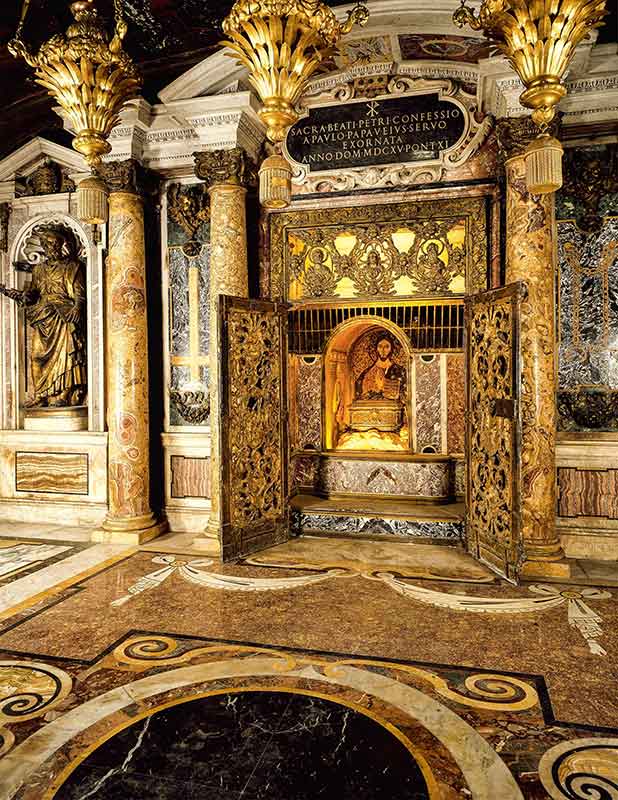
Question: In “Your Questions Answered” in the February 2026 issue, you claim “St Peter’s tomb lies directly beneath the high altar of the current basilica. Historical records and archaeological evidence strongly support the belief that the tomb holds the Apostle’s bones.” How do you know that the bones kept in St Peter’s basilica are actually those of the Apostle?
Answer: The case that the remains in St Peter’s are indeed those of the Apostle is more compelling than the arguments against it.
All Churches, in the East and West, have always agreed that the remains of St Peter and St Paul were in Rome, where both were executed about 30 years after Christ’s crucifixion. There have never been credible competing claims for the location of the Apostles’ respective tombs: in today’s basilicas of St Peter’s and St Paul’s Outside the Wall in Rome.
The tradition that the early Christians of Rome venerated Peter’s burial site on Vatican Hill is well supported by writers such as Gaius of Rome, who around 200 AD referred to a “trophy” (meaning a memorial or monument) marking St Peter’s grave.

He wrote: “I can show you the trophies of the Apostles. If you go to the Vatican or to the Ostian Way, you will find the trophies of those who founded this Church.” The “trophy” on the Ostian Way refers to the tomb of St Paul, while the one on the Vatican Hill refers to that of St Peter.
During excavations in the 1940s, archaeologists discovered graffiti near the site of St Peter’s reputed tomb, including the phrase “Petros eni” (Greek for “Peter is here”) as well as other inscriptions bearing the name Peter. These graffiti, found in a hidden niche, indicate that the early Christians were confident about the location of Peter’s grave.
When Emperor Constantine ordered the construction of the first St Peter’s basilica in 324 AD, the site identified as that of St Peter’s burial was unsuitable for large-scale construction, and an ideal spot was available nearby. Yet, construction took place at the less suitable location. The appointed site required extensive levelling of Vatican Hill and the partial demolition of the local necropolis, which had moral and legal implications.
All this effort suggests that the site had long been revered as the Apostle’s true burial place, and that early Christians were resolute in preserving its exact location, not some random symbolic spot.
1940s excavations
Excavations beneath the current basilica in the 1940s — which, it must be noted, for various reasons caused controversies — revealed a Roman necropolis with a shrine-like monument (aedicula) dating to around 160 AD, likely the “trophy” mentioned by Gaius. Beneath this structure was a modest grave in a style consistent with early Christian burial practices for a martyr.
Nearby, in a wall niche known as the loculus, an ossuary containing bones had been carefully stored. Many scholars believe that these remains were removed from the grave and preserved for safekeeping. And it was on that niche that the “Petros eni” graffito was inscribed.
Tradition holds that the remains of Ss Peter and Paul were kept for safekeeping in the catacombs of St Sebastian during a 3rd-century persecution. Dirt found on the bones in the loculus shows that the body had very likely been kept in a catacomb.
The bones were scientifically examined by pathologists of Rome’s La Sapienza University in the 1960s. They were found to belong to a robust male in his sixties. Peter’s traditional age at the time of his martyrdom is 63. The bones had been wrapped in a rich purple cloth woven with gold thread, indicating that they were highly venerated.
On June 26, 1968, Pope Paul VI announced that Peter’s bones had been found and identified “in a way that we can consider convincing”.
While some scholars caution that definitive identification is impossible without more concrete data, the aggregate of early testimony, the location of St Peter’s basilica, the graffiti, the reverential treatment of the bones, the identification of the bones as belonging to a man corresponding with what is known about St Peter, and the absence of competing claims, all point to the authenticity of the tomb in St Peter’s basilica.
And the evidence, both physical and traditional, makes a strong case that the bones in that tomb are almost certainly those of the Apostle Peter.
(Answered by Günther Simmermacher)
Published in the June 2026 issue of The Southern Cross Magazine

- Is St Peter’s Tomb Authentic? - October 19, 2026
- Pope: Seek the Kingdom of God - October 19, 2026
- Pope Leo’s Prayer for Mission Sunday - October 17, 2026