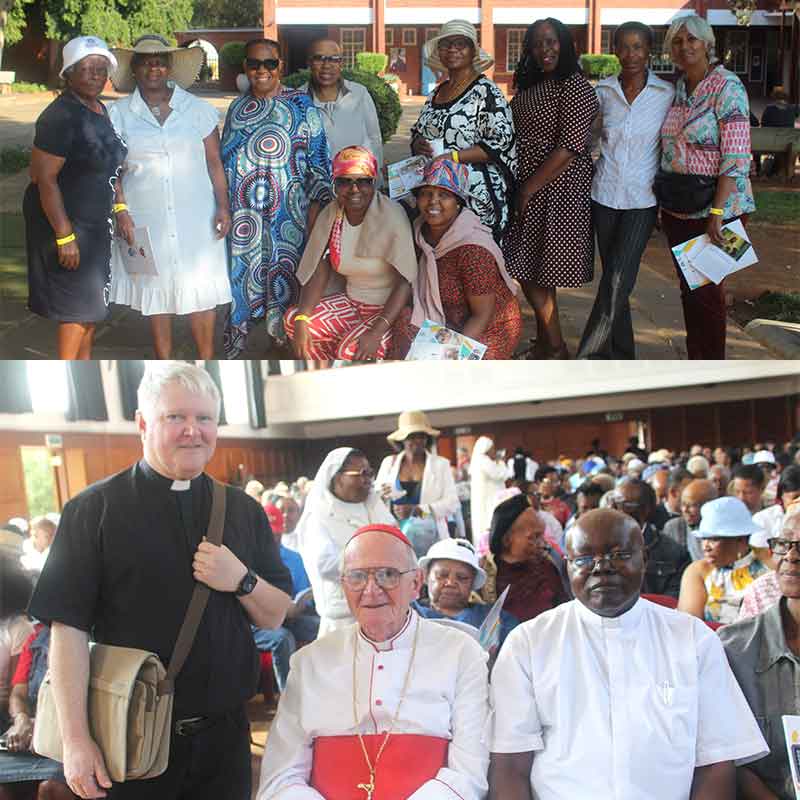
More than 550 Catholic leaders gathered at Holy Family College on Saturday, 17 October 2026, for the Archdiocese of Johannesburg’s annual leadership conference, which challenged participants to strengthen parish leadership, embrace synodality and renew their commitment to evangelisation.
Held under the theme “Spirituality, Governance and Mission in the Light of Synodality,” the full-day conference brought together clergy and lay leaders for reflection and discussion on how the Church can become more participatory, mission-oriented and responsive to the needs of the faithful and wider society.
The conference opened with a keynote address by Kevin Bailey, executive director of Divine Renovation for Australia and Asia, who encouraged participants to move beyond maintaining existing parish structures and focus on bringing more people into a relationship with Jesus Christ.
Twenty-two speakers also facilitated parallel sessions following the keynote address, and explored issues affecting the Church today, including healing liturgical abuses through the spirit of synodality, building a synodal culture through faith formation, safeguarding as governance and marriage as an instrument of mission in the synodal Church.

The day concluded with Holy Mass presided over by Cardinal Stephen Brislin, Archbishop of Johannesburg, who reminded participants that every Christian is called not only to follow Christ but also to bear witness to him through prayer, personal conversion and the way they live their lives.
Bailey challenges parishes to look beyond their walls
In his keynote address, Bailey challenged Catholic communities to reconsider their purpose, warning that parishes can sometimes become inward-looking and focus primarily on serving those who already belong to the Church.
He stressed that the Church exists to evangelise and share the Gospel, particularly with those who have become disconnected from their faith or have not yet encountered Christ. “When you’re in a club, the club exists for its members,” Bailey said, explaining that the Church must resist becoming a community concerned only with its own needs.
Drawing on his experience in Australia, he spoke about the pain experienced by parents and grandparents whose children no longer practise the faith. He shared his own struggle when his eldest son decided that he no longer wanted to attend Mass.
At the time, Bailey had built a successful career in business and had hoped that his son would follow in his professional footsteps. However, a conversation during a dinner with friends changed his perspective.
As parents discussed their children’s future careers, Bailey was preparing to explain that his son wanted to pursue a career similar to his own. Before he could speak, his wife, Grace, expressed a different priority: she did not mind what career their son chose, provided she could spend eternity with him. Her words confronted Bailey with the importance of passing on the faith and the need to place his relationship with God at the centre of his life.
He subsequently sold his business and invested the proceeds in a foundation dedicated to evangelisation and building up the Church. Since then, he has focused on helping Catholic communities become vibrant places where people can encounter Christ and grow in their faith.
Bailey’s personal story illustrated that evangelisation is not simply a programme organised by a parish or a responsibility reserved for priests. It is a shared mission rooted in a genuine relationship with Jesus and a concern for those who have drifted away from the Church.
He also shared that his son eventually experienced a significant conversion during World Youth Day in 2011. He became a daily Mass-goer, prayed the rosary and began taking his own children to Mass.
Synodality requires co-responsibility
A central message in Bailey’s address was the importance of co-responsibility between clergy and laity in the life and mission of the Church. He argued that synodality must move beyond discussions about listening and participation and become a lived reality in parish communities. This requires lay Catholics to recognise that, through baptism, they share responsibility for the Church’s mission. He challenged the attitude that laypeople should simply attend Mass, contribute financially and leave the work of evangelisation and leadership to priests. While affirming the priest’s leadership role in the parish, Bailey called for greater collaboration, with laypeople supporting their priests, sharing responsibility and contributing their gifts to the community.
He clarified that co-responsibility does not mean laypeople replacing clergy. Rather, it means working alongside priests and helping them build teams that can advance a common vision for parish life. Bailey also called for stronger leadership development, encouraging parish leaders to identify people’s abilities, nurture their potential and entrust them with meaningful responsibilities.
Christian leadership, he said, should be rooted in humility and service rather than personal recognition. Using the example of Jesus washing his disciples’ feet, he reminded participants that leadership is about serving others and helping them grow.
He also highlighted the importance of prayer, describing it as the foundation of authentic mission. Parish renewal, he said, cannot be achieved through human effort alone but requires openness to the Holy Spirit.
Cardinal Brislin: Every Christian is called to be a witness
Bringing the day’s discussions to their spiritual foundation, Cardinal Brislin reminded participants in his closing homily that every Christian has a mission flowing from baptism. Reflecting on the day’s Gospel, he acknowledged that some people are afraid to identify themselves openly as Catholic or Christian. Yet, he said, the call to follow Jesus also involves the responsibility to witness to him.
“My dear brothers and sisters in Christ, you have been through an intense day of input, discussion and reflection,” the cardinal said, expressing hope that the day’s focus on the mission of every Christian had helped participants reflect on their responsibilities within the Church.
He explained that Christian witness involves sharing the Good News and bringing the light of Christ into the world through the way people live. “It is primarily when we make the love and mercy of God visible in the world around us that the authenticity of our faith is manifest,” he said.
However, Cardinal Brislin stressed that effective evangelisation begins with a personal relationship with God. Christians cannot convincingly share the love of Christ if they have not taken time to encounter that love in their own lives. He reminded participants that Jesus first called his disciples to be with him before sending them out to proclaim the Gospel. The same principle applies to Christians today: their mission must flow from their relationship with Christ. The cardinal also encouraged those who feel inadequate or unqualified to share their faith, reminding them that the apostles were ordinary people with weaknesses, limitations and fears. What equipped them for their mission was not exceptional talent or influence but their encounter with Jesus and their gradual transformation through his presence. “We cannot give what we have not received and so we cannot proclaim God’s love if we have not experienced it ourselves,” he said. He emphasised that being part of the Church’s mission does not begin with a programme, meeting or pastoral plan, but with an encounter with the Lord.
Prayer is the foundation of mission
Cardinal Brislin warned that the demands of daily life can cause prayer to become an afterthought, even for those who devote considerable time to Church activities.He challenged participants to consider whether they were working for God while neglecting to spend time with God. The cardinal described prayer as a discipline that requires a deliberate commitment to setting aside time and space for communion with the Lord.
“Prayer is the lifeblood of our relationship with God,” he said, explaining that prayer involves not only speaking to God but also listening to him. Reflecting on the listening circles experienced during the conference, he noted that synodality requires people to listen to the Holy Spirit speaking through others, while allowing silence and prayer to guide discernment. He acknowledged that prayer does not always bring immediate consolation or clarity. At times, people may struggle and wonder whether God has abandoned them. Nevertheless, a deepening relationship with God gradually transforms them into the people he calls them to be. The cardinal encouraged participants to make prayer a regular part of their lives through Scripture, the Eucharist, adoration and the sacraments. He urged them to allow prayer to become more than a recitation of words, describing it instead as an encounter with the living God.
Mission calls for humility and courage
The cardinal further reminded participants that evangelisation is God’s mission, in which Christians are privileged to participate. He pointed to the transformation of the disciples at Pentecost, when the Holy Spirit turned fearful followers of Jesus into courageous witnesses. The same Spirit, he said, continues to work in the Church today, equipping Christians to proclaim the Gospel with humility and courage. Cardinal Brislin cautioned that the success of evangelisation cannot be measured solely by visible results or personal recognition. Christians are called to be faithful instruments in God’s hands, remaining open to his guidance rather than insisting that their own plans must prevail. He also stressed that Christian credibility depends not only on words but on how people live their lives. Through prayer, Christians develop a heart that notices the poor, welcomes those in need and seeks reconciliation where there is division. The cardinal encouraged leaders to remain open to the Holy Spirit changing their plans and leading them towards new opportunities for service.
He concluded by praying that their friendship with Christ would deepen, that the Holy Spirit would equip them for mission and that their words and actions would help others discover the joy of knowing and loving God.
From conference discussions to parish life
The conference brought together two complementary messages about the renewal of the Church. Bailey challenged participants to build mission-oriented parishes through shared leadership, hospitality and active participation, while Cardinal Brislin emphasised that authentic mission must be rooted in prayer and a personal encounter with Christ. The closing Mass was concelebrated by Father Tebello Moeti of the Diocese of Kroonstad and Father Bruce Botha, vicar for the Department of Evangelisation. Deacon Kgosi Peter Mpuang assisted at the altar. The annual leadership conference was relaunched on 22 October 2022 following a hiatus caused by the COVID-19 pandemic. Its continued gathering of Church leaders provides an opportunity to reflect on the responsibilities of leadership and the changing needs of Catholic communities.
For the more than 550 participants at Holy Family College, the challenge was to carry the day’s reflections into their parishes and communities. Synodality must be expressed not only in discussions and structures but also in how Catholics listen, discern, serve and take responsibility for the Church’s mission.

- JHB leadership conference calls Catholics to shared responsibility for Church’s mission - October 19, 2026
- Justice & Peace call for responsible mining, youth empowerment and accountable leadership - October 16, 2026
- Bishop Nyandoro calls on religious leaders to defend human dignity and advocate for peace - October 14, 2026