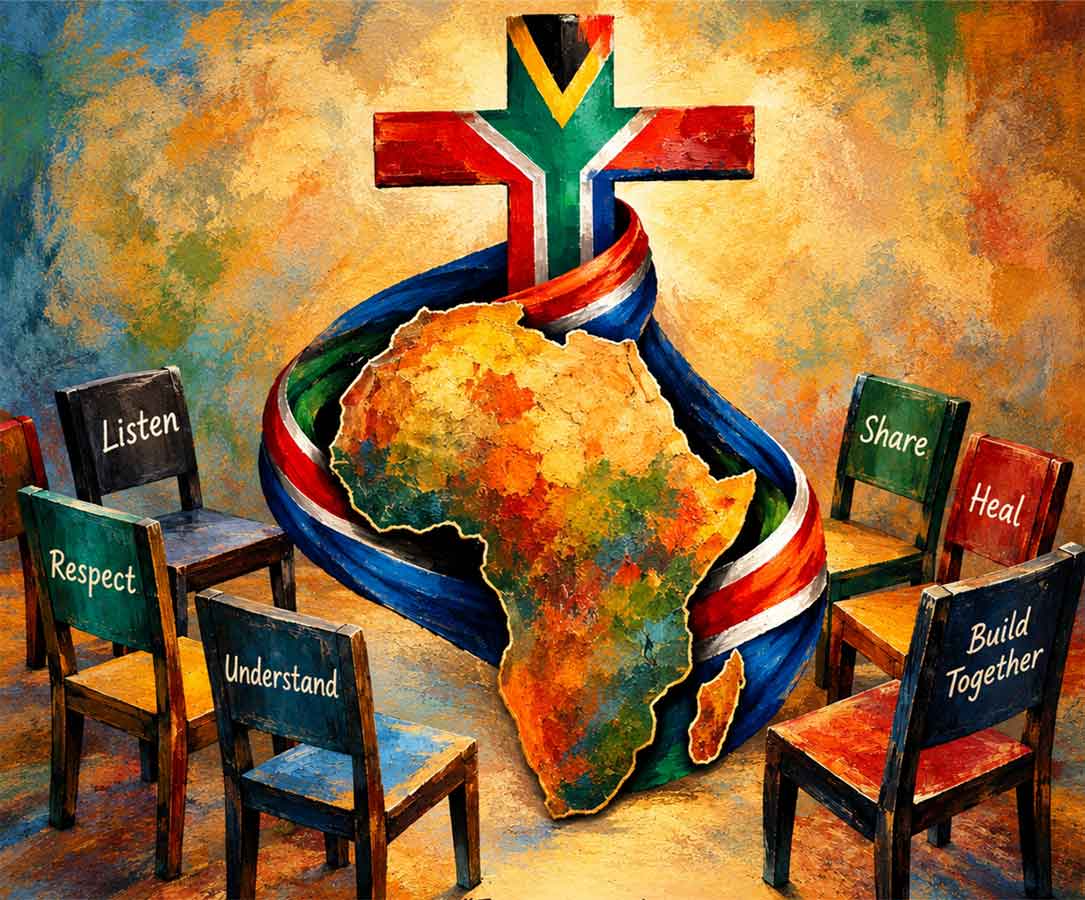
An honest conversation over tea and biscuits reminded me that we cannot heal our land if we are unwilling to listen to one another.
It started around a tea and biscuit table at our fellowship after Sunday Mass. I found myself in conversation with a Zimbabwean national. What began as an ordinary chat became something much more meaningful. We spoke honestly about xenophobia, the frustrations experienced by South Africans, the rights of foreign nationals and the tensions that continue to shape our society.
We did not necessarily approach every issue from the same perspective. But we could exchange our views openly. We could listen, question and respond without the conversation becoming hostile.
And when it was over, I found myself reflecting on something that troubled me. Why is this kind of conversation not happening more often?

It was precisely because we could speak honestly, without fear of being misunderstood or labelled, that I felt comfortable putting pen to paper. This article was born not out of an argument, but out of a conversation. Perhaps that is where the conversation South Africa desperately needs must begin.
Xenophobia is not simply a conversation about foreign nationals. It is also a conversation about our fears, our frustrations, our responsibilities and the kind of society we want to become. When we speak about xenophobia, we often find ourselves confronted by two opposing positions.
On one side are South Africans who feel that it is unfair for foreign nationals to enjoy the same rights and access to opportunities when citizens themselves are struggling to find employment, secure housing and access basic services. They question whether their own needs and interests are receiving the attention they deserve in their country.
On the other side are foreign nationals who believe that their dignity and fundamental human rights must be respected, regardless of where they were born. Between these two positions lies a dangerous vacuum.
It is a vacuum where meaningful dialogue should have taken place. A space where fears could have been acknowledged, legitimate grievances addressed and misunderstandings challenged before they hardened into resentment. Instead, too often, we find ourselves talking about one another rather than to one another. And where dialogue disappears, suspicion takes root.
Let us be clear. Acknowledging the frustrations of South Africans does not require us to deny the humanity of foreign nationals. Equally, defending the dignity of foreign nationals does not require us to dismiss the hardships experienced by South African citizens.
Both realities can exist at the same time.
Our country carries deep wounds. Unemployment, poverty, corruption, inequality and the daily struggle to make ends meet are not abstract political talking points. They are lived realities for families wondering where the next meal will come from, young people unable to find work and communities that feel forgotten. Those frustrations deserve to be heard. They deserve honest answers and practical solutions.
But frustration, when left unaddressed, can become anger. Anger, when directed towards a specifically identified group, can become hostility. And hostility, when allowed to flourish, can become violence.
Foreign nationals can become convenient targets for grievances that are far more complex than any single community. At the same time, dismissing every concern raised by South Africans as xenophobic closes the very conversation we need to open. We must distinguish between legitimate concerns about migration, law enforcement and access to public resources, and the prejudice that blames people collectively because of their nationality.
One requires responsible leadership and practical solutions. The other requires moral courage and a refusal to dehumanise our neighbours. Where, then, have our leaders been in creating the space for this conversation?
Our political leaders have a responsibility to communicate honestly, implement fair and lawful policies, uphold the rule of law and address the conditions that leave communities feeling abandoned. They cannot expect people to remain silent when they believe their concerns are being ignored. Leadership requires more than promises. It requires accountability, consistency and the courage to confront difficult realities without turning human beings into political scapegoats.
But the responsibility does not end there.
What About Our Church Leaders?
As I reflected on that conversation at our fellowship, I found myself asking why our churches are not creating more opportunities for people to engage with one another on these difficult subjects. Sometimes I feel that these spaces are simply not being created, and I find that deeply sad.
Our churches should be among the safest places to have uncomfortable conversations. Places where a South African and a Zimbabwean can sit at the same table, share their experiences, speak honestly about their concerns and leave with a better understanding of one another. Not necessarily agreeing on everything, but recognising one another’s humanity.
The tea and biscuit table might seem an insignificant place from which to begin addressing a national problem. Yet it was there that I experienced something we desperately need more of: the freedom to speak, the willingness to listen and the opportunity to understand a perspective different from our own.
What if our parish fellowships deliberately created these opportunities? What if we invited people from different backgrounds to share their experiences, their concerns and their hopes for our country? What if our church halls became places where the difficult conversations we avoid in public could take place in an atmosphere of mutual respect?
The Church cannot preach reconciliation within the walls of its sanctuaries while remaining absent from the difficult conversations taking place beyond them. We cannot speak about love, mercy and human dignity on Sunday and leave our communities to navigate fear, prejudice and resentment alone for the rest of the week.
This is not about taking sides. It is about standing for what is right, even when doing so makes everyone uncomfortable. Our faith gives us no permission to ignore the suffering of our fellow South Africans. Neither does it give us permission to disregard the dignity of the stranger.
In Matthew 25:35, Jesus says: “I was a stranger and you welcomed me.”
These words challenge us to recognise Christ in the person whose background, language or nationality may be different from our own. But welcoming the stranger does not mean abandoning our responsibility to govern borders, enforce the law or address the needs of citizens. Compassion and accountability are not enemies. Justice and mercy are not mutually exclusive. The real test of our Christian witness is whether we can hold these truths together.
Can we demand that our government protects the interests of its citizens while insisting that every person is treated with dignity? Can we listen to the fears of a struggling community without allowing those fears to become hatred? Can we challenge unlawful conduct without making assumptions about an entire nationality? And can our churches become places where these questions are not avoided, but confronted with honesty, courage and faith?
There is a song by South African musician Jonathan Butler that has stayed with me: Heal Our Land. It speaks to the longing for forgiveness, understanding and healing in the land we call home. Its message is particularly relevant to the South Africa we find ourselves living in today. We speak about healing our nation, but healing requires more than words. It requires us to acknowledge our wounds, confront the things that divide us and take responsibility for the part we play in rebuilding relationships.
We cannot pray for a healed land while refusing to listen to the people with whom we share it. We cannot sing about unity while allowing prejudice to go unchallenged. And we cannot expect reconciliation to flourish where opportunities for honest dialogue are absent.
Perhaps this is where the familiar prayer associated with St Francis of Assisi becomes more than a prayer we recite. Its appeal to become instruments of peace asks something of us personally: that where there is hatred, we choose love; where there is division, we work towards understanding.
That prayer should not simply be heard in our churches. It should be lived in our communities.
Sometimes, the first instrument of peace is not a microphone, a pulpit or a political platform. Sometimes, it is an ordinary person willing to sit down with someone whose experiences are different from their own. Sometimes, it is a conversation over tea and biscuits.
South Africa knows what happens when people are divided into those who belong and those who do not.
Our history should have taught us the devastating cost of allowing prejudice to determine a person’s worth. We cannot undo that history by repeating its patterns against another group of people. Nor can we build a just society by asking struggling citizens to suppress their concerns in the name of tolerance.
We need a better conversation. One grounded in truth, fairness, accountability and the recognition that every human being possesses dignity that cannot simply be switched off by nationality. That conversation must begin somewhere. It can begin in our homes, around our tables, in our parish halls and in the public spaces where people from different backgrounds encounter one another.
It must be facilitated by leaders prepared to listen as well as speak. And it must be sustained by ordinary people willing to engage without surrendering either their convictions or their compassion.
The vacuum must be filled. Not with slogans. Not with blame. Not with silence. But with dialogue.
My conversation with a Zimbabwean national did not resolve South Africa’s challenges. Nor did it pretend to. What it did was remind me that we can speak about difficult issues without losing respect for one another. That alone is worth something.
Imagine what might happen if more of us were given that opportunity. Imagine if our churches took the initiative, opening their doors and creating spaces where our differences could be discussed honestly, our concerns heard and our shared humanity rediscovered.
Perhaps we have waited too long for political leaders to provide every answer. Perhaps we have expected our church leaders to offer comfort without always creating opportunities for the difficult work of reconciliation. And perhaps we, too, must accept responsibility for the conversations we avoid, the assumptions we repeat and the humanity we sometimes fail to recognise in others.
The question is no longer simply why xenophobia exists. It is whether we are prepared to have the conversation that help us confront it.
I left that fellowship thinking about the conversation we had. More importantly, I left thinking about all the conversations we are not having.
If two people can sit around a tea and biscuit table and speak honestly about xenophobia, what is stopping us from creating a thousand more such tables across our churches and communities?
We pray, “Lord, make me an instrument of Your peace.”
Perhaps the work begins when we are willing to listen. Perhaps healing begins when we are willing to speak. And perhaps the conversation we never had and maybe even reluctant to have, is the very conversation we must now begin.
- Xenophobia: The Conversation We Never Had - October 20, 2026
- When Wooden Spoons Become Instruments Of Grace - October 3, 2026
- All Things Bright and Beautiful — A Beautiful Hymn, An Ugly Reality - September 11, 2026