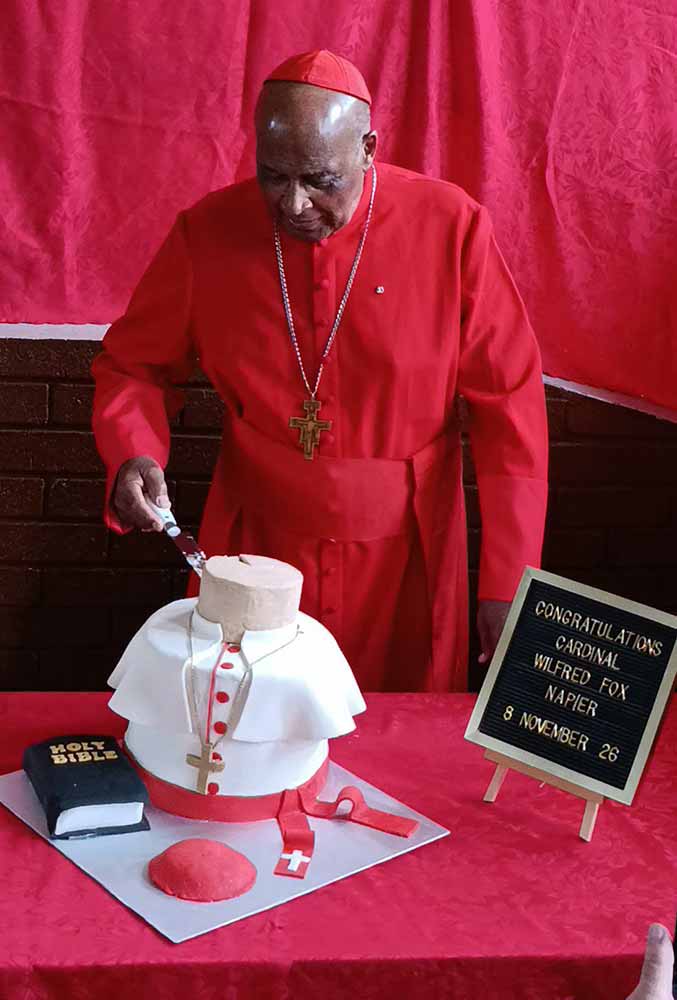
The Catholic Church in Southern Africa gathered at St Patrick’s Cathedral in the Diocese of Kokstad on Sunday, 8 November 2026, to honour the life and ministry of Cardinal Wilfrid Fox Napier OFM, celebrating five significant milestones that reflect more than six decades of religious vocation and service to the Church.
The celebration brought together hundreds of people from across the Southern African Catholic Bishops’ Conference (SACBC), including bishops from various dioceses, priests, religious, members of the faithful, friends and members of the Cardinal’s family.
The celebration marked Cardinal Napier’s 85th birthday, 65 years since his first religious profession in the Order of Friars Minor (OFM), 56 years of priesthood, 45 years of episcopal ministry and 25 years since his elevation to the College of Cardinals. The gathering went beyond commemorating important milestones, providing an opportunity for the Church in Kokstad and the wider Catholic community to pay tribute to Cardinal Napier’s lifelong commitment to ministry, inspired by Franciscan values of humility, simplicity, courage and service
A son of Kokstad honoured by the Church
The celebration was particularly meaningful for the Diocese of Kokstad, where Cardinal Napier has deep family, spiritual and pastoral roots. Born in Matatiele on 8 March 1941, he became the first indigenous Bishop of Kokstad in 1981, serving the diocese until 1992, when he was appointed Archbishop of Durban. Bishop Thulani Victor Mbuyisa CMM, the current Bishop of Kokstad, said that the celebration was an opportunity to bring the Church in Kokstad and beyond together in gratitude for the Cardinal’s life and vocation. Bishop Mbuyisa, who took responsibility for preparing and organising the celebration, wanted the occasion to go beyond acknowledging the Cardinal’s achievements. “This celebration is an opportunity to recognise the person behind the titles and give thanks for his generous response to God’s call throughout his life.”

Archbishop Mpambani: A life that continues to teach the Church
The homily was delivered by Archbishop Zolile Peter Mpambani SCJ, Metropolitan Archbishop of Bloemfontein and a former Bishop of Kokstad. His presence carried particular significance, having succeeded Cardinal Napier in leading the Diocese of Kokstad before his appointment to Bloemfontein in 2020. Reflecting on the Gospel of the day, the parable of the ten bridesmaids (Matthew 25:1-13), Archbishop Mpambani focused on the importance of spiritual preparedness and the need to remain faithful in one’s relationship with Christ.
He explained the Jewish wedding customs behind the parable, describing how the bridegroom could arrive unexpectedly, requiring those waiting to be prepared at all times. The Archbishop drew attention to two important lessons from the Gospel: certain things cannot be acquired at the last minute, and some things cannot be borrowed from others. A relationship with God, he explained, is personal. Faith and character must be nurtured through one’s own commitment and daily choices. He reminded the congregation that Christian readiness is not about predicting when Christ will come, but about living a life that is continually directed towards him.
Archbishop Mpambani explained that the lamps could be understood as the light of faith, while the oil represented charity that keeps that light burning. Faith, therefore, must find expression in love of neighbour, acts of mercy, forgiveness, service and care for those in need. He encouraged the faithful to recognise that holiness is not only achieved through extraordinary acts of generosity, but also through ordinary responsibilities carried out with love. Patience at home, honesty at work, keeping commitments, prayer and participation in the life of the Church are all ways in which Christians prepare to meet the Lord.
Turning his reflection towards Cardinal Napier, the Archbishop said the Gospel was equally relevant to those who serve in the Church, including priests and bishops. He described the Cardinal’s ministry as a lifelong journey of preparation to meet Christ, sustained through prayer, devotion and acts of charity. Addressing him directly, Archbishop Mpambani acknowledged the years he had spent serving others, saying that his life demonstrated the importance of giving oneself in love rather than seeking recognition, power or appearances. He also observed that Cardinal Napier had initially been reluctant to have such a celebration organised, something he interpreted as a sign of humility. Drawing on the words of Pope Francis about a life given in service, the Archbishop reminded the congregation that the secret of Christian living is to live in service of others.
He challenged Cardinal Napier and the faithful to continue giving their time and attention to people, particularly those who are struggling, rather than treating their needs as interruptions. In congratulating the Cardinal, Archbishop Mpambani said the five milestones represented a testimony to a life generously offered to God and his people, characterised by faithfulness, sacrifice, pastoral dedication and commitment to the mission of the Church. He prayed that the Cardinal would continue to enjoy good health, inner peace and renewed strength, with the Franciscan spirit and the example of Christ the Good Shepherd remaining his constant guide.
Archbishop Mpambani: Kokstad taught me how to become a bishop
Speaking after the celebration, Archbishop Mpambani reflected on his own connection with the Diocese of Kokstad and explained why attending the occasion was important to him.
He described Kokstad as the diocese that taught him how to become a bishop, recalling the support and guidance he received from Cardinal Napier during his episcopal ministry. When he was appointed Bishop of Kokstad in 2017, he was already aware of Cardinal Napier’s history in the diocese, where he had served from 1978 to 1992 before Archbishop William Slattery succeeded him. Archbishop Mpambani said he found a diocese whose foundations had been shaped by the Cardinal’s leadership and pastoral contribution. He also recalled the warmth of the Napier family, describing them as people deeply rooted in their faith and actively involved in the life of the local Church, particularly at the cathedral and through Couples for Christ.
The Archbishop spoke fondly of his conversations with Cardinal Napier, particularly their discussions about his family, his years in Kokstad and his experiences in Church leadership. He explained that the Cardinal had been a source of advice and encouragement during his early years as a bishop, including during metropolitan meetings where he shared his experiences and offered guidance on episcopal responsibilities. Archbishop Mpambani added that attending the thanksgiving Mass was an opportunity to celebrate someone who had also supported him along his own journey of service. He congratulated Cardinal Napier for his perseverance and generous dedication to the Church, acknowledging his contribution not only to Kokstad but also to the Archdiocese of Durban, where he spent a significant part of his episcopal ministry. He also expressed admiration for the Cardinal’s continued willingness to serve, despite his age.
Cardinal Napier: A journey of faith, simplicity and hope
For Cardinal Napier, the thanksgiving celebration was an unexpected but deeply moving occasion. Speaking on the sidelines after lunch, he described the day as exceptional, explaining that he had not anticipated such a celebration at this stage of his life. He had initially thought that a celebration might have taken place when he left Kokstad for Durban. However, bringing together the different milestones of his life made the occasion particularly special. Reflecting on the celebration, he said that almost every significant milestone in his life as a Catholic had been remembered, from his religious vocation and priesthood to his episcopal ministry and elevation to the College of Cardinals. Asked about how his love for Jesus had developed throughout his years of ministry, the Cardinal explained that his understanding of Christian discipleship had evolved with age and experience.
As a young Franciscan and priest, he understood living his religious and priestly vocation as a way of demonstrating his love for Jesus. However, as the years progressed, he began to reflect more deeply on whether his ministry was truly the fullest expression of that love or whether he was simply carrying out a function or pursuing a career. He said this reflection had helped him appreciate the importance of walking with Jesus rather than seeing Christian life as something undertaken alone. Drawing on the image used by Pope Francis, he described discipleship as a journey in which Jesus accompanies his followers. He explained that being conscious of Christ’s presence means that a person should never feel abandoned or alone.
Lessons in human dignity and equality
One of the most striking moments in the interview came when Cardinal Napier reflected on two experiences that transformed his understanding of race and human relationships. He recalled travelling to Ireland as an 18- or 19-year-old young man, having grown up in South Africa under racial segregation. Coming from a limited background and having little experience of living alongside white people, he initially wondered how he would relate to the Irish community. However, his experience taught him that it was not the colour of a person’s skin that determined their character, but the values they carried. He decided that he would relate to people as human beings, rather than allowing racial or cultural differences to define his interactions. The second experience came when he returned to South Africa after ten years and was working in Lusikisiki.
After celebrating Mass at one of his outstations, the catechist’s wife stood up to give a thanksgiving message. She began by expressing how wonderful it was to have one of their own sons serving them as a priest. For Cardinal Napier, those words were significant because they challenged the racial divisions he had previously internalised. He said the experience helped him understand that people should relate to one another on the basis of their shared humanity. These encounters, he explained, were among the important graces that changed his attitude towards race relations. Whether speaking to an Indian, coloured, white or American person, he now saw himself as a human being relating to another human being.
The Franciscan spirit of simplicity
Reflecting on the connection between his life and the Franciscan charism, particularly during the Church’s special Jubilee Year of St Francis, Cardinal Napier acknowledged that many aspects of his ministry had reflected the spirituality of St Francis of Assisi. He said he had not always been consciously aware of this influence, but recognised it in the way he had lived and related to others. He added that simplicity was one of the most important expressions of Franciscan spirituality. It was reflected not only in his lifestyle but also in his approach to people, treating everyone as fellow human beings who deserved dignity and respect. This simplicity was also evident in the reflections shared by Bishop Mbuyisa and Archbishop Mpambani, who both described the Cardinal as approachable and humble despite his years of leadership.
A message of hope for the Church in Southern Africa
Cardinal Napier was asked during the interview to share a message of hope with the Catholic Church in Southern Africa. He pointed to the Gospel of Luke chapter 24, which recounts the encounter between Jesus and the two disciples on the road to Emmaus. He recalled the disciples’ words: “We had hoped that he was the one to set us free.” The disciples had lost hope following the death of Jesus, but their encounter with the risen Lord transformed their understanding and renewed their faith.
He encouraged Christians to show others that Jesus is alive through the way they respond to his teachings and live out his way of life. “Hope has to be our message,” he said.
A legacy that continues
Cardinal Napier’s ministry has extended far beyond the Diocese of Kokstad. He served as Archbishop of Durban from 1992 until his retirement in 2021 and twice served as president of the Southern African Catholic Bishops’ Conference, from 1987 to 1994 and again from 1999 to 2006. He also played an important role in the Church’s contribution to peace and dialogue during South Africa’s political transition. His service to the universal Church included participation in the 2005 and 2013 papal conclaves as a cardinal elector.
He continues to serve the Church as Apostolic Administrator of the Diocese of Eshowe. The thanksgiving Mass in Kokstad was therefore both a celebration of an individual vocation and a recognition of the wider contribution Cardinal Napier has made to the Catholic Church in Southern Africa. As for the people of Kokstad, it was also a homecoming: an opportunity to celebrate one of their own sons whose journey from the local Church to the College of Cardinals.

- Cardinal Napier’s lifetime of service celebrated in thanksgiving Mass in Kokstad Diocese - November 9, 2026
- St John Vianney Seminary bids farewell to formators and seminarians - October 31, 2026
- African seminary rectors seek to form priests who listen and walk with the people - October 30, 2026