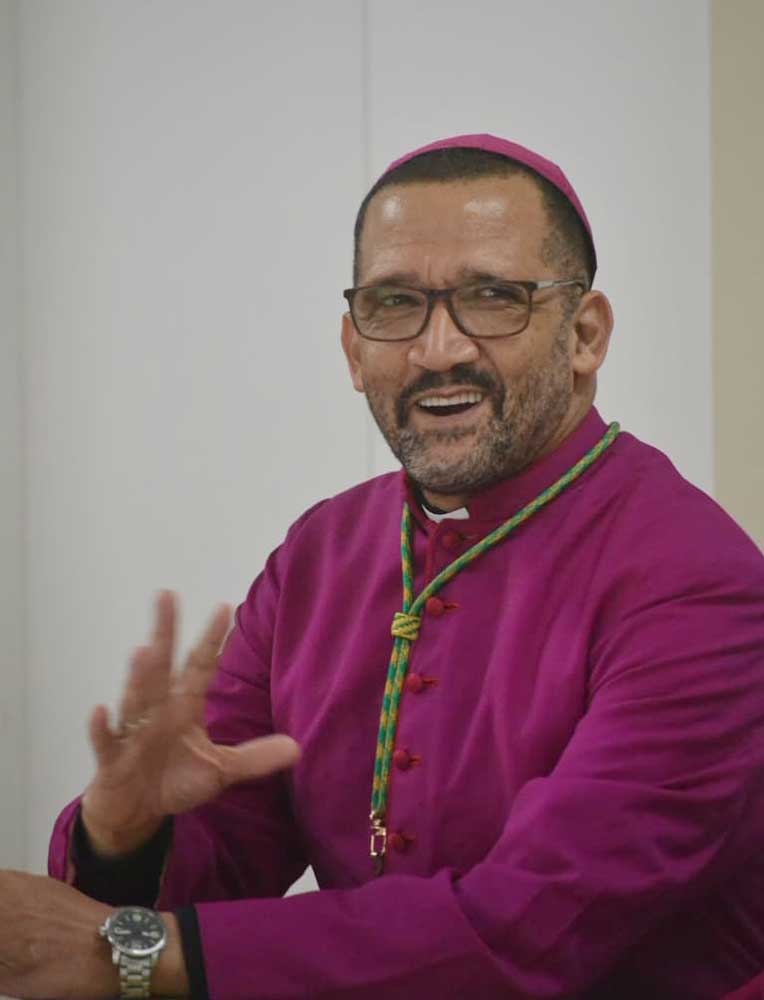
The archbishop of Cape Town has called on the Church in his archdiocese to move beyond talking about synodality and begin putting it into practice, calling for a change in the way parishes listen, discern and make decisions. Parishes have been instructed to hold workshops with its Parish Pastoral Council and sodalities by January 31, 2027.
In his November newsletter, Archbishop Sithembele Sipuka notes that awareness and enthusiasm for synodality in the archdiocese seems to remain limited. It is “not yet part of our common vocabulary, nor is it consistently visible in the everyday life of our parishes”, he observes.
“Ask parishioners leaving Mass on Sunday what synodality means, and many might struggle to explain it. Ask our councils how it has changed the way they work, and the honest answer in many cases might be that it has not. I offer this observation not to discount the good work already being done, but to invite us to build on it with greater purpose and urgency,” he writes.
The archbishop wants the archdiocese to recognise that having structures for consultation does not automatically make a community synodal.

“We must ask whether we understand and practise synodality intentionally,” he writes. “Do we listen before deciding? Do we make room for those whose voices are seldom heard? Do our meetings help us discern what God asks of us, or do they merely organise activities and communicate decisions already taken?”
For Archbishop Sipuka, synodality begins with baptism. All the baptised share responsibility for the Church’s mission, although not everyone has the same role. The faithful are not simply helpers of the clergy but members of Christ’s body, endowed with gifts by the Holy Spirit.
He illustrates this by pointing to the experiences of ordinary people: “A parent raising children, a young person seeking work, a teacher forming young minds, and a person caring for a sick relative, all know something about living the faith that the rest of us need to hear.”
Their experiences do not replace Scripture or Church teaching, he emphasises, but help the Church discern how that teaching is understood and lived, and where pastoral care needs to improve.
This calls for a change of attitude among both clergy and laity. Bishops and priests must be willing to listen and acknowledge that they do not have every answer. Laypeople, too, must move beyond leaving everything to “Father”, find their voices and accept their responsibilities.
“We are not exchanging one group’s dominance for another’s,” the archbishop explains. “We are learning to recognise and bring together the gifts God has entrusted to his people.”
Conversation in the Spirit
A central distinction in the archbishop’s explanation is between synodality as an everyday spirituality and Conversation in the Spirit as a structured method of communal listening and discernment. Both are necessary, but they are not interchangeable.
Synodality should be evident in ordinary relationships. At home, it begins with giving someone full attention rather than preparing a reply while they are still speaking. In a parish, it means allowing concerns to be raised without fear of dismissal, listening to young people, and noticing those who are absent. In leadership, it means genuine listening before decisions are made, rather than consultation intended merely to confirm a conclusion already reached.
For significant pastoral questions, Conversation in the Spirit offers a more deliberate approach. Participants prepare in prayer, speak without interruption, reflect on what they have heard and discern together areas of agreement, differences and unresolved questions.
“Silence is part of the process because we seek more than an exchange of opinions: we ask what God is calling us to do,” Archbishop Sipuka writes.
He also addresses concerns about synodality, insisting that it does not put revealed truth to a vote or remove the responsibilities of bishops and priests. Rather, authority must be exercised through genuine listening and discernment, in fidelity to Scripture, Tradition and Church teaching.
He points out that Pope Francis, in his accompanying note to the Synod’s Final Document, affirmed that it forms part of the ordinary magisterium and should be received accordingly. Its implementation requires discernment and adaptation to local circumstances.
“There is room, therefore, for questions, careful reflection and approaches suited to different communities,” the archbishop writes. “But we cannot exclude ourselves from the journey of the universal Church. We can debate how we walk; we cannot decide not to walk.”
From reflection to action
The archbishop’s newsletter sets out a practical programme for the archdiocese.
Archbishop Sipuka is reviewing responses from parishes to questions circulated in August and envisages a representative archdiocesan gathering in February 2027 to discuss the findings and the way forward.
In preparation, he has made synodality workshops mandatory for every parish. Each must hold a workshop with its Parish Pastoral Council and sodalities by January 31, 2027.
Parish priests are asked to work with deacons in leading the process, beginning with council members, sodalities and parish groups. Similar workshops are encouraged in monasteries, convents, Catholic schools and other Church institutions.
The accompanying presentation is intended to assist facilitators, while a booklet on synodality, originally prepared by Archbishop Sipuka for the diocese of Mthatha, provides a more comprehensive introduction. He encourages Catholics to read it individually and in groups, discussing how its teaching relates to their own communities.
A one-page report must be submitted to the archbishop’s office after each parish workshop, recording what took place, the fruits and challenges identified, and the practical steps envisaged. Deans will also report on progress at their deanery meetings, with parish representatives bringing their experiences to the February gathering.
The timetable is important. The universal Church expects local Churches to evaluate their implementation of synodality during the first half of 2027. A narrative report and a letter sharing their experiences with other Churches must be submitted by June 30, 2027. Further national, regional and continental stages will lead towards an Ecclesial Assembly at the Vatican in October 2028.
But the archbishop cautions against allowing deadlines and paperwork to become the purpose of the exercise.
“The real question is whether there will be lived experience to report: communities listening more attentively, responsibilities being shared more fruitfully, and a renewed commitment to the Church’s mission.”
Archbishop Sipuka appealed: “Let us approach synodality not as a slogan or an additional task, but as a way of bringing our lives and responsibilities before God together.”
And, he adds: “We do not have to resolve every question before beginning. We do, however, have to begin — and to do so together.”

- Sipuka: Make Synodality a Way of Life - November 12, 2026
- Pope in Argentina: Open your hearts, and with God’s grace, go forth and be holy - November 11, 2026
- St Joseph Sodality visits tomb of Servant of God Nkhono Magabriel - November 11, 2026