St Anthony
Born Fernando Martins de Bulhões on August 15, 1195, in Lisbon, Portugal, he was educated by priests and joined the Augustinians at age 15. Deeply moved by the martyrdom of five Franciscan friars in Morocco, he joined the newly formed Order of Friars Minor in 1221, adopting the name Anthony after St. Anthony of Egypt. Though he initially set sail for Africa to preach, severe illness and a storm forced his ship off course to Italy, bringing him near Assisi and into the company of St Francis himself.
Modest about his elite theological background, Anthony spent his early Franciscan years as a humble kitchen assistant in a remote hermitage. His genius was revealed unexpectedly in 1222 when he was asked to deliver an improvised sermon at an ordination. Stunned by his eloquence and profound scriptural knowledge, St. Francis personally authorised Anthony to teach theology across Italy and France, where his compelling sermons earned him the title “Hammer of Heretics.”
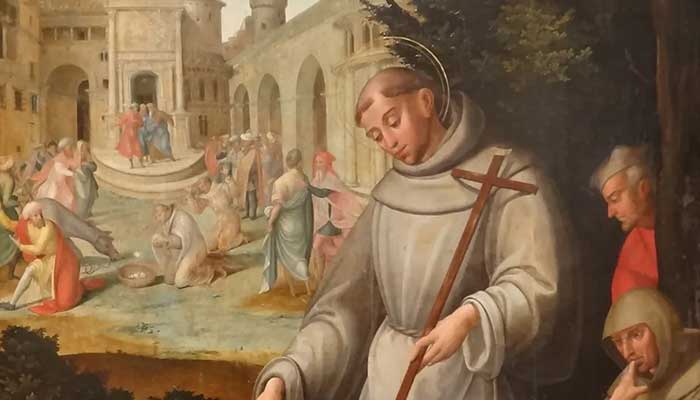
Numerous traditions surround his life, including his famous lost psalter—stolen by a novice who returned both the book and himself to the order after Anthony prayed for its recovery, establishing his modern legacy as the patron saint of lost items. Legends also attribute miraculous events to him, such as a starved mule bowing before the Eucharist and fish gathering at the shore to hear his preaching when townspeople refused to listen.
Exhausted by constant travel and preaching, Anthony died on June 13, 1231, at the age of 35 near Padua, Italy. So widespread was his reputation for holiness and miracles that Pope Gregory IX canonised him less than a year after his death. Declared a Doctor of the Church in 1946, Saint Anthony of Padua remains one of the most widely venerated saints in Catholicism.