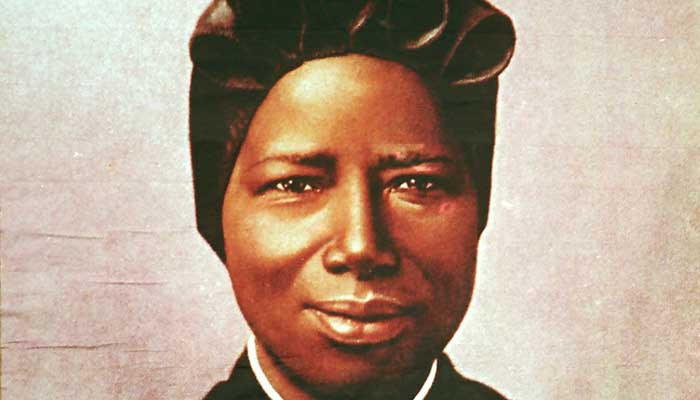
St Josephine Bakhita
Born around 1869 in Darfur, Sudan, the girl who would become Saint Josephine Bakhita was abducted by slave traders at age seven. The trauma caused her to forget her birth name, and her captors renamed her Bakhita (meaning “fortunate”). Over 12 years of brutal enslavement, she was sold multiple times, severely beaten, and heavily scarred through ritualistic mutilation, during which salt was rubbed into 114 knife wounds.
In 1882, she was bought by an Italian vice-consul who treated her kindly and eventually brought her to Italy. While working as a nanny for the Michieli family, she was placed in the care of the Canossian Sisters near Venice, where she encountered Christianity for the first time. When the family attempted to move her back to Sudan in 1889, Bakhita refused. Backed by the Sisters, an Italian court ruled that she had never legally been a slave, granting her absolute freedom.
Choosing to remain with the order, she was baptised as Josephine Margaret Fortunata in 1890 and took her religious vows as a Canossian Sister in 1896. She spent the rest of her life in Schio, Italy, working humbly as a cook, sacristan, and porter. Renowned for her joyful holiness, gentle nature, and profound capacity to forgive her abusers, her life story became a celebrated biography in 1931.
Josephine died on February 8, 1947, at age 77, after a period of failing health. Canonised by Pope John Paul II on October 1, 2000, she is the patron saint of Sudan, South Sudan, and victims of human trafficking. Her feast day, February 8, is observed globally as the International Day of Prayer for Victims of Human Trafficking.