LITURGY
In the Catholic Mass, liturgy refers to the official, public, and communal worship of the Church. It is the collective “work of the people” bringing praise to God, structured around set rites, prayers, readings, and the celebration of the Eucharist. The Liturgy of the Mass consists of four parts. Each part builds upon the last to draw the community deeper into worship and communion with God. See also Liturgy: Why Care and Get Involved?
- Entrance Procession and Hymn: The priest, deacon, and altar servers process toward the altar while the congregation sings a gathering hymn to unite their voices.
- Sign of the Cross and Greeting: The priest officially opens the Mass with the Sign of the Cross and extends a formal liturgical greeting to the congregation.
- Penitential Act: The community pauses for silent reflection to acknowledge their sins, ask for God’s mercy (often praying the Confiteor or the Kyrie / “Lord, have mercy”), and receive an introductory absolution.
- The Gloria: On Sundays (outside of Advent and Lent) and major feast days, the congregation sings or recites this ancient, joyous hymn of praise to God.
- The Collect (Opening Prayer): The priest invites everyone to pray, pauses for a moment of silence to gather everyone’s individual intentions, and prays a structured prayer that sets the specific spiritual theme for that day’s Mass.
- First Reading: Typically taken from the Old Testament (or the Acts of the Apostles during the Easter season), this reading highlights God’s historic covenant and promises to His people.
- Responsorial Psalm: The congregation responds to the first reading by singing or reciting a passage from the Book of Psalms, reflecting on what they just heard.
- Second Reading: Taken from the New Testament letters (the Epistles), this reading offers practical instruction and spiritual wisdom for early Christian communities that still applies today.
- Gospel Acclamation (Alleluia): The congregation stands to welcome Christ, who is about to speak to them, singing “Alleluia” (except during Lent, when a different verse of praise is used).
- Gospel Proclamation: A priest or deacon reads a passage from one of the four Gospels (Matthew, Mark, Luke, or John), charting the actual words, life, ministry, and miracles of Jesus Christ.
- The Homily: The priest or deacon gives a practical reflection, breaking open the readings to help the congregation apply the scriptures to their modern daily lives.
- Profession of Faith (The Creed): On Sundays and solemnities, the congregation stands together to recite either the Nicene or Apostles’ Creed, publicly declaring their core theological beliefs.
- Universal Prayer (Prayers of the Faithful): The community offers up specific petitions for the global Church, world leaders, the local community, the sick, the suffering, and those who have died.
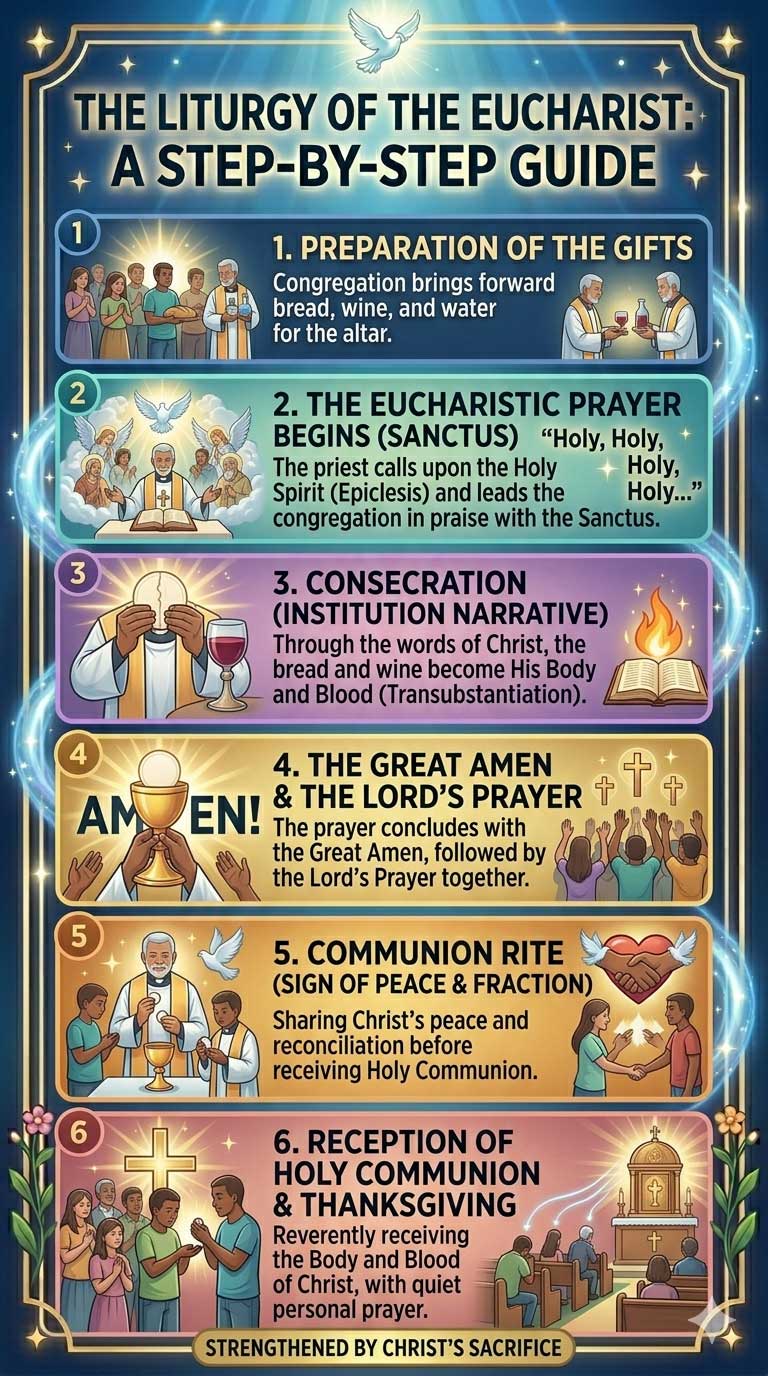
- A. The Preparation of the Gifts
- Offertory Procession: Members of the congregation bring forward bread, wine, and water to the altar, alongside financial offerings collected for the church and the poor.
- Presentation and Washing: The priest places the bread and wine on the altar, offering prayers of praise, and ritually washes his hands as a sign of his desire for interior purification before entering the most sacred part of the liturgy.
- B. The Eucharistic Prayer
- The Preface and Holy, Holy, Holy (Sanctus): The priest invites the congregation to lift up their hearts in thanksgiving, leading into a combined hymn of praise with the angels and saints (“Holy, Holy, Holy Lord God of hosts…”).
- Epiclesis: The priest extends his hands over the bread and wine, calling down the Holy Spirit to come upon the gifts so that they may become the Body and Blood of Christ.
- Institution Narrative and Consecration: The priest repeats the exact words spoken by Jesus at the Last Supper. Through the power of the Holy Spirit and the actions of the priest, the bread and wine are completely transformed (transubstantiation) into the literal Body and Blood of Jesus Christ.
- The Mystery of Faith (Memorial Acclamation): The congregation proclaims a central truth of their faith, usually focusing on Christ’s death, resurrection, and future return.
- Doxology and Great Amen: The Eucharistic Prayer concludes with a solemn prayer of praise to the Trinity (“Through him, and with him, and in him…”), and the congregation responds with a thunderous “Amen,” signifying their complete agreement.
- C. The Communion Rite
- The Lord’s Prayer: Bound together as children of God, the entire congregation stands to pray or sing the Our Father.
- Sign of Peace: Before sharing the sacrificial banquet, the congregation extends a ritual sign of peace, reconciliation, and Christian unity to those standing near them.
- The Lamb of God (Agnus Dei): The priest breaks the consecrated host while the congregation asks Christ for mercy and peace (“Lamb of God, you take away the sins of the world…”).
- Reception of Holy Communion: The faithful process forward to reverently receive the Body and Blood of Christ, spending time afterwards in quiet, personal prayer and thanksgiving.
- Prayer after Communion: The priest gathers the communal thanksgiving into a final prayer, asking that the sacrament just received will bear spiritual fruit in everyone’s lives.
The final section transitions the community from worship inside the church walls to their mission out in the world.
Recessional Procession: The priest and ministers process out while a final hymn is sung, and the faithful depart to carry Christ’s presence into the world.
Final Blessing: The priest invokes God’s blessing upon the entire congregation in the name of the Father, the Son, and the Holy Spirit, sending them forth with supernatural grace.
The Dismissal: The deacon or priest formally sends the people forth to live out what they just celebrated, saying words such as, “Go forth, the Mass is ended,” or “Go in peace, glorifying the Lord by your life.”
More about the Liturgy