
Lock ‘em up! …but give them a key
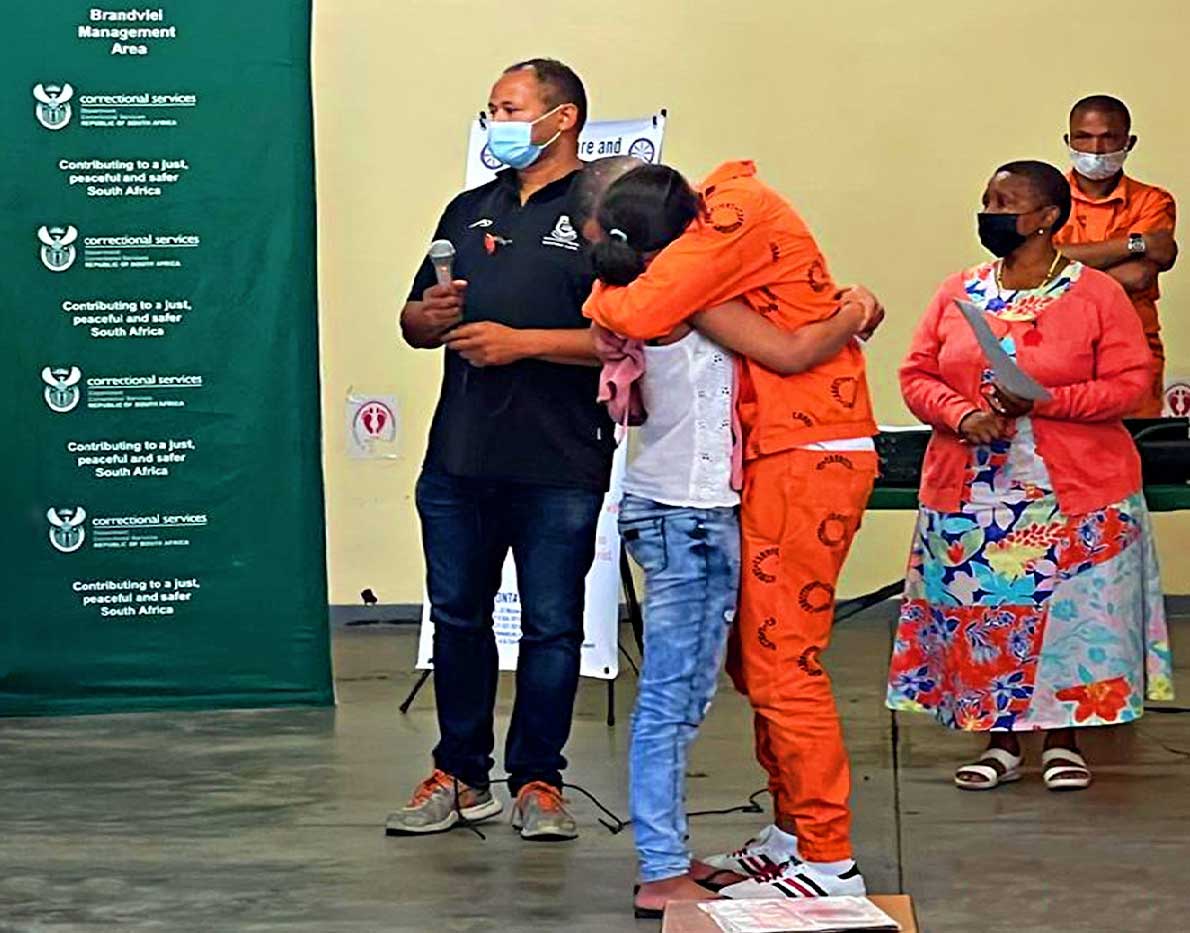
Family members reconcile at a Family-Offender Mediation Day
Simply locking offenders up and throwing away the key is not the Christian option, as Jesus himself warned. But what is the Christian way of dealing with convicted criminals? Dr Nathanael Siljeur explains.
We’re all sick of crime. So why shouldn’t we just lock the criminals up and throw away the key?
The recently released crime statistics paint a bleak picture of crime in South Africa. South Africans are rightfully frustrated and angry with the level of crime in the country. The statistics relating to rape, gender and child offences, and murders evoke extreme emotions.
Prison ministry is sensitive to the consequences of crime: the loss, hurt, pain, brokenness, and vulnerability experienced by victims of crime, their families, and broader society. Therefore Archbishop Stephen Brislin of Cape Town explains that prison ministry rests on the offenders “acknowledging, accepting and owning the consequences of their actions”.

However, Christians cannot shy away from being that beacon of hope and ambassadors of God’s love, mercy and forgiveness. Forgiveness entails restoring the communion between the victim, offender, and community damaged by sin.
How can criminals be rehabilitated? Don’t most relapse into crime when they get out?
Rehabilitation entails a process of assisting an offender to better deal with risk factors that could make them offend. Criminals can be rehabilitated. However, rehabilitation of offenders should be a collaborative effort between the offender, the victim, and the community, including the offender and victim’s families and correctional services.
Indeed the most extensive responsibility rests with the offenders as they should use the tools they have learnt during the rehabilitative programmes to make the correct choices.
Collectively, the broader society, including the different faith formations, has a responsibility to create an enabling environment to ensure an offender’s continued and sustainable rehabilitation and reintegration back into their families and the community.
What happened to the biblical “an-eye-for-eye”?
Often, groups in society refer to passages from the Old Testament like “an eye for eye, tooth for tooth” (Leviticus 24:19-21) to justify harsh punishment. In her book Harm, Healing, and Human Dignity, Catholic author Caitlin Morneau correctly explains that punishment in the Old Testament was not intended as a form of revenge but rather as a means of purification. The punishment was meant to lead the offender to atone through self-sacrifice and repentance.
In our society today we have a term for that: restorative justice. Interventions using restorative justice are and should be about accountability, acceptance and responsibility.
The New Testament further amplifies a merciful and forgiving approach, characterised by turning the other cheek. Jesus said: “You have heard that it was said, ‘Eye for eye, and tooth for tooth.’ But I tell you, do not resist an evil person. If anyone slaps you on the right cheek, turn to them the other cheek also” (Matthew 5:38-40).
There are many instances in the Gospels where Jesus tells us how to approach the outcasts and those suffering. He has a loving and merciful approach to these marginalised individuals. Firstly, in Matthew 25:16, Jesus commands us to visit prisoners. Secondly, in the parable of the Prodigal Son (Luke 15:11-32), Jesus emphasises the forgiving and merciful nature of God the Father. Therefore we are called to emulate Jesus’ example by rejoicing when a “brother of yours was lost and is found”.
So what is restorative justice?
Restorative justice is an alternative to the traditional criminal justice approach. It focuses on the victim, offender and community relationships, the harm caused by the crime, and what can be done to repair the harm.
Throughout the entire restorative justice process, the impact is considered and emphasised. The mediator facilitates a voluntary dialogue between the victim and the offender.
We must also remember that the offender’s family is usually the secondary victim of the offender’s crimes. The family commonly suffers embarrassment, possibly the loss of a breadwinner, and the offender’s company, whether as a father, son or brother (or, in rarer cases, mother, daughter or sister).
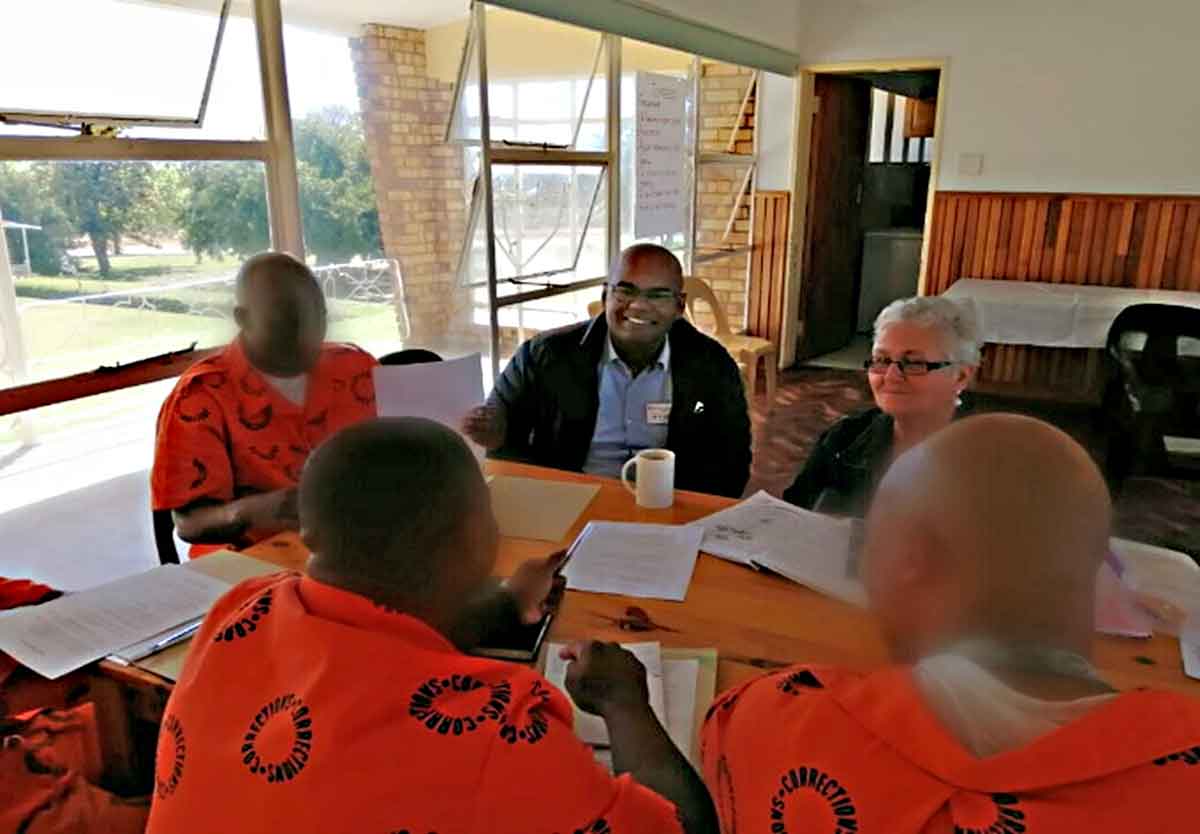
Group session during a restorative justice course. Inmates’ faces have been blurred.
How does restorative justice work in action?
The mediation takes place in a safe and secure environment. The offender has the responsibility to truthfully explain his actions to the victim and take personal responsibility for the consequences of his crime.
Usually, the family-offender mediation occurs before victim-offender mediation. Although the victim and offender are usually primary participants during the mediation, other family members can support them during the victim-offender mediation.
Many prisons globally implement variations of the restorative justice programme. I can speak from experience about that in the Western Cape correctional facilities, where the Prison Care and Support Network (PCSN) of the archdiocese of Cape Town, which I serve as chair, is active.
The two primary restorative practices are family-offender mediation and victim-offender dialogue. The PCSN specialises in the former. Our ten-day restorative justice programme focuses primarily on assisting the offender in understanding himself, understanding crime and its consequences, understanding the impact on the victim and the victim’s family, and understanding risk factors that could lead to them reoffending. In addition, we endeavour over the ten days for the offender to forgive himself and allow God’s grace and forgiveness to penetrate his life. This, we hope, will give them a key to liberating themselves.
Secondly, we prepare the families to choose to come to a Family-Offender Mediation Day and be open to forgiving the offender for the hurt, loss, disappointment, shame, betrayal, and struggle that his actions have caused. That day usually is a very blessed and emotional time for the offender and his family. It is a blessing to experience God’s healing work to change people’s circumstances. Our sister NGOs assist with the Victim-Offender Day.
Is there any evidence that restorative justice is effective?
The empirical evidence indicates that the imprisonment of offenders is not an effective deterrent to recidivism. Recidivism — which is when a released offender reoffends — remains a challenge. However, empirical studies and our experience in the Prison Care and Support Network ministry suggests that restorative justice processes are helpful in reducing recidivism. Further, the studies indicate that juvenile offenders who attend restorative justice programmes and return to enabling environments have a lower level of recidivism.
However, the broader society must create an enabling environment to prevent recidivism. An enabling environment includes family and institutional support to help the offender adjust to life outside prison. Rehabilitative programmes are not the silver bullet to prevent all crimes or prevent offenders from committing more offences. Still, it provides the offender with substantive tools to help him reintegrate into society, which mitigates reoffending.
Quite often, recidivism is used as the only measure to determine the impact of restorative justice programmes. However, rehabilitative programmes such as restorative justice should be measured more broadly. For example, other measures might include improved spousal or child-parent relationships, reduced aggression, and so on.
Improving other socio-economic factors, such as poverty and unemployment, will also reduce recidivism.
What is the Church doing?
The Church has played a supportive role in ministering to offenders in prison. In addition, the Church advocates and ensures the pastoral needs of offenders are met at an international level and local level.
In 1972, a group of Catholic chaplains from different countries that had loosely cooperated since 1950 met with Pope Paul VI. With the pope’s guidance and support, the group received a juridical format with a charter and statutes. Today the organisation is known as the International Commission of Catholic Prison Pastoral Care (ICCPPC). For the past 15 years, the commission has ensured that they maintain the official observer status as an NGO at the United Nations. In this role, the ICCPPC provides input at the UN deliberations relating to crime prevention, criminal justice reform, promotion of human rights, application of UN standards, gender issues and social defence.
There’s also a national prison chaplaincy. Again, speaking from my experience, within the archdiocese of Cape Town, the PCSN has ministered to offenders and their families for more than 20 years at correctional facilities include Pollsmoor, Goodwood, Worcester, Allandale, Brandvlei and Helderstroom. We have a board of management consisting of seven members, two fulltime staff members, and approximately 30 volunteers. The ministry we provide in prison includes weekly visits from our spiritual workers, about six ten-day restorative justice programmes per year, and our chaplain administers the sacraments for Catholics on request.
Outside prison, the work includes monthly ex-offender meetings, bursaries for the offender’s children to attend secondary school, food parcels for families in need, and facilitating bursaries for offenders pursuing tertiary studies.
The PCSN needs to do much more in advocating for criminal justice reform, including reforms in the correctional facilities and programmes specifically tailored to support victims. However, we need more support and funding to do this.
Why should Catholics care about the prison ministry?
The Church promotes prison ministry because Christians are called to create a culture of encounter. Pope Francis explains that we should go to the margins of society, sharing a ministry of presence with those we meet. Prison ministry creates a vehicle for such encounters with victims, offenders and the community.
We should be agents of restoration. As Caitlin Morneau, the director of Restorative Justice at the Catholic Mobilising Network, states: “Jesus not only modelled how to live restoratively but his death and resurrection, in atonement for our sins, was the ultimate act of restorative justice. This redemption and promise of salvation implore us to be ministers of reconciliation.”
Dr Nathanael Siljeur is the chair of the Prison Care and Support Network. The network can be supported by donations or volunteering. For more information, see www.pcsn.org.za
This article was published in the July 2022 issue of The Southern Cross magazine

- Palm Sunday Prayer - March 24, 2026
- Pope: We Cannot Remain Silent - March 24, 2026
- Pope Leo: We are Made for God - March 24, 2026



