
Blessed John Duns Scotus
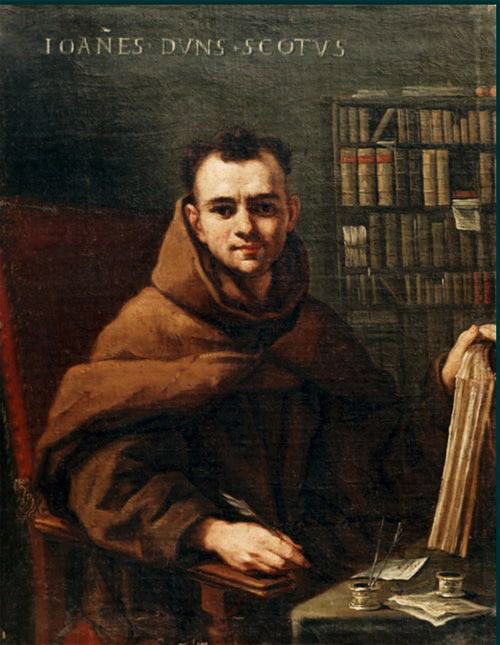
Blessed John Duns Scotus died in November 1308 and was buried near Cologne, Germany. Beatified by Pope St John Paul II in 1991, his feast day is Nov. 8.
St Francis tells us quite simply how he envisages living a Gospel life centred on the pursuit of God in solitude and fraternal caring for one another that can only be characterised only by a mother’s love and a child’s simple acceptance.’
This description of a mother’s love and a child’s simple acceptance used by Regis left me ‘gob-smacked’ to use this very British idiom. I spent some weeks in the rather weird situation of seeking a philosophical argument for the source of knowledge leading to human rationality while believing that it is not, in effect, the intellectualised idea of knowledge that leads to rationality. Trying to disprove the proof, using the very arguments of the proof; this circular problem left my head spinning.

My own experience convinced me that there was an experience of love on which we built our knowledge of rational beings. To find me up against the teachings of Aristotle as taken up by St Thomas Aquinas as well as Lonergan in contemporary philosophy did not help the situation. The all too solid Aristotelian idea of knowledge moving from experience to knowledge through understanding, then to judgment and the will and finally leading us to love, appeared unassailable.
It was therefore like a child with a new toy, that I discovered the teaching of Blessed John Duns Scotus. It is Scotus states unequivocally that philosophers are wrong. In his rejection of the over-intellectualised philosophical view of the supremacy of the intellect, Scotus argues that Ordered love, not knowledge, defines and perfects human rationality. Human dignity has its foundation in rational freedom. In contrast to the philosophical, intellectualist model of human nature and destiny, the Franciscan offers and strengthens the Christian alternative, centred not merely on knowledge but on rational love…The Franciscan tradition consistently defends a position wherein the fullest perfection of the human person as rational involves loving in the way God loves, rather than knowing in the way God knows (Ingham & Dreyer 2004:7-8).
This was the brilliant intuition of Francis in his primitive rule to which Duns Scotus gives the rational explanation.
Scotus asks;’ Does this infer that we can love what we do not know? For Scotus, this is not a licit question because love and knowledge are not of the same order, just as goodness and truth are not of the same order, and therefore the act of love is distinct from the act of knowing as these acts are distinct faculties. Through knowledge, we are informed of the object of our love. By our love, we are attracted to the object of our knowledge.
Here, I believe is the Franciscan answer to such difficult questions as the juxtaposition of Mercy and Justice which place God’s actions within our temporal ideas; implying God’s actions take place in time; as though God first knows and then love or who first applies justice followed by mercy. Scripture tells us that God is Love and it is therefore that very same relational Love that knows.

- The Church Year and Advent - December 1, 2024
- Easter Sunday Reflection: The Way – Love Overcomes Violence & Death - March 29, 2024
- Palm Sunday Reflection: Re-Espousing And Anointing - March 22, 2024



