Medjugorje: Place of Prayer and Grace

In May, a group of Southern Cross pilgrims travelled to Medjugorje in Bosnia-Herzegovina. Günther Simmermacher shares his impressions.
There are people young enough to still have hair in its natural colour who’ll remember when Medjugorje was all fields. That changed over the decades following the first apparition reported by six children on June 24, 1981. In the intervening 40 years, Medjugorje developed these fields around the parish church of St James, built in 1892, to include a beautiful sanctuary and an abundant infrastructure of hotels, restaurants and souvenir shops to accommodate the million pilgrims who annually come to this small town in Bosnia-Herzegovina of 2300 inhabitants.
The apparitions are controversial. To cut a long, complex story short, the local diocese of Mostar for four decades dismissed the apparitions, which were strongly supported by the local Franciscans, and the Vatican sided with the local bishops. Pilgrimages to Medjugorje were never banned by the Church authorities, but priests could not lead groups as official spiritual directors. It is understating things to note that the disputes were not always edifying, culminating in the brief abduction of Bishop Ratko Peric of Mostar in 1995.


Stations of the Cross on Mount Krizevac, Medjugorje.
But the pilgrims kept coming in ever-increasing numbers, experiencing graces and conversions in this place. In May 2019, Pope Francis finally permitted official pilgrimages, acting on an official Vatican report. The report acknowledged that the first six apparitions might have had supernatural character, but discounted all subsequently reported apparitions. The Holy Father is cautious about the ongoing apparitions, too, saying that the Blessed Virgin is not “the head of the telegraphic office who sends a message every day”. However, Pope Francis also noted that “there are people who go there and convert, people who find God and their lives change… This is a spiritual and pastoral fact that cannot be denied.” And these pilgrims, he decided, require pastoral care.
Bishops may now lead pilgrimages to Medjugorje, on the assumption that this does not suggest implicit support for the apparitions. One of them, working on that assumption, was Archbishop Stephen Brislin of Cape Town, who led our group of Southern Cross pilgrims. His presence was greatly welcomed in Medjugorje. Our group was invited to lead two of the daily English-speaking Masses. Archbishop Brislin presided with Frs Vukani Masango CMM and Fr Peter Whitehead concelebrating, while members of our group served as proclaimers of the Word and collectors. Archbishop Brislin was also interviewed on various Medjugorje media.
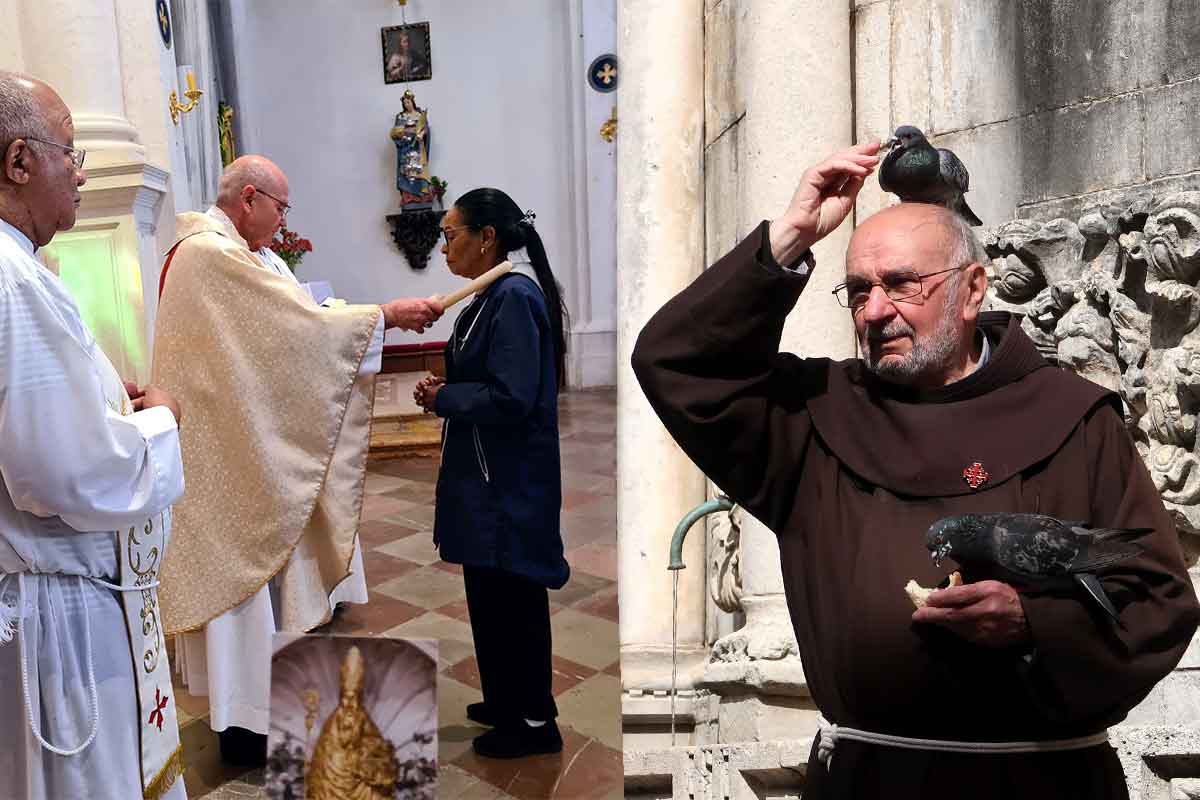
(Left) Archbishop Stephen Brislin blesses the throat of Norma Moonsamy after Mass in St Blaise church in Dubrovnik, Croatia, as Fr Peter Whitehead looks on. (Right) A Franciscan Friar feeds pigeons in Dubrovnik.
Emphasis on prayer
Whether or not the reported apparitions are authentic has become a point of personal judgment in Medjugorje; the spiritual fruits are available independently of one’s position on them. The place has become sanctified by the prayer of the people. And the emphasis here is strongly on prayer and grace, with the apparitions more of an adjunct than the focus of Medjugorje’s spirituality.
This is also the view of the pope’s apostolic visitor, Archbishop Aldo Cavalli. The former nuncio to countries such as Chile, Malta and the Netherlands has been based in Medjugorje since November 2021, when he succeeded the first incumbent in that office, who died suddenly. Our group was privileged to have a private meeting with Archbishop Cavalli. He emphasised that this was a site of grace and conversion.
When I asked him about the historically strained relationship between Medjugorje and the diocese of Mostar, he replied, in the skilled manner honed by years in the diplomatic service, that disagreement within the Church can be good and fruitful, if conducted in a constructive spirit. Since a new bishop of Mostar was installed in 2020, relations have improved, Archbishop Cavalli noted. Recently, he told us, he had met with the now-retired Bishop Peric, who had just published a book outlining the case against the apparitions. “He presented me with a copy of the book. Very good. And then we drank a grappa,” Archbishop Cavalli laughed.
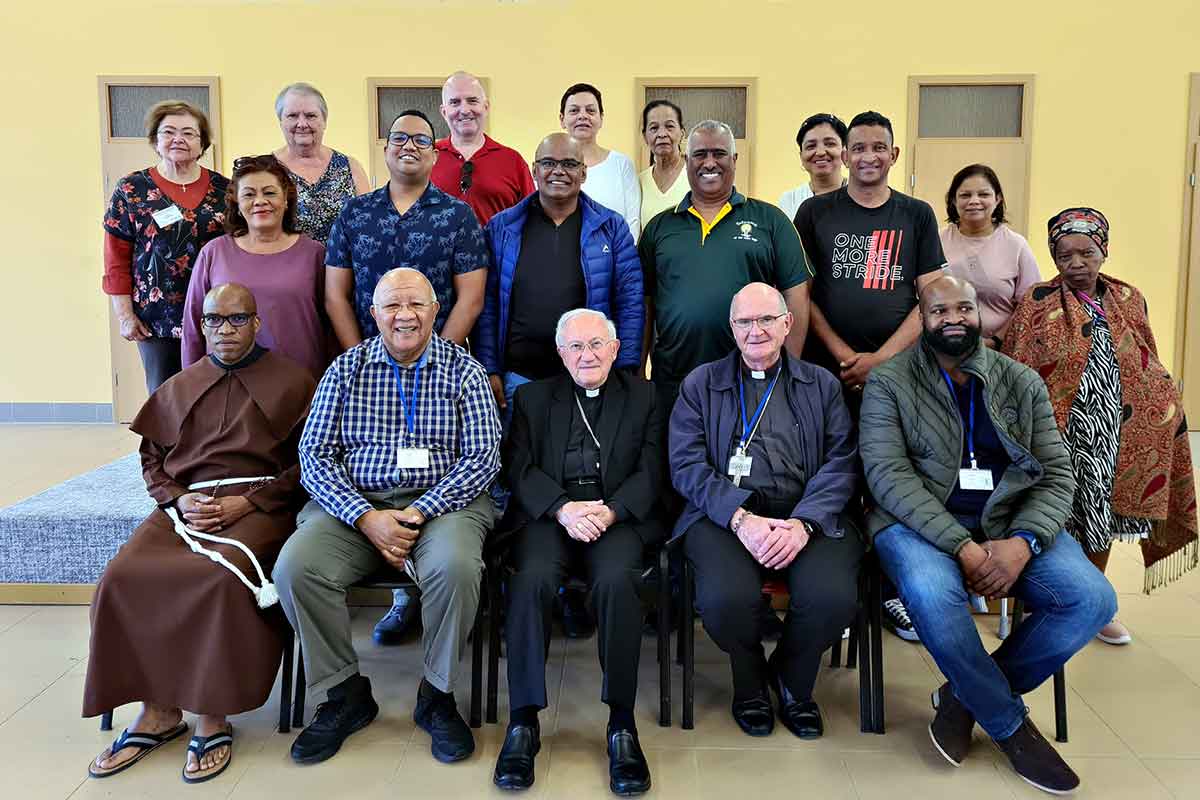
The Southern Cross pilgrims with Archbishop Aldo Cavalli (front centre), the pope’s apostolic visitor in Medjugorje. Fr Vukani Masango CMM is bottom left.
Measure the fruits
Sites like Medjugorje must be measured by their fruits, especially when the personality cult around the visionaries is relatively restrained. Even Jakov Colo, the youngest of the six visionaries, said in the talk our group attended that he is nobody special and turned the focus on prayer and repentance, and on Jesus, to whom Mary always points. The personality cult doesn’t interest him. “Nothing special will happen to you if you touch me,” he pointed out.
But the place will touch those of open heart and prayerful mind. Medjugorje has an extraordinary kind of peace, one which possibly every pilgrim testifies to. And the place retains a certain unspoiled ruggedness. The Stations of the Cross lead up Mount Krizevac (Cross Mountain) on a harsh, torturous rocky terrain — only just over half our group persevered to the top, where a huge cross erected in 1933 presides over the village. Reaching the summit, and descending from it, is an exercise in penance.
Medjugorje is not (yet) a polished pilgrimage operation either. The texts for the hymns in the English-speaking Mass in St James’ church were cast on a badly-positioned pull-down screen by means of an overhead projector, conceivably a relic from the time of the first apparition. Some of these texts were scrawled by hand and kept in plastic sleeves. Our school teachers were slicker than that.
But pilgrims come for more important things than glossy production values. The queues for confession were long, the Masses were packed, the devotions exercised with sincerity and enthusiasm. There were many young people and families, coming to this village in Herzegovina to be closer to God, to find healing, to experience a conversion. And many people evidently do.
Praying and shopping
The attendant commercialisation needn’t bother us. As in Lourdes and other sites of apparitions, the sanctuary is peaceful and conducive to prayer and edification; its only nod to commercialism is a Franciscan shop. But the pilgrims need to sleep, eat and buy their souvenirs somewhere, and these needs are amply provided for. In return, families are making a living.
It is a good arrangement for everyone. The village of Medjugorje has grown as a result. One has a sense that those in Medjugorje share the faith of those whom they serve, unlike some of the purveyors of commercial services in Lourdes. On houses one might see banners proclaiming in several language, “Thank you, Gospa!”, using the local name for Our Lady. These banners might thank the Blessed Virgin for graces just as well as they might thank her for the fortunes which her reported apparitions have showered upon the local population.
And we may thank Our Lady for what she has done for us — in Bethlehem and Cana, in Knock and Lourdes, in Fatima and Ngome, and in our lives, wherever we are.
Read about the Turkey part of the pilgrimage visiting the Seven churches in Revelation
Published in the August 2022 issue of The Southern Cross magazine

- Shrines around the World: Our Lady of Beauraing - March 21, 2026
- St Patrick: From Slave to Apostle - March 17, 2026
- New Cape Town Archbishop Calls For Unity and Prophetic Courage - March 14, 2026