St Catherine Labouré: Saint of the Miraculous Medal
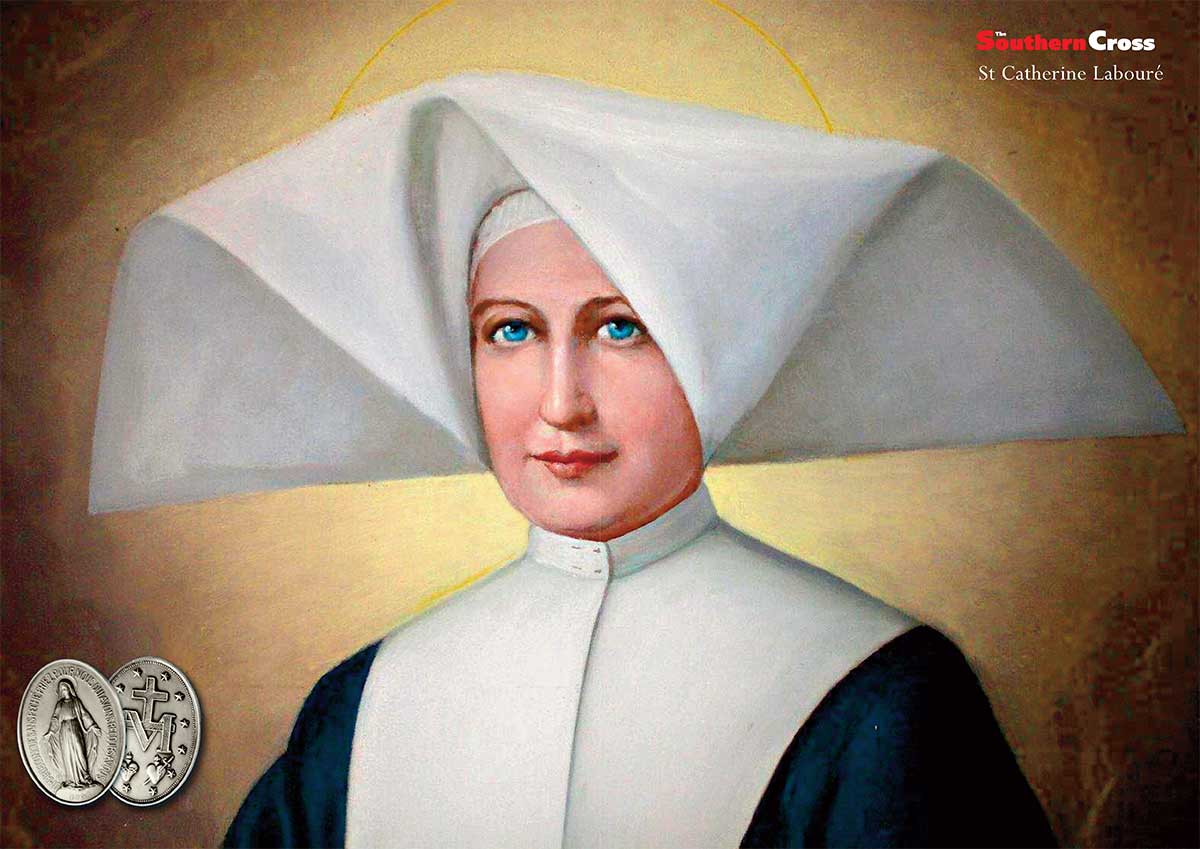
St Catherine Labouré
In 1830, Our Lady appeared to a simple novice in Paris and told her to have a special medal made. This is the story of St Catherine Labouré.
St Catherine at a glance
Name at birth: Zoé Labouré
Born: May 2, 1806, in Fain-lès-Moutiers, France
Died: December 31, 1876 (aged 70), in Reuilly, Paris
Beatified: 1933
Canonised: 1947
Feast: November 28
Patronages: Miraculous Medal, the infirm, the elderly
Sprinting legend Usain Bolt ran his world records wearing the Miraculous Medal around the neck. And at this year’s Olympics in Tokyo, Hidilyn Diaz flashed the Miraculous Medal alongside the gold medal she had won in weightlifting. The Filipino athlete’s success came at a time of a pandemic; the Miraculous Medal gained popularity in a time of an epidemic. For that story, we need to flash back almost 200 years.

In July and December 1830, a 24-year-old novice of the Daughters of Charity had two apparitions of Our Lady in the order’s chapel at 140 rue de Bac in Paris. It was not the first apparition Sr Catherine Labouré had experienced in that chapel. Previously she had visions of Christ and of the heart of St Vincent de Paul, the co-founder of her order (and September’s Saint of the Month).

The front and reverse of the Miraculous Medal.
At 23:30 on July 18, 1830 — the eve of what then was the feast of St Vincent de Paul — Sr Catherine was awoken by “a shining child” directing her to come to the chapel. There the Virgin Mary appeared to her for two hours. She told Sr Catherine: “God wishes to charge you with a mission. You will be contradicted, but do not fear; you will have the grace to do what is necessary. Tell your spiritual director all that passes within you. Times are evil in France and in the world.”
During Sr Catherine’s evening meditations on November 27, 1830, Mary appeared again — inside an oval frame, standing upon a globe, with her hands coming out as rays of light, and the invocation: “O Mary, conceived without sin, pray for us who have recourse to thee.” Sr Catherine saw the frame rotating to form a circle of 12 stars, and a large letter M intertwined with a cross above the Sacred Heart of Jesus and Immaculate Heart of Mary. Asked why some of the rays of light did not reach the ground, Our Lady explained: “Those are the graces which people forget to ask for.” She then asked Sr Catherine to have medals struck featuring the image she had seen. “All who wear them will receive great graces,” the Blessed Mother promised.

The Miraculous Chapel in Paris, where Our Lady appeared to St Catherine Labouré in 1830. The saint’s glass tomb is beneath an image of the Blessed Virgin to the right of the sanctuary. Photo: Günther Simmermacher
Catherine’s secret
Sr Catherine did as instructed, taking the encounters with Mary to her spiritual director, Fr Aladel, on condition that he would keep her identity secret. The priest treated her reports with respect but also prudence. Before he would act upon them, he observed Sr Catherine for a year. Once he was satisfied that the young woman had told the truth, he approached the archbishop with his report on the matter, and the proposal that Our Lady’s request to have the medals struck be acted upon. The archbishop agreed. A well-known Parisian goldsmith named Adrien Vachette was tasked with designing the medals. The result of the 79-year-old goldsmith’s design was first struck in June 1832.
Not long after, Paris suffered a cholera epidemic which in the end killed 20000 people. The Daughters of Charity had been distributing the medals at that time and many survivors attributed their cure to the protection received through them. And so the medallion became known as the Miraculous Medal. Soon millions of Catholics adopted a devotion to the Miraculous Medal, first throughout France and then the world.
By then Sr Catherine had made her vows and was transferred to her order’s hospice at Reuilly, then a village just outside Paris. Nobody at the convent knew of her remarkable experience; in their reports, her superiors described Sr Catherine as “rather insignificant”. She repeatedly refused to appear before the archbishop’s inquiry which had been set up to confirm the authenticity of the apparitions. The inquiry found them to be authentic anyway.
Meanwhile the popularity of the medal grew, especially after the conversion of the future Jesuit Alphonse Ratisbonne from Judaism in 1842, on account of the Miraculous Medal. (The hospital pictured on our backpage this month was in the monastery established by Fr Ratisbonne in Jerusalem.)
Catherine would spend the remaining 40 years of her life in happy obscurity at Reuilly, caring for the elderly and frail, and looking after the poultry on the hospice’s farm. She was known for her humility and reserve, and her lifelong devotion to Our Lady.
Call to religious life
That devotion went back to when she was nine years old. Catherine was born on May 2, 1806, near Saint-Rémy in eastern France to the farmers Pierre and Madeleine Labouré, the ninth of 11 children. She was baptised as Zoé. After her mother died in 1815, nine-year-old Catherine picked up a statue of Our Lady, kissed it, and said: “You will be my mother now!” While cared for by her aunt in Saint-Rémy, Catherine had a dream of a priest who told her: “My daughter, it is good to care for the sick. For now, you flee from me, but one day you will be glad to approach me. God has plans for you. Don’t forget it!” Later she recognised the priest as St Vincent de Paul.
When Catherine heard God’s call to the religious life, her father tried to discourage it. His older daughter Louise had already abandoned her housekeeping duties to join the Daughters of Charity. So Pierre sent Catherine to Paris where she was to work in his brother’s canteen for poor workers. But the suffering she saw there cemented her decision to enter the religious life, and after a period of postulancy, Catherine joined the convent of the Daughters of Charity, a congregation devoted to caring for the poor which had been founded in the 1620s by St Vincent de Paul and St Louise de Marillac.
In the night of April 21, 1830 — the day before the body of St Vincent de Paul was going to be translated (or moved) from Notre-Dame cathedral to the Lazarist church in rue de Sèvres, just around the corner of rue de Bac — Catherine had her vision of St Vincent’s heart. Three months later, Our Lady would appear to her.
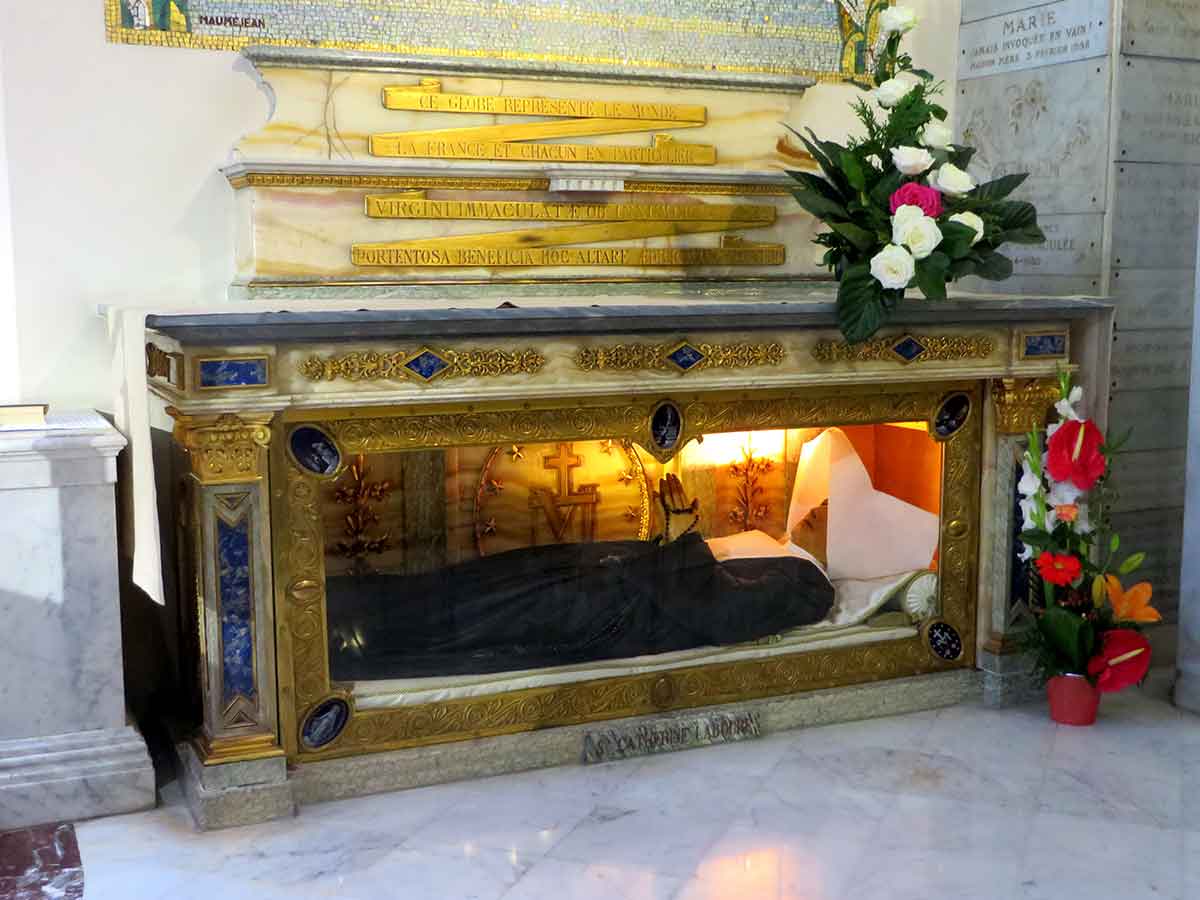
Close-up of St Catherine’s glass tomb. Photo: Günther Simmermacher
Death on New Year’s Eve
Catherine died on December 31, 1876, at 70 in the hospice in Reuilly. Decades later, when her body was translated to the convent at rue de Bac, it was found to be incorrupt, prompting the introduction of her sainthood cause. Catherine Labouré was beatified in 1933 by Pope Pius XI and canonised on July 27, 1947, by Pope Pius XII. Her feast day is observed on November 28, the date of the second Marian apparition.
St Catherine’s body is now encased in glass beneath the side altar in the rue du Bac convent’s chapel of Our Lady of the Miraculous Medal. On the other side of the sanctuary is the glass tomb of St Louise de Marillac, who died in 1660. The relic of St Vincent de Paul’s heart is above the altar.
The chapel where St Catherine had her visions, originally built in 1813, has been remodelled several times since. Its present appearance dates to 1930, the centenary of the apparitions. It is a popular site of devotion, for locals and international pilgrims alike.
This article was published in the November 2021 issue of The Southern Cross magazine

- The Angelus Prayer - March 25, 2026
- Palm Sunday Prayer - March 24, 2026
- Pope: We Cannot Remain Silent - March 24, 2026