
St Juan Diego: The Man who Saw Our Lady of Guadalupe
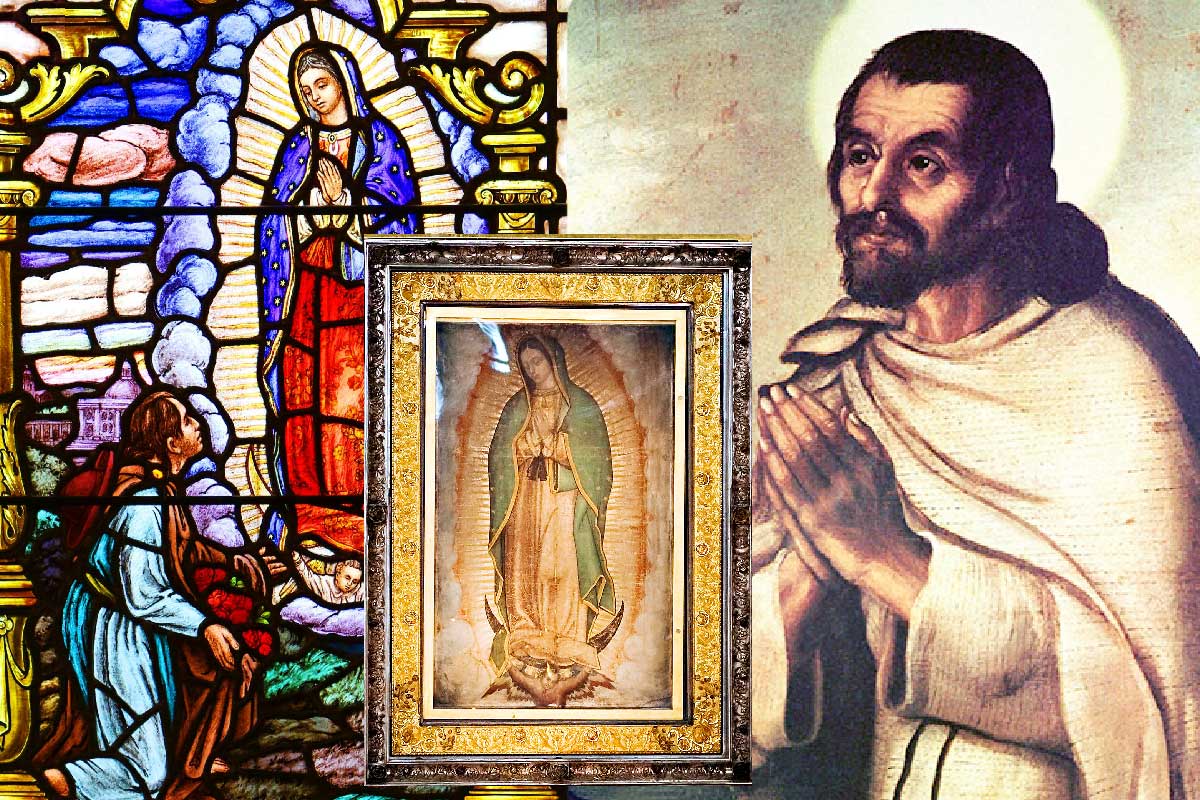
(Left) Poster in the December 2021 issue of The Southern Cross. (Inset) The original tilma in the basilica of Our Lady of Guadalupe in Mexico City. (Right) A detail from an original painting of St Juan Diego which is kept in a vault at the basilica of Our Lady of Guadalupe. (CNS photo by Sergio Dorantes)
How the Blessed Virgin appeared to a simple indigenous peasant in newly-conquered Mexico.
Name: Juan Diego Cuāuhtlatoātzin
Born: 1474 in Cuauhtitlán, Tenochtitlan, Aztec Empire (modern Mexico)
Died: 1548 (aged 73–74) Tepeyac, Mexico City, New Spain
Beatified: May 6, 1990
Canonised: July 31, 2002
Feast: December 9
Patronages: Indigenous peoples of the Americas
The world’s most popular site of Catholic pilgrimage is not, as one might guess, Lourdes or Fatima but the shrine of Our Lady of Guadalupe in Mexico City. It attracts an estimated 10 million people a year. The popularity of the shrine goes back to the four apparitions of the Blessed Virgin to St Juan Diego, and another to his uncle, Juan Bernardino, over a few days in December 1531.


A painting by Rick Ortega in honour of Our Lady of Guadalupe and St Juan Diego. Photo: CNS/ courtesy Archdiocese of Los Angeles)
Juan Diego Cuauhtlatoatzin (the last name means “the talking eagle”) was born in 1474. A peasant of the Chichimec people, he wasn’t poor, but certainly not a person of note. However, he was rich in the Catholic faith which he and his wife, María Lucía, converted to in 1524, soon after the arrival of Franciscan missionaries and three years after the Spanish had conquered the Aztec Empire.
Very little is known about Juan Diego’s life. His parents seem to have died when he was young, so the boy was raised by his uncle, Juan Bernardino, who also became a convert. Tradition mentions a son, but his name and fate are unknown. María Lucía is believed to have died by 1529, two years before the apparitions.
First apparition
The first of these apparitions took place on Saturday, December 9, 1531, at Tepeyac, a hill near what is now Mexico City, while Juan Diego was on his way to Mass. The lady who appeared to him identified herself as “the Mother of the True God” and told Juan Diego that she wanted the local bishop to build a church on the site. As instructed, Juan Diego, who was 57 at the time, rushed to see the bishop, Juan Zumárraga, a Franciscan. He was received politely but sent away.
As he returned to Tepeyac on his way home, the Virgin appeared again. Juan Diego told her that his mission had failed and suggested that she might enlist somebody with greater influence, not a nobody like him, to speak to the bishop. The Virgin insisted that Juan Diego was the right man for the job and instructed him to return to the bishop the following morning.
And the second meeting went better. Bishop Zumárraga was receptive, but demanded a sign as proof that the lady was indeed the Blessed Virgin. With that, the emissary returned to Tepeyac where Our Lady appeared for the third time. Juan Diego reported back about the bishop’s demand for a sign, and the Virgin said she’d provide one the next day, December 11.

A detail from an original painting of St Juan Diego which is kept in a vault at the basilica of Our Lady of Guadalupe. (CNS photo by Sergio Dorantes)
Death scare
When Juan Diego returned home from the apparition, he found his uncle seriously ill. Juan Bernardino had contracted cocoliztli, a usually fatal fever. Over the next day Juan Diego tended to his uncle the best he could, but by the early morning of December 12, the ill man was close to death. So at 4am, Juan Diego set out to fetch a priest to hear his uncle’s confession and administer the last rites. Left alone, Juan Bernardino prepared himself for the end when suddenly his room filled with light. A luminous woman stood in the room — and his fever suddenly disappeared. The lady told him about her encounters with his nephew and, helpfully, notified him that she had instructed Juan Diego to see the bishop.
Juan Diego knew nothing of this as he rushed to find a priest in time before his uncle died. Since he was embarrassed at having failed to keep his appointment with Our Lady the day before, he took a different route around Tepeyac hill. Of course, the Virgin couldn’t be fooled, so she intercepted him and asked what he was doing. The man explained the situation, and was gently reprimanded with the words that today are inscribed above the entrance to the basilica of Guadalupe: “Am I not here, I who am your mother?”

The old and new basilicas of Our Lady of Guadalupe in the hugely popular sanctuary in Mexico City.
She told Juan Diego that his uncle had recovered and then gave him a new task: to go up the hill and collect flowers to be presented to the bishop. To his surprise, the dry, rocky outcrop which normally let only cacti and weeds sprout was filled with roses, unseasonally in bloom. As instructed, he used his cloak, or tilma, to hold the flowers. When he returned to the foot of the hill, Our Lady rearranged them a little and sent Juan Diego off to meet the bishop.
At first the bishop’s officials, who were already suspicious of the Juan Diego’s claims, blocked access. After a long wait, he was finally admitted to the bishop’s office. In his presence, Juan Diego opened his cloak and the flowers poured out. The bishop was amazed at the sight of fresh roses in the middle of winter. And then he saw the sign he had demanded: on the tilma, made of inferior cactus-cloth, Our Lady had left an imprint of her image. The bishop was convinced. More than that, he was enthusiastic. He took the tilma to his personal chapel and asked Juan Diego to stay for another day.
When Juan Diego finally got home, he had no need to explain himself to his uncle. Juan Bernardino told him about his own apparition and miraculous cure he had experienced. And he related that the Virgin had told him by which title she desired to be known: Our Lady Of Guadalupe.
This is not the first Our Lady Of Guadalupe, though. The first shrine of that name is in the Spanish city of Extremadura — the home region of conquistador Hernán Cortés. What was Our Lady saying when she appeared in Mexico as a mestizo — or mixed-raced person — to a man who was already in his forties when Spain had conquered the Aztec empire only ten years earlier?

A pilgrim carries an image of Our Lady of Guadalupe outside the Basilica of Our Lady of Guadalupe in Mexico City. (CNS photo/Henry Romero, Reuters)
Growing excitement
In the days that followed the apparitions, there was great excitement among the indigenous Christians about the reported apparitions, and especially about the miraculous image. On December 26, 1531, a procession was held to take the tilma to Tepeyac, to be placed in a hastily erected chapel. On the way, there was drama: a man was lethally struck by a stray arrow from a militaristic display held in honour of Our Lady. The distraught people carried his body to the tilma and prayed. When they removed the arrow, the man made an immediate recovery.
Juan Diego lived out his days in a hermitage next to the shrine at Tepeyac, the site that is now the sanctuary of Our Lady of Guadalupe. He died in 1548, four years after his uncle, at the age of around 78. He was beatified in 1990 and canonised on July 31, 2002, both by Pope John Paul II at the shrine in Mexico City. His feast day is on December 9, and the feast of Our Lady of Guadalupe on December 12.
The immensely popular sanctuary has two basilicas: The old basilica was consecrated in 1709; the new basilica in 1974. The tilma is housed in the huge new structure.
The miraculous image shows a woman with local features and dress. The black girdle around her waist signifies that she is pregnant. “Thus, the image graphically depicts the fact that Christ is to be ‘born’ again among the peoples of the New World,” as the Vatican put it in a commentary.
The tilma mystery
Science cannot explain how the image appeared on the cloth, or how it has remained as clear as it was in 1531, especially given the inferior fabric on which it appears — the material should have disintegrated after 20 years — and the centuries of candle smoke it was exposed to. Moreover, the tilma has survived two disasters which should have destroyed it but didn’t even cause damage: in 1785 a worker accidentally spilled nitric acid on the right side of the cloth, and in 1921 an explosion of a bomb placed by an anticlerical terrorist near the tilma caused great damage, but none to the cloth or image, nor even to the glass that encased it.
The tilma is Mexico’s most popular religious and cultural symbol, venerated by the faithful and used as a symbol of anti-colonialism and Mexican nationalism. This also explains desperate attempts to prove that the devotion to Our Lady of Guadalupe is based on a pre-conquest cult. None of such theories have stood up to scrutiny.
Our Lady of Guadalupe inspired anti-colonial liberation fighters throughout Latin America in the 19th century, drawing from the fact that she appeared to Juan Diego and on the tilma in the appearance of a mestizo.
For many Mexicans, she is the glue that holds their nation together. In 1974 the Nobel Literature laureate Octavio Paz wrote: “The Mexican people, after more than two centuries of experiments and defeats, have faith only in the Virgin of Guadalupe and the National Lottery.”
This article was published in the December 2021 issue of The Southern Cross magazine

- The Angelus Prayer - March 25, 2026
- Palm Sunday Prayer - March 24, 2026
- Pope: We Cannot Remain Silent - March 24, 2026



