Mariannhill on a Motorbike
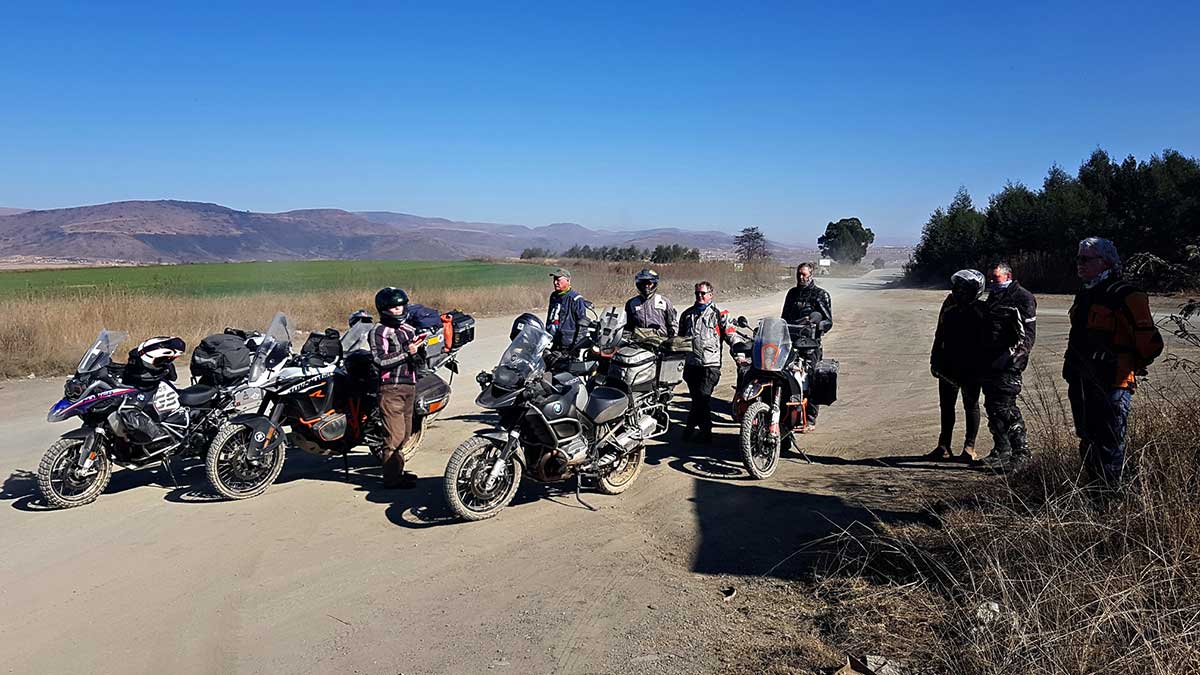
The motorbikers in the Umzimkulu Valley near Centocow mission. All photos courtesy Big Dog’s Adventure Tours & Safaris
In KwaZulu-Natal there is a pilgrim route that takes in many of the Trappist monasteries that gave birth to the Congregation of Mariannhill Missionaries. John Parkin writes about doing the “Trappist Camino” with a group by motorcycle.
This is my tale of one of the most stirring adventures I have ever had; a total soul-cleansing experience after the ravages of Covid and its long-drawn-out effects. Along with a few friends on motorcycles, and some in vehicles, we travelled the KwaZulu-Natal underbelly of remote valleys and rugged hills in search of the Trappist mission stations built around 120 years ago.
We tackled the first long-distance pilgrimage trail in South Africa — a local Trappist Camino — through the beautiful southern regions of KwaZulu-Natal, between the Southern Drakensberg, the Midlands Mist Belt, and the Eastern Cape on the saddles of our motorbikes.

Strung out across the hills and valleys between the Drakensberg and the sea, like knots on a string of rosary beads, are 22 historic Trappist missions, established over a century ago by extraordinary Trappist monks, led by Abbot Francis Pfanner. These mission churches are hidden treasures and I wanted to share them with the world. Very few South Africans are even aware of these marvels.
We ventured deep into rural KwaZulu-Natal, following in the footsteps of Abbot Pfanner’s Trappist monks and the Sisters of the Precious Blood, all of whom served in these monasteries. We experienced the history and mission of the Trappists and the Congregation of Mariannhill Missionaries which they gave birth to. We absorbed the fascinating folklore and legends, the landscape, the fauna and flora of this amazing trail, as described by Alan Paton in his book Cry the Beloved Country.
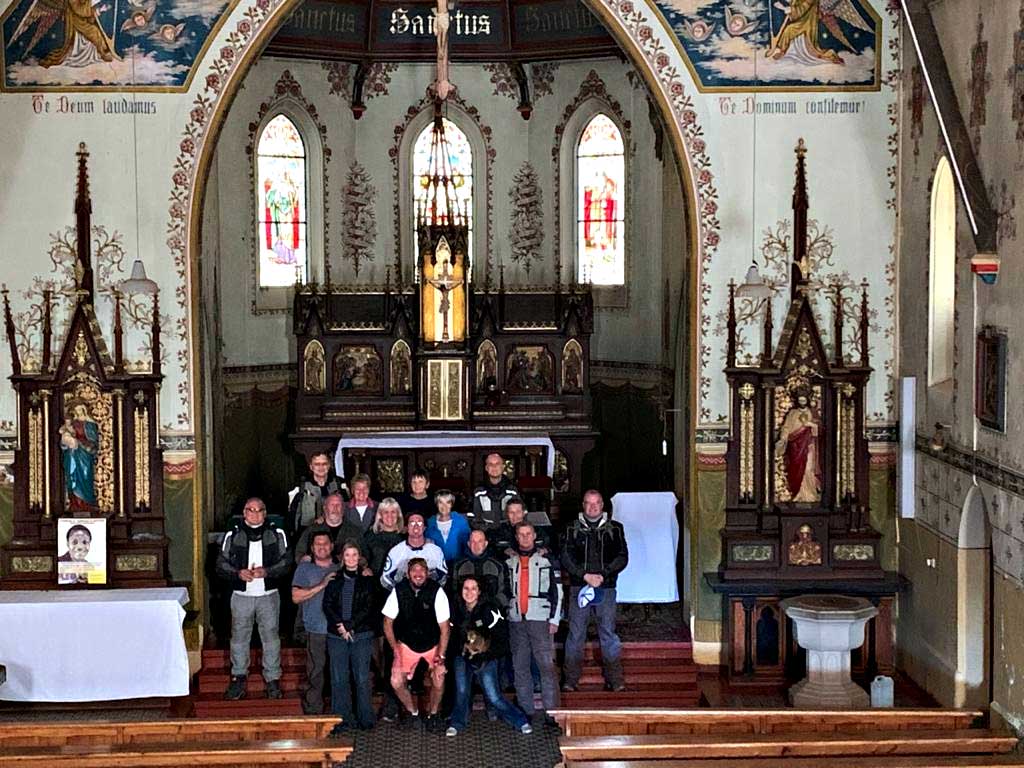
The group of pilgrims in the chapel of the Kevelaer shrine.
In his landmark 1948 novel, Paton wrote: “There is a lovely road that runs from Ixopo into the hills. These hills are grass-covered and rolling, and they are lovely beyond any singing of it. The road climbs seven miles into them, to Carisbrooke; and from there, if there is no mist, you look down on one of the fairest valleys of Africa. About you there is grass and bracken and you may hear the forlorn crying of the titihoya, one of the birds of the veld. Below you, the valley of the Umzimkulu, on its journey from the Drakensberg to the sea; and beyond and behind the river, great hill after great hill; and beyond and behind them, the mountains of Ingeli and East Griqualand.”
A great infrastructure
Some of these monasteries are truly magnificent while some are in the final throes of breaking up. We also visited a working mill that is over 100 years old, with all the water-driven (now diesel-powered) sheave wheels with their canvas belts running from level to level, crushing the wheat from whole kernels to fine flour, before finally emptying the flour into bags.
Gardens that once bore magnificent vegetables and trees which had provided fruits of the farm are now a thing of the past. Store facilities, workshops, printing and carpentry rooms and many other aspects of life, are all but operational. They still exist but are no longer in use except at the larger monasteries.
All of this great infrastructure which once sustained communities is attributable to an amazing man of the time: Abbot Pfanner, who was born in Austria in 1825, and came to South Africa with a group of fellow Trappists in 1880. After an unsuccessful attempt to establish a presence in the Eastern Cape, they came to what is now KwaZulu-Natal.
In 1882 the monastery of Mariannhill was founded near Durban, with Pfanner as its first abbot. By 1898, it was the largest Christian monastery in the world, with 285 monks. Out of that emerged the Congregation of Mariannhill Missionaries.
Abbot Pfanner died on May 24, 1909, at Emaus mission, in Umzimkulu diocese, which was part of our itinerary.
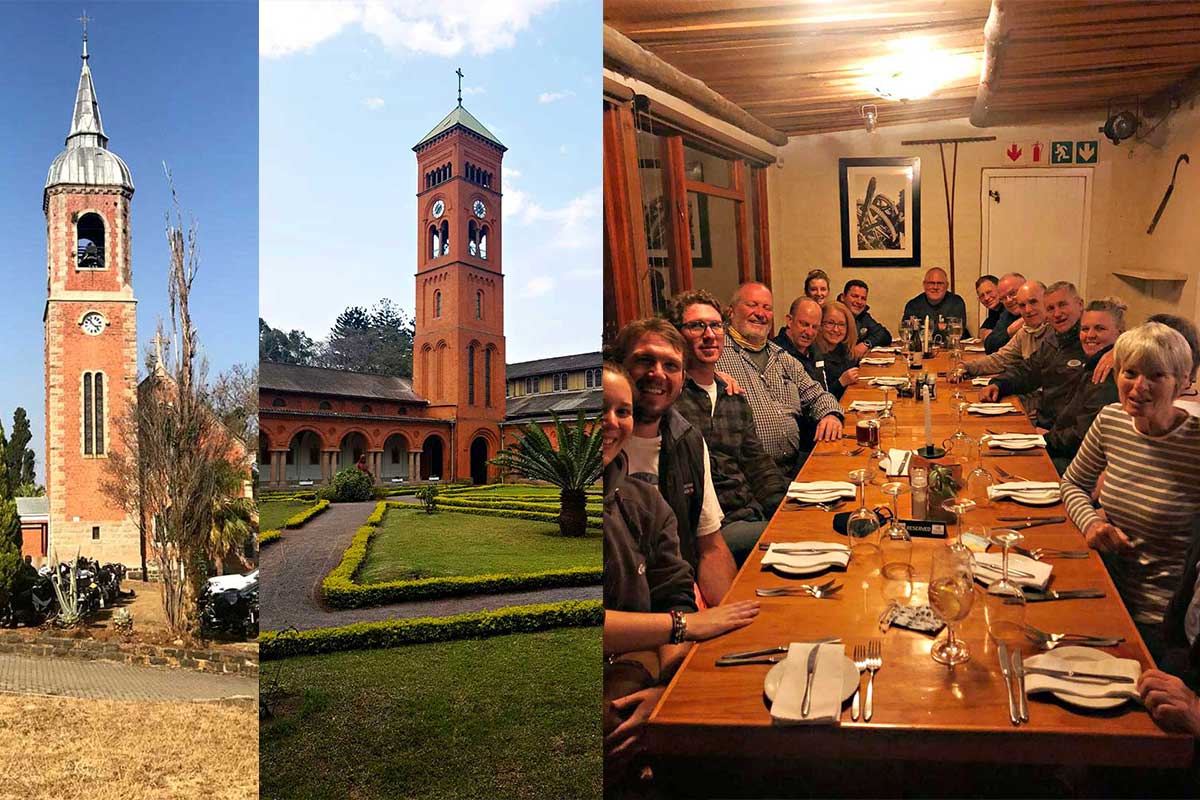
Left: The church of the mission of Maria Ratschitz, near Dundee. Both Kevelaer and Maria Ratschitz missions were founded by Abbot Francis Pfanner in 1888. Centre: Mariannhill monastery, near Pinetown in Durban, was established by Abbot Francis Pfanner in 1882. It once was the world’s largest monastery. Right: The pilgrims enjoy dinner at St Isidore monastery at Mariathal, near Ixopo.
Ten amazing monasteries
During this four-day, three-night adventure drive, we visited ten of these 22 amazing monasteries and churches “in the middle of nowhere”. With the monasteries as the central focus of the tour, we drove some of the very best off-the-beaten track roads the Southern Berg could offer, all in perfect safety.
Some of the landscapes are ancient and sacred, and the environment is great for twitchers. We tried to spot the shy purple-crested loerie (gwalagwala) with its brilliant colours, but saw only one in a tree above us. This area is also home to the very rare blue swallow, Cape parrot, and the black-winged plover. We saw all of this as we covered the backroads of the rural areas of the Lotheni, Impendle, Pholela, uMzimkhulu, and the Ixopo valleys.
At the centre of our itinerary was Mariannhill monastery where we saw the many aspects of monastic life and everything that keeps the wheels turning. Luminaries such as Mark Twain, Ghandi and Mother Theresa visited the monastery!
Our motorbike pilgrimage can also be done by four-wheeled vehicles. As a national tourist guide, I put this Camino together after researching these monasteries for years. We enjoyed wonderful accommodation and food at the three overnight stops, along with amazing stories of what happened those many years ago at each of the monasteries.
It’s the unexpected sights, sounds, emotions, and feelings on a trip like this that capture one’s reason for the wanderlust. Whether one walks the route, drives it in a 4×4 or rides it on a motorbike, it’s a bucket-list item you may not know about. The sensation of riding the wide-open, flowing gravel highways of the Umzimkulu Valley and sleeping in a tastefully restored monastery overlooking a century-old, terraced garden makes an impression. All this and then to discover in yourself a wondrous spiritual connection in some of the country’s most incredible places of worship.
The monasteries we visited were Maria Ratschitz, Mariannhill, Mariathal, St Isidore, Maria Hilf, Emaus, Lourdes, Centocow, Kevelaer, and Reichenau.
The Trappist Camino Trail is presented by Big Dog’s Adventure Tours & Safaris and led by John Parkin, one of a few tour operators with permission to access these sacred destinations. To do the Trappist Camino Trail by motorcycle, vehicle or Camino bus, contact John at or 063 411-2014.
Published in the January 2023 issue of The Southern Cross magazine

- Good Friday Prayer - April 3, 2026
- Holy Thursday Prayer - April 2, 2026
- Scorsese Series on Saints comes to SA TV - April 1, 2026