The Clericalism of the Laity: A Hidden Obstacle to a Synodal Church
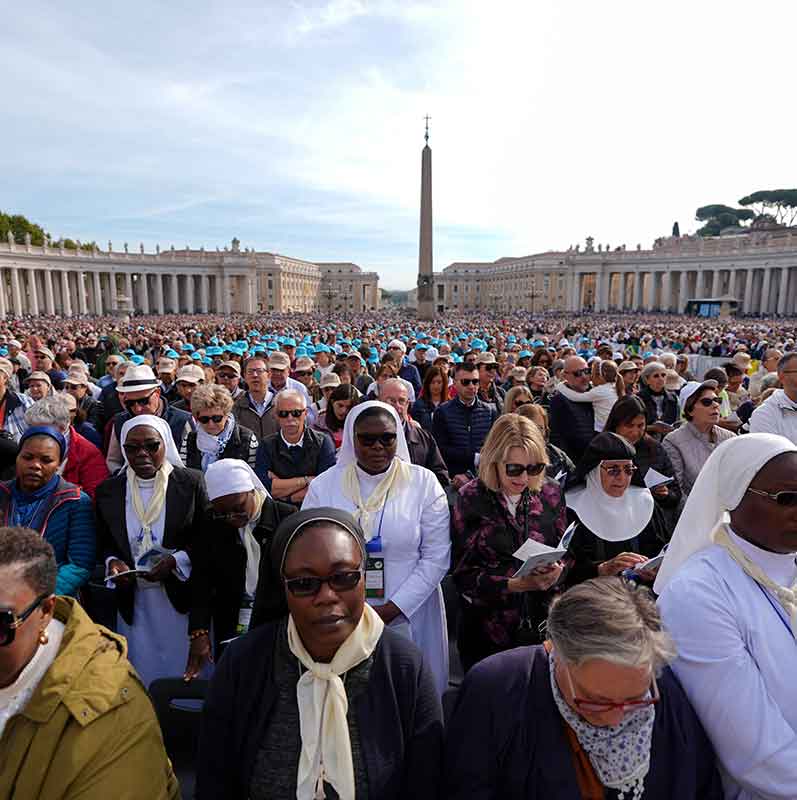
Pilgrims gather in St. Peter’s Square at the Vatican for Pope Leo XIV’s celebration of Mass marking the Jubilee of Marian Spirituality Oct. 12, 2025. (CNS photo/Lola Gomez)
By Laurika Nxumalo – Clericalism has long been recognised as a distortion of leadership and service within the Catholic Church. Traditionally, it refers to the excessive emphasis on the authority and privilege of the clergy, often resulting in the marginalisation of the laity. However, a more subtle and increasingly prevalent form of clericalism has emerged within the laity themselves.
This phenomenon, often called “clericalism of the laity”, occurs when the lay faithful adopt attitudes, behaviours, or structures, which imitate the authoritarian, status-driven, or egotistical tendencies usually associated with the clergy. Such behaviours undermine the spirit of synodality and the participation of all baptised members of the Church.
At its root, the clericalism of the laity stems from a misunderstanding of vocation and service. Some lay people, unconsciously or consciously, view participation in the life of the Church as a path to influence or status rather than as a calling to humble discipleship. This happens when lay leaders treat their positions in sodalities, ministries, or parish councils as personal spaces or platforms for self-promotion. Instead of fostering participation and communion, such attitudes create competition and exclusivity. Clericalism of the laity erodes the Gospel’s ideal example of servant leadership, which is embodied by Christ washing the feet of His disciples; and it also becomes a fertile ground for different kinds of clericalism among the clergy.

Pope Francis repeatedly warned that clericalism is not limited to ordained ministers but is a “perversion” that can infect all members of the Church. In the 2013 apostolic exhortation Evangelii Gaudium, the late Pontiff reminded the faithful that “lay people are, put simply, the vast majority of the people of God,” and their role is not to mimic the clergy but to bring the Gospel into the world through their ordinary lives. When the laity seek to “clericalise” themselves, they alienate others and blur the lines between lay and ordained vocations. The Church then loses Her identity as a community of missionary disciples and turns into a hierarchy of self-appointed elites.
The clericalism of the laity hinders true synodality. When laity who are in leadership positions dominate discussions, fail to listen to each other, or cling to power, they replicate the very attitudes that synodal reforms are attempting to heal. This creates a trust deficit within parish communities and discourages collaboration between the laity and the clergy. The laity should work together with the clergy, not imitate or compete with them.
The lay faithful need to understand that their authority within the Church does not come from offices or titles, rather, it comes from their baptism as it is written in the Catechism of the Catholic Church 1268, “The baptized have become “living stones” to be “built into a spiritual house, to be a holy priesthood.” By Baptism they share in the priesthood of Christ, in His prophetic and royal mission. They are “a chosen race, a royal priesthood, a holy nation, God’s own people, that [they] may declare the wonderful deeds of Him who called [them] out of darkness into His marvelous light.” Baptism gives a share in the common priesthood of all believers.”
To overcome lay clericalism a profound conversion of heart and mindset is necessary. Lay leaders must undergo formation programs that emphasise servant leadership, humility, and spiritual maturity, humility, in order to eliminate power struggles. Parishes should ensure that they create an environment where all parishioners feel heard and valued without looking at their social status, level of education, or church position.
In essence, efforts should be made to help the lay faithful to stick to their main mission of sanctifying the world through social engagement, culture, work, and family life. The laity should be reminded that the clergy are not the only ones who have the task of conversion towards greater communion, participation, and mission, it is the task of the entire People of God. We can only build a synodal Church if both the clergy and laity embrace the humility of Christ, who came “not to be served, but to serve” (Matthew 20:28). Only then will the Church be able to discern, listen with a loving heart, and have mutual respect to hear what the Holy Spirit is saying to all.
Ms Laurika Nxumalo is the Archdiocesan Pastoral Council Secretary of the Archdiocese of Pretoria. She’s also the Southern African Catholic Bishops Conference (SACBC) Council of the Laity Representative of Pretoria, the Deputy Secretary of the SACBC Commission for Synodality, and the Deputy Chairperson of the South African Council of Churches Women’s Forum.
- Trials and Wounds: “Divine Medicine” for the Soul - March 4, 2026
- The Church is Not a Monologue, She is a Conversation in the Spirit - January 30, 2026
- The Clericalism of the Laity: A Hidden Obstacle to a Synodal Church - October 18, 2025