When All Was Quiet on the Western Front
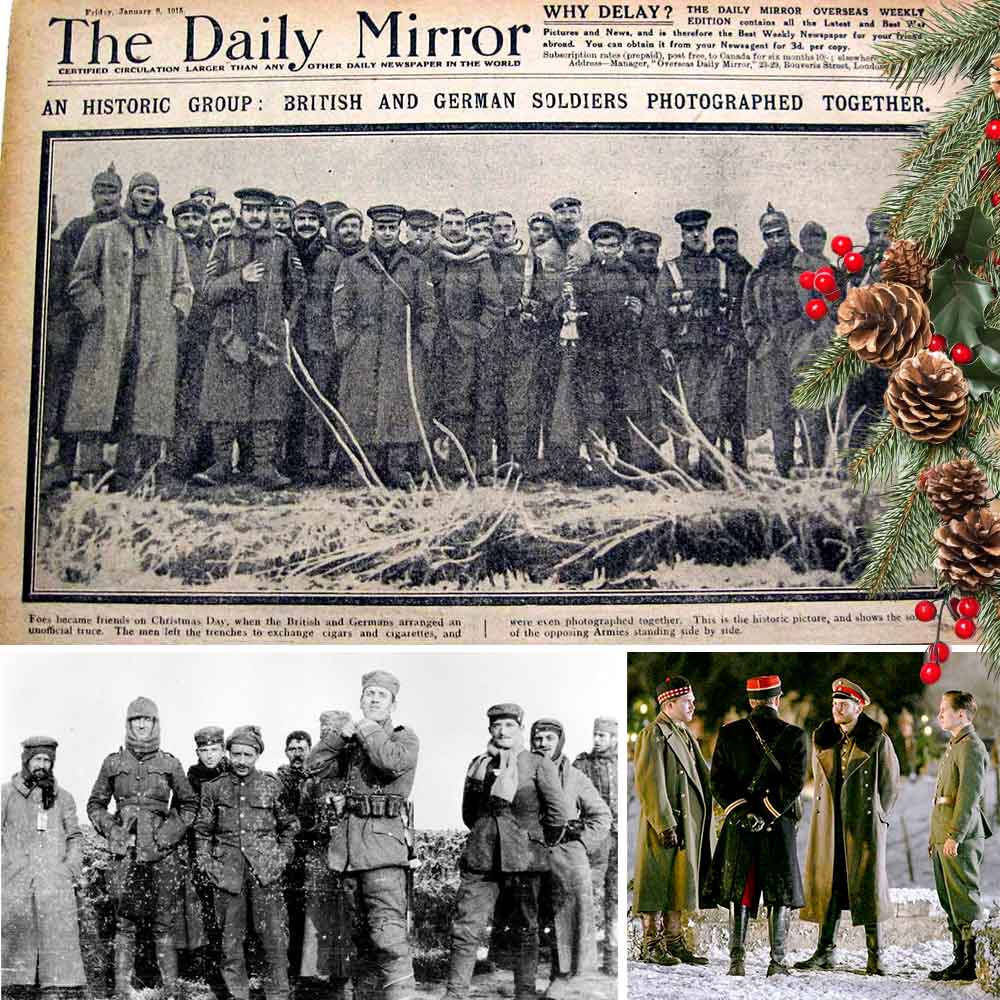
Top: The British Daily Mirror reporting on the unofficial festive ceasefire in its edition of January 8. Merely two weeks after the event, the newspaper rightly called the photo it published “historic”. Bottom left: British and German soldiers celebrate Christmas together on the Western front in 1914. Bottom right: A scene from the 2005 film Joyeux Noël, about the 1914 Christmas truce.
On the first Christmas of World War I, 110 years ago, enemy soldiers on the Western front decided that, just once, peace and goodwill should briefly reign on the battlefield. Günther Simmermacher looks at the Christmas truce of 1914.
Only a few hours earlier they had been trying to kill each other. Now they were exchanging biscuits, whisky, tobacco, souvenirs, stories and, above all, goodwill.
The unofficial Christmas truce of 1914, just over four months after hostilities commenced in the First World War, was a spontaneous outbreak of peace, entirely uncoordinated. It spread quickly across large sections of the front lines of Belgium and parts of France. Nobody is quite sure where exactly it began, though Ypres in Belgium is often mentioned. A cross there commemorates the occasion. Most commonly the initiative came from the German side of the trenches.

Even in this brutal war, there often were short periods of secession of hostilities, normally at breakfast. At other times, the warring sides would agree to stop shooting to allow soldiers to collect the rotting corpses and body parts of their comrades in No Man’s Land, the area of the front lines which separated the two hostile positions. In the course of that grisly job, soldiers would often interact.
At Christmas, German front soldiers in the trenches tended to put up small tabletop Christmas trees, decorated with lit candles. It is the German custom to celebrate Christmas in the evening of December 24. That first Christmas of the Great War was no exception. German soldiers were singing Christmas carols, some of which, such as “Silent Night”, were familiar to their British counterparts.
Taken aback by this curious and non-martial behaviour, British officers ordered that no shots were to be fired, but that the situation be monitored.
The carols would be followed by exchanges of seasonal greetings across the trenches. In some positions, German soldiers (and even officers) invited their enemies to come over to their side for a visit. Having ascertained the sincerity of the Germans’ purpose, the British would cautiously accept the invitation, and on occasion even reciprocate.
Graham Williams of the Fifth London Rifle Brigade recalled: “First the Germans would sing one of their carols and then we would sing one of ours, until when we started up ‘O Come, All Ye Faithful’, the Germans immediately joined in singing the same hymn to the Latin words ‘Adeste Fideles’. And I thought, well, this is really a most extraordinary thing — two nations both singing the same carol in the middle of a war.”
Football on killing fields
In at least one position, English and German soldiers engaged in a game of football. In Plooegsteert, Belgium, the Germans beat the Scottish regiment by 3-2. It is uncertain whether it was this match or another which had to be abandoned when the ball struck a barbed wire and deflated.
Cynicism wasn’t entirely absent, though. British soldiers took advantage of visiting the German trenches to scrutinise them for weaknesses in the enemy’s defences, with a view to exploiting these when hostilities would resume (presumably the Germans did the same).
Bruce Bairnsfather, a war cartoonist who observed the Christmas truce first-hand, wrote soon after the event: “There was not an atom of hate that day, and yet, on our side, not for a moment was the will to war and the will to beat them relaxed. It was just like the interval between rounds in a friendly boxing match. I wouldn’t have missed that unique and weird Christmas Day for anything.”
Bairnsfather was unimpressed with the Germans he met, though, calling them “unimaginative products of a perverted culture”. Arthur Conan Doyle, creator of Sherlock Holmes, took a more romantic view of the truce, calling it “one human episode amid all the atrocities which have stained the memory of the war”.
A German soldier, in a letter home, summed up what likely was a widespread sentiment: “It was a day of peace in war. It is only a pity that it was not a decisive peace.” If it had been decisive, the youth of several countries might have been spared the horrors of the Somme, Verdun, Passchendaele or Arras.
‘We’ll aim high’
In some areas the truce lasted only until midnight on Christmas Day, in others up to New Year’s Eve. In some positions, zealous snipers or immoderately ambitious junior officers would periodically interrupt the ceasefire. These, however, were isolated incidents.
One chronicle from the Messines Ridge, by British soldier Henry Williamson, records that a Saxon soldier warned him that the Germans would resume fire on New Year’s Eve. But even then, the German assured, they would “aim high, well above our heads. Would we, even so, please keep under cover, lest regrettable accidents occur”.
One British officer recalled the gentlemanly conclusion to the truce at his position on December 26: “At 8:30, I fired three shots into the air and put up a flag with ‘Merry Christmas’ on it on the parapet. [The German] put up a sheet with ‘Thank You’ on it, and the German captain appeared on the parapet. We both bowed and saluted and got down into our respective trenches, and he fired two shots into the air — and the war was on again.”
Resentment to truce
The truce was not popular in France. In positions where Germans fought French troops, the likelihood of a ceasefire was remote. After all, the Germans were the invaders. Indeed, the French populace even resented the British soldiers for ceasing fire. Soldier Frank Richards recalled in his memoirs that French women spat at British troops when they heard “how we spent Christmas Day”.
One Austrian soldier of the 16th Bavarian regiment expressed his disgust as well. “Such things should not happen in wartime,” exclaimed Corporal Adolf Hitler. “Have you Germans no sense of honour left at all?”
Temporary ceasefires had not been uncommon in previous wars. The Boer War, just a decade and a half previously, had even presaged the famous World War I football match with an encounter of its own. The scale of the 1914 truce, however, far exceeded the localised respites of previous wars.
Official reaction to the truce was mostly predictable. The French and British governments and high commands especially were not amused. Sir John French, the British commander-in-chief, ordered that “any recurrence of such conduct” be prevented, and called “the local commanders to strict account, which resulted in a good deal of trouble”.
French general Victor d’Urbal wrote in a letter that men “who stay too long in the same sector become familiar with their neighbours opposite. This results in conversations and sometimes visits which often lead to unfortunate consequences” — like soldiers seeing the enemy as human.
News of the Christmas truce must have pleased Pope Benedict XV. A few weeks previously the Holy Father had called for a temporary ceasefire over Christmas — “that the guns may fall silent at least upon the night the angels sang”. While the German government was open to the idea, the Allies insisted that the war had to go on, Christmas or not.
After the improbable outbreak of Christmas peace, the enemies soon resumed their senseless mutual slaughter. Still, enemy soldiers would sporadically meet under ceasefire conditions on the battlefield — usually to clear it of the dead — and even hold joint prayer services. The hatred among peoples came from governments, not the soldiers.
Isolated incidents of later Christmas truces apart, the rest of the conflict would not see a repetition of “Tommy” and “Fritz” sharing the goodwill of Christmas amid the brutal madness of war.
Published in the December 2024 issue of the Southern Cross Magazine

- Vocations and Easter - April 6, 2026
- Shrines around the World: Our Lady of Beauraing - March 21, 2026
- St Patrick: From Slave to Apostle - March 17, 2026