Bishops Address Key Church Matters at SACBC Press Conference in Pretoria
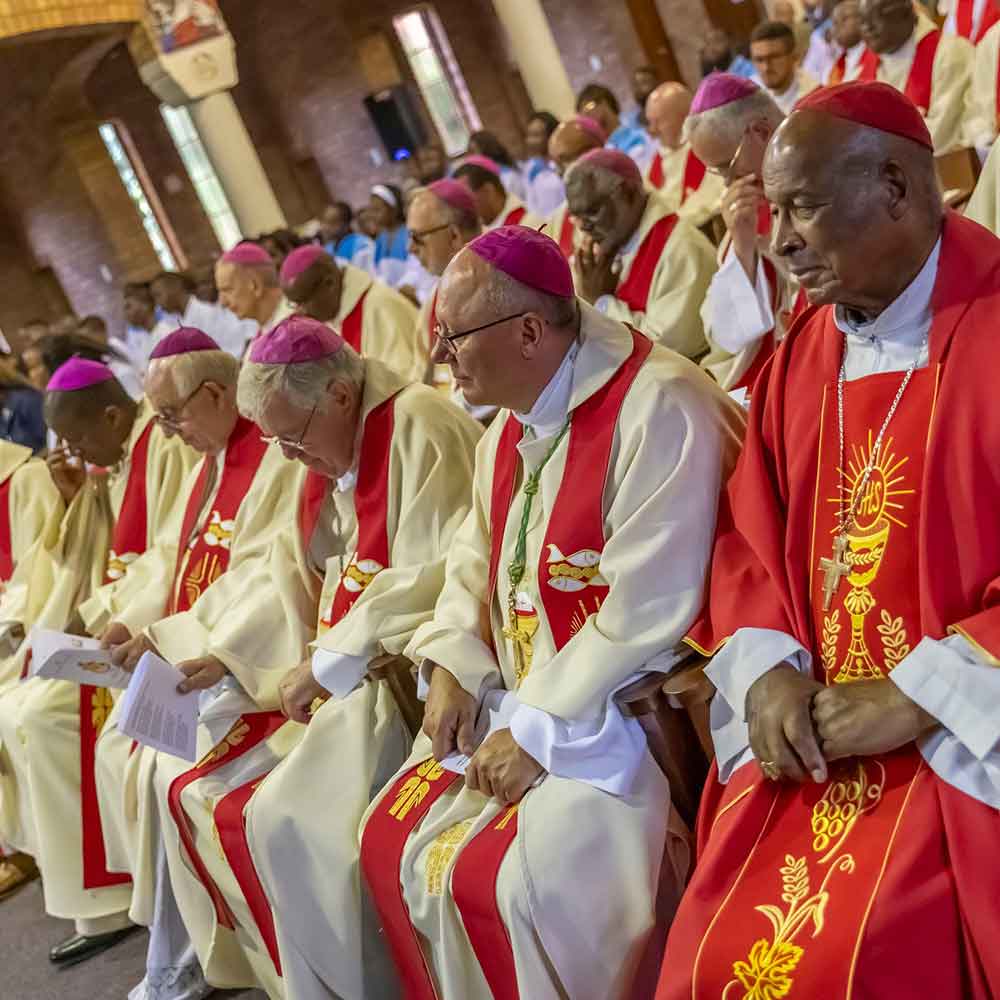
SACBC opening Mass at Plenary. Photo: Sheldon Reddiar, Sacred Photos
Fr Mathibela Sebothoma – At the conclusion of the Southern African Catholic Bishops’ Conference (SACBC) plenary and its official press conference held at Khanya House, the conference headquarters in Pretoria, bishops and senior clergy responded candidly and at length to questions from journalists.
The engagement touched on liturgy, governance, culture, vocations, synodality, social media, ecological concerns, and the future vision of the Church in Southern Africa, as the bishops continue celebrations marking 75 years of the Southern African hierarchy.
Feast of Blessed Benedict Daswa

Responding to questions on the liturgical observance of Blessed Benedict Daswa, Archbishop Dabula Mpako clarified that the proposal to observe his memorial on a Sunday across the conference is still awaiting approval from Rome.
“That is a proposal that still needs to be ratified by Rome,” Archbishop Mpako said. “So, this year is only the Diocese of Tzaneen that is going to celebrate the memorial on Sunday, because Blessed Benedict Tshimangadzo Daswa belongs to them.”
He added that the bishops intend making a formal representation to the Dicastery for Divine Worship to allow wider observance when the memorial falls on a Sunday. “We are going to make a representation… to approve that if it falls on a Sunday, that all the dioceses of this conference will then observe it,” he said.
Catholic Women’s League and Church Accountability
On matters concerning the Catholic Women’s League (CWL), Fr Hugh O’Connor explained the rationale behind the incorporation of the CWL into the Department for Formation, Life and Apostolate of the Laity of the SACBC.
“The incorporation of the Catholic Women’s League is part of what we are trying to move as a conference,” he said. Fr O’Connor emphasised that the bishops hold the name Catholic in trust, and that organisations using the name should do so with official ecclesial recognition.
“This is an attempt to recognise that the bishops hold in trust the name Catholic… when positive things are done in the name of the Church, that builds Church communion, Church unity, and it is for the common good,” he explained. At the same time, he noted concerns about organisations operating under the Catholic name without formal links to Church structures, prompting the move towards “greater transparency and greater accountability”.
Invitation to Pope Leo XIV
On the much-anticipated possibility of a papal visit to Southern Africa, Archbishop Mpako confirmed that the bishops have resolved to invite Pope Leo XIV to the region.
“We did make a decision that we are going to invite the Holy Father to visit Southern Africa,” he said, noting that preparations had already begun before the death of Pope Francis. He added that the process has gained renewed momentum following President Cyril Ramaphosa’s recent meeting with the Pope, during which the President endorsed the SACBC’s invitation.
“We are hoping that there will be a positive response,” Archbishop Mpako said, adding that the visit would likely include South Africa, Botswana, and Eswatini, with Lesotho also under consideration.
Ubungoma and the Church’s Theological Response
Addressing questions around ubungoma (traditional healing practices), Archbishop Zolile Mpambani explained that the SACBC had established a commission several years ago to research the phenomenon, particularly in response to growing interest among young people and the faithful.
“The commission worked very hard and last year they came up with the final document of their research,” he said. The bishops subsequently referred the document to the SACBC Theological Advisory Committee to ensure that the Church’s response is not only theoretical but also deeply theological.
He also contextualised a recent pastoral letter issued in Durban, explaining that it was an urgent local response addressed specifically to priests and religious. “It is not allowed for them to practise any ubungoma issues,” he reiterated, recalling earlier clarifications given to clergy on the matter.
World Day of Prayer for the Care of Creation
Fr O’Connor also spoke on the Church’s commitment to ecological justice, particularly in relation to the World Day of Prayer for the Care of Creation, observed on 1 September.
“Every Eucharist includes a celebration of creation through the bread and the wine,” he said, noting that a special Mass for the Season of Creation has been approved for that day. Any attempt to move such observances to a Sunday would similarly require special permission.
He highlighted the visible impact of environmental degradation across the region, from floods in Mozambique and Limpopo to storms in KwaZulu-Natal and prolonged droughts and fires in the Western Cape. “Care of creation remains an important mission and work of the Church,” he said, adding that the SACBC will continue providing resources and working ecumenically and with members of other religions.
Synod on Synodality: Progress and Challenges
As the bishop responsible for the Commission for the Implementation of Synodality, Archbishop Mpako acknowledged that progress across dioceses has been uneven.
“The process obviously is somewhat slow,” he said, noting that while some dioceses have established synodal teams, others are lagging behind. He emphasised that the responsibility ultimately rests with the local ordinary. “The commission is only there to enable, empower, support, but the bishop must take responsibility.”
Archbishop Mpako stressed that synodality is not merely a strategy but “the way of being Church,” and urged bishops, religious institutes, and formation houses to embrace it more fully. “We are hoping that as many leaders as possible will take this thing up more earnestly,” he said.
Proposed New Archdiocese in the Eastern Cape
On structural developments, Archbishop Mpako confirmed that the bishops have approved a proposal to establish a new archdiocese in the Eastern Cape, with East London identified as the centre, though a new name is being considered.
“There’s always been a need to have an archdiocese in the Eastern Cape,” he said. The proposal includes adjustments to surrounding dioceses, with Queenstown and Maletsoai suggested to merge into a new Diocese of Maletsoai-Komani. The plan will now be submitted to the Apostolic Nuncio, with final decisions resting with Rome.
There are plans to reconfigure all the dioceses in the SACBC region, but that is a long-term project.
Year of Saint Francis 2026
Fr O’Connor announced that 2026 will be marked as the Year of Saint Francis, generating enthusiasm within the Franciscan family locally and internationally. Proposed celebrations include pilgrimages and catechetical initiatives, with materials to be distributed by the Department for Catechetics, Liturgy, and Culture.
Vocations to Priesthood and Religious Life
Archbishop Mpambani addressed concerns over declining numbers at seminaries, including St Francis Xavier Orientation Seminary in Cape Town and St John Vianney Seminary.
“The numbers seem to be going down,” he said, underscoring the need not only to promote vocations but to “plant” them from a young age. He called for sustained engagement with children, youth, and young adults to foster a culture of vocation and service.
Social Media, Fake News, and Balance of Life
Responding to questions on social media, Fr O’Connor highlighted growing concerns about its addictive and destructive potential.
“Everyone suddenly becomes a journalist,” he remarked, pointing to the dangers of fake news and AI-generated content. He stressed the need for education, responsible use, and equipping parents, while also linking the issue to broader concerns about imbalance in modern life, including excessive academic demands on learners that undermine family, community, and church participation.
“As social beings, we need each other,” he said. “Yet there are many things today that take us away from one another.”
Looking Ahead: The Next 75 Years
Reflecting on the future of the Church, Archbishop Mpako said that synodality will remain central for the foreseeable years.
“We are called to be a synodal Church in mission,” he said, noting that implementation itself has become a multi-phased synodal process. He expressed hope that synodality would become the ordinary way of being and acting within the Church, not merely a theoretical concept.
Fr O’Connor concluded by linking the ongoing celebrations of the 75th anniversary to conversion and mission. “It’s not just about the party,” he said, “it’s about the change of heart and the impact that we can still make.”
Archbishop Mpambani added that bishops have been encouraged to ensure that the faithful at parish and household level understand not only the celebrations but the deep historical and spiritual significance of the Church’s journey in Southern Africa.
As the SACBC continues its anniversary year, the press conference offered a clear picture of a Church reflecting honestly on its challenges, while remaining committed to renewal, unity, and mission in a rapidly changing world.
- Bishops Address Key Church Matters at SACBC Press Conference in Pretoria - January 31, 2026
- Father Christmas, Capitalism and the Divine Gift of Ubuntu - December 24, 2025
- Remembering Father Charles Kuppelwieser: A Legacy of Compassion in South Africa - February 25, 2025