Cardinal Stephen Brislin’ s First Anniversary as Johannesburg’s Shepherd
By Kati Dijane – On Sunday, 25 January 2026, the Archdiocese of Johannesburg marks a significant milestone: one year since the installation of Cardinal Stephen Brislin as metropolitan archbishop. From Rome to Johannesburg, consistory halls to parish pews, as well as added responsibilities, it has been an intense and busy year for Cardinal Brislin.
Far from a quiet settling-in period, the cardinal’s first year has unfolded against the backdrop of global Church moments, national leadership responsibilities and the daily pastoral life of one of Southern Africa’s largest dioceses. Yet, as he reflects on the journey, his words are anchored not in busyness, but in gratitude and trust.
From the Vatican to Johannesburg

One of the defining moments of the past year was Cardinal Brislin’s participation in the recent consistory in Rome — a gathering that brought together approximately 170 cardinals from across the world. Shortly after the consistory concluded on 8 January 2026, he found himself participating in a late-night media briefing, responding to questions from international journalists on behalf of the Church.
“I did not volunteer,” he recalls simply. “I was approached and requested to be part of it.”
The briefing itself stretched well into the night, beginning later than planned after the consistory session ended. Yet the lateness of the hour did not dull the importance of the discussion. Among the four key themes on the agenda, synodality emerged as a central concern and a topic that, Cardinal Brislin notes, resonated strongly across the groups.
“What struck me was the respectfulness of the discussion,” he says. “There were divergent views, yes, but also a strong sense that synodality must continue with greater clarity.”
For many cardinals, the question was not whether synodality should endure, but how it should be understood within the Church’s hierarchical structure. “The consensus,” he reflects, “was that we want the synod and synodality to be successful. There was no sense of wanting to stop it.”
An unexpected appointment
Cardinal Brislin describes his appointment to Johannesburg as entirely unexpected. After 15 years in Cape Town, the move required tying up longstanding commitments, relocating and beginning anew, all while the global Church experienced historic moments, including the passing of Pope Francis, the papal funeral, the conclave and the installation of the new pope, Pope Leo XIV.
At the same time, he continued serving as Apostolic Administrator of Cape Town, while being the president of the Southern African Catholic Bishops’ Conference (SACBC).
“It has really been quite an intense year,” he admits.
And yet, despite the pace, his reception in Johannesburg has been deeply affirming. “I have been extraordinarily well received,” he says warmly. “I feel very happy here.”
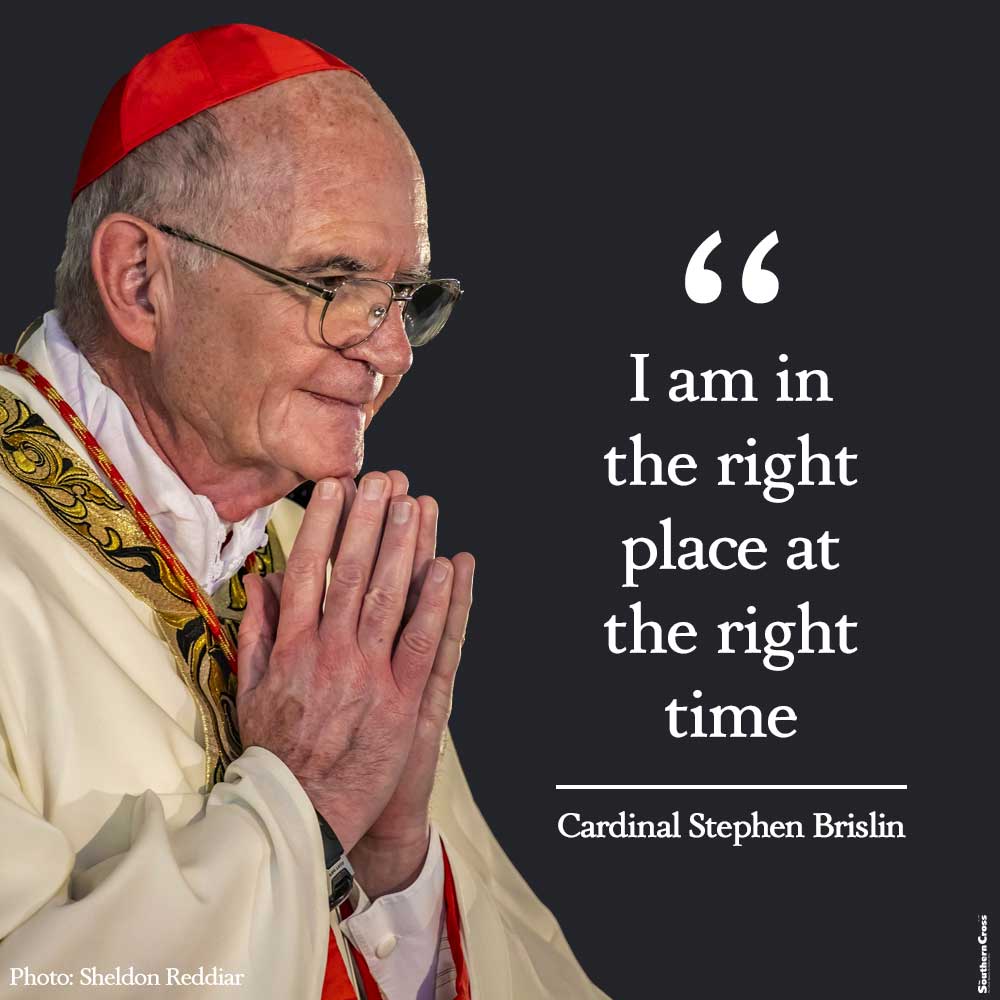
While he acknowledges missing Cape Town, the people and relationships built over a decade and a half, he speaks with unmistakable conviction about Johannesburg. “I immediately felt that I am in the right place at the right time.”
Shepherding a third diocese
Johannesburg marks Cardinal Brislin’s third diocese, following Kroonstad and Cape Town. Each, he notes, has been profoundly different and each has shaped his leadership approach.
“You cannot come into a new place with fixed ideas,” he explains. “You have to arrive with openness to learn, to listen and to understand how people live their faith.”
For Johannesburg, a vast archdiocese of approximately 1.1 million Catholics, communication has emerged as a key priority for the cardinal. With its many parishes, religious congregations and initiatives, Cardinal Brislin believes stronger systems of communication are essential for building a unified diocese.
“People need to know one another, understand one another and share in what is happening,” he says.
His leadership style, rooted in listening and accompaniment, aligns closely with the spirit of the Synod on Synodality. “It has come at a very appropriate time for me,” he reflects. “It’s about listening to people and encouraging the initiatives that already exist.”
Faith alive in the parishes
As he has visited parishes across the archdiocese, Cardinal Brislin has been struck by what he describes as the “depth of faith”, particularly among young people.
“There is such love for the Church,” he says. “It has been deeply inspiring.”
Yet he is also honest about the challenges facing the Church in South Africa, including lingering social divisions. “We tend to remain in our own cultural spaces,” he observes. “But we are one Catholic Church, and we must find ways of breaking down those barriers.”
Building unity, he believes, is not only Johannesburg’s task but a national one.
Wearing many hats, guarding balance
In addition to shepherding Johannesburg, Cardinal Brislin serves as the president of the SACBC and as a member of two Vatican dicasteries: the Dicastery for the Clergy (appointed August 2025) and the Dicastery for the Causes of Saints (appointed October 2023). The responsibilities are many, and the demands significant, but he is clear that delegation and trust are essential.
He speaks with gratitude of his vice-presidents of the SACBC, Archbishop Zolile Mpambani SCI and Archbishop Siegfried Jwara CMM, and of the clergy and staff who ensure continuity when he travels. “Delegation is very important,” he says. “We have very competent people.”
Mindful of personal well-being, he takes a weekly day at a gentler pace and finds joy in simple routines, including walking his two dogs. “A lot depends on the grace of God,” he says. “And trusting Him to work through us.”
Importantly, he refuses to sacrifice time with people for administrative tasks. “I love people,” he says simply. “Being with them is essential.”
Seventy-Five years of a mature church
This year also marks 75 years since the establishment of the Catholic hierarchy in Southern Africa, a milestone Cardinal Brislin describes as a moment of maturity and gratitude.
“The Church in Southern Africa has reached a stage of maturity,” he reflects. “And I think it is increasingly appreciated within civil society.”
Yet celebration must be paired with mission. In a country grappling with poverty, unemployment and corruption, he believes the Church’s role is to witness to Christ through love, justice and compassion.
“How do we bring hope?” he asks. “How do we give courage to people facing the future?”
Hope found in ordinary encounters
As the Jubilee of Hope drew to a close, Cardinal Brislin says his own hope is renewed not primarily through grand celebrations, but through quiet, human encounters.
“You meet someone who is struggling and yet they are joyful, trusting in God,” he says. “That faith inspires hope in us.”
His message, after a year marked by transition and trust, is both simple and profound: “Let us look to the future together. United, hopeful and committed to building the Kingdom of God.”

- Blessed Benedict Daswa Pilgrimage at Mother of Mercy Shrine - March 25, 2026
- Archbishop Sipuka Takes Possession of St Mary’s Cathedral - March 16, 2026
- Young designer from Ratanda wins Archdiocese of Johannesburg youth logo competition - March 10, 2026