
Sr Majella Quinn’s Life of Service
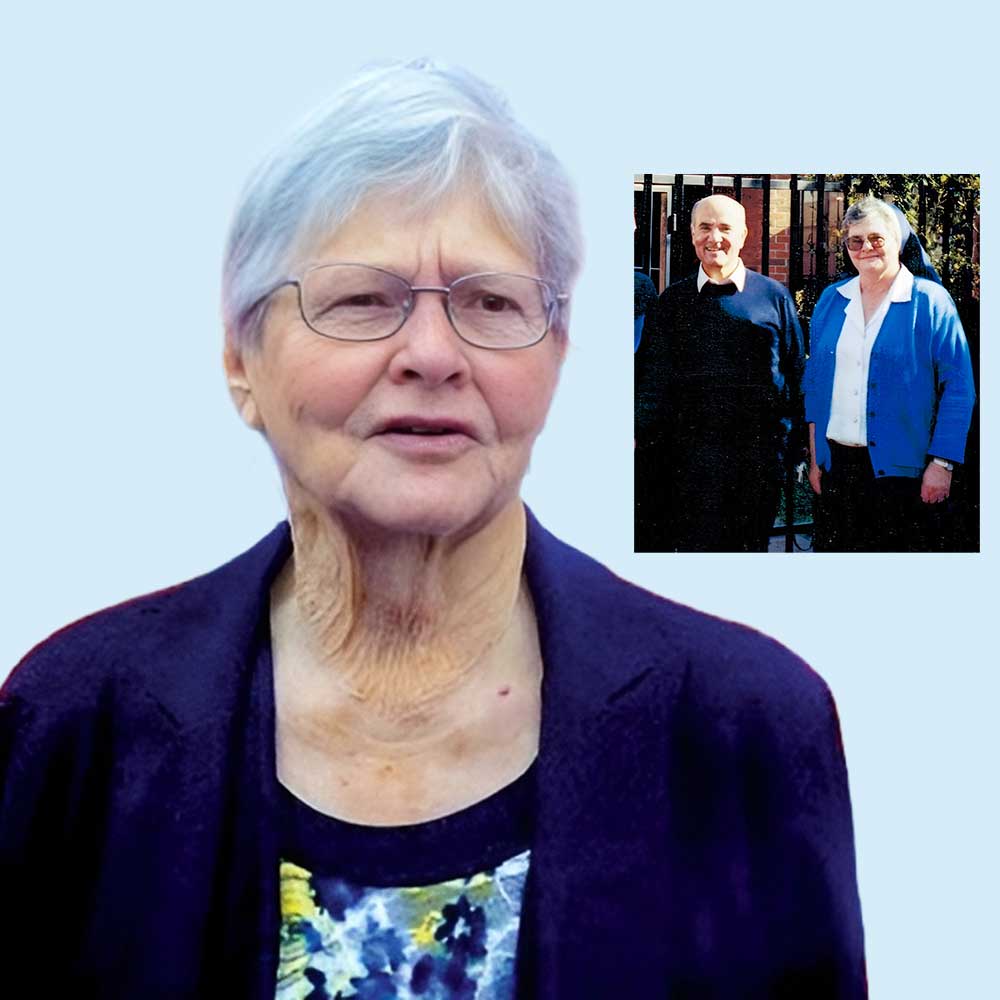
Inset: Sr Majella Quinn with the late Stigmatine Father Michele D’Annucci, with whom she co-founded Tsogo High School in Mmakau, North West, in 1975. Sr Majella was the school’s first principal.
Mercy Sister Majella Quinn spoke to Daluxolo Moloantoa about her vocation, which 65 years ago took her from rural Ireland to South Africa, where she co-founded a hugely influential Catholic high school.
Long before she became a Sister of Mercy, Sr Majella Quinn was a farm girl from Campile in County Wexford, in southeastern Ireland. Born Mary Quinn on June 22, 1939, in a whitewashed farmhouse, she was the eldest of nine children in a hardworking Catholic family.
Her father farmed peas and corn, and the family lived largely off what they produced. “Everyone had their role. The boys milked the cows, and the girls helped in the house. We weren’t ladies of leisure,” she recalls. “We didn’t have much, but we had enough — and we had each other.”

Rural Ireland was not immune to politics. Her father was in the Irish Republican Army, then still a liberation movement (rather than the banned paramilitary Provisional IRA). “He was fiercely loyal, fiercely Irish. It wasn’t something we questioned — it was simply part of who we were.”
Mary attended Horeswood Primary School, a Catholic institution tied to the local parish. “The teachers were very strict,” she recalls. “If you made a mistake, they’d carry out corporal punishment on you. That’s just how it was. But we learned.” Religious instruction was part of the daily routine. “Faith was part of the curriculum — and the priests made sure of that.”
Her home parish was served by three priests who were active in the community. “You had to go to Sunday Mass,” she recalls. “On Monday at school, you’d be asked: ‘Did you go to Mass? What did the priest say?’”
After primary school, Mary went to a Catholic girls’ boarding school in New Ross, run by the Sisters of Mercy. The town, bigger and busier, had several Catholic schools run by different congregations.
The Sisters were strict and Mass was daily. “Sr Oliver — God rest her soul — was the head. We all hated her at the time. She was stern beyond words, sharp as a tack, and always watching. But looking back now… we know she was fair. She cared. She gave everything to that school, to us. The Sisters didn’t just teach us lessons — they shaped our lives.”
The call to vocation
Mary first felt a calling to the consecrated life in late 1959. “I didn’t know it then, not in any full or certain way, but something began to settle in my spirit. A stillness, a seriousness, a sense that life had a deeper path waiting for me.”
After high school, she didn’t return home. “I found myself drawn to the convent, not just the building, but the life it held. A life of service, of prayer. By the time I left, I knew I was being called.”
She entered the postulancy with the Mercy Sisters in New Ross, then moved to Limerick for the novitiate. Of the 15 postulants, seven were preparing for mission assignments in Africa.
Towards the end of her postulancy, visiting Sisters from St Teresa Mother House in Rosebank, Johannesburg, asked who might be interested in the South African mission. “I wrote my name down. It was a small act. But it changed everything,” says Sr Majella, who took her religious name after St Gerard Majella, an 18th-century Redemptorist lay Brother.
She arrived in South Africa in 1960 with four fellow Sisters. “I was 21, uncertain but willing. The plane touched down, and I stepped into a world I couldn’t have imagined. I remember the singing, voices welcoming us as we stepped through those gates.” At St Teresa convent, they were met by the superior, Mother Gabriel, “a woman of quiet power and deep kindness. She welcomed us with the utmost warmth.”
Sr Majella expressed a wish to teach. Mother Gabriel suggested she enrol at Johannesburg College of Education — but first came two years of religious formation. In 1963, she finally enrolled for a secondary teachers’ diploma. After graduating in 1965, Sr Majella earned a BA in education from UNISA.
She began teaching mathematics at St Teresa Convent School and later at McAuley House, both in Johannesburg.
Founding a school
In 1973, Stigmatine Father Michele D’Annucci asked the Mercy Sisters to start a school in Mmakau, in what is now North West Province. Initially, Mother Gabriel declined, citing stretched resources. “Fr Michele was not one to accept a no,” Sr Majella notes. He returned weeks later to renew his appeal, and the Sisters agreed to collaborate with the Stigmatines. Srs Majella, Myra Milburn and Xavier Guiry were appointed to lead the project, commuting daily from Pretoria to what was then Bophuthatswana.
Named Tsogo High School, it opened on January 18, 1975, with 71 students. Sr Majella was its founding principal. The name Tsogo means “resurrection” in Setswana, reflecting Fr D’Annucci’s vision: “We are the people of the Resurrection.” It symbolised the revival of Catholic education for black students in Pretoria after the apartheid-era closure of Little Flower High in Lady Selborne.
By 1976, Tsogo High already had a reputation for rigour and values-based teaching. “It wasn’t always easy — those were difficult times,” she recalls. “The weight of apartheid hung over everything.” After the 1976 uprisings, Tsogo became a political flashpoint. Perceived as “white-run” because of its administration by missionary nuns, the school faced boycotts from one side and police scrutiny on the other. Activists, hunted by the apartheid police, often sought refuge, food or transport money from the Sisters. Despite harassment and even brief detentions, they continued quietly helping.
“We were determined to offer a good education to anyone who needed it. Many converted to the faith, not because they were pressured, but because of the quiet witness of community,” Sr Majella says.
One year, more than 600 applicants had to be turned away. “People came from everywhere — Soweto, the East Rand. They would do anything to get their children in.”
‘We were blessed’
Looking back, Sr Majella believes that Tsogo High was blessed. “From the moment we opened the doors, something greater was guiding us.” She credits the staff, especially lay teachers, with shaping students’ lives. “They didn’t just fill classrooms — they transformed mindsets.”
Tsogo High produced many notable alumni, including Bishop Victor Phalana of Klerksdorp, business tycoon Patrice Motsepe, broadcaster Tim Modise, Eskom CEO Dan Marokane, sports administrator Cecilia Molokoane, and the late academic and author Dr Gomolemo Mokae. From the late 1980s to mid-2000s, Tsogo High maintained a 100% matric pass rate. “I don’t believe there’s any black school in South Africa that has produced as many university professors as Tsogo,” Sr Majella says.
She later led McAuley House and then St Matthew’s School in Soweto during the political unrest of the early 1990s. Despite ongoing threats, she never closed the school.
Now retired at Iona convent in Pretoria, Sr Majella still attends events and stays in touch with former pupils. Many credit her influence, but with characteristic humility, she resists taking individual credit. “It wasn’t about me,” she says. “It was the teachers. Their devotion didn’t just teach — it healed, lifted and inspired.”
Sr Majella’s life reflects the era she lived through — one of struggle, service and quiet resistance. “It’s amazing what faith, teamwork and prayer can build, especially in the middle of chaos.”
She adds: “My generation of Sisters inherited values from those who came before us. We didn’t invent them — we carried them forward. Those values still guide me.”
Published in the October 2025 issue of The Southern Cross magazine

- Cameron Upchurch: Making Music fit for God - February 27, 2026
- Sr Majella Quinn’s Life of Service - February 9, 2026
- Moloantoa and Seleke Present Inspiring Catholic Memoirs to First Lady Dr Tshepo Motsepe-Ramaphosa - February 4, 2026



