Archbishop Sipuka Takes Possession of St Mary’s Cathedral
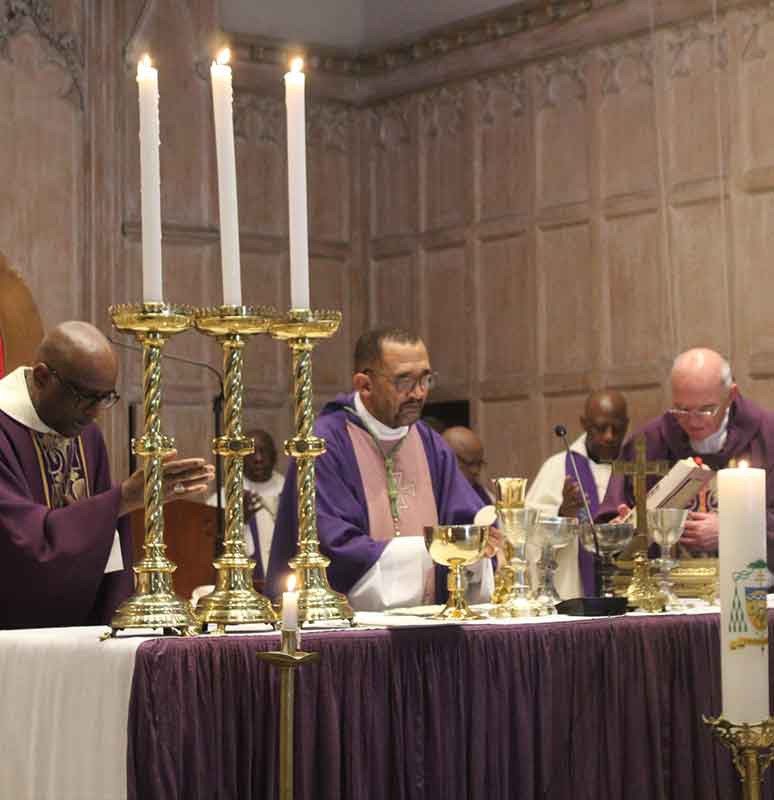
Archbishop Sipuka’s first Mass at St Mary’s Cathedral. (Photo: Kati Dijane)
By Kati Dijane – On Sunday, 15 March 2026, Archbishop Sithembele Anton Sipuka officially took possession of the cathedra at St Mary’s Cathedral, Cape Town, marking the formal beginning of his pastoral ministry as archbishop of the Archdiocese of Cape Town.
The solemn celebration followed his installation the previous day at the GrandWest Arena, where thousands of clergy, religious, civic leaders and faithful gathered to welcome their new shepherd. Archbishop Sipuka succeeds His Eminence, Cardinal Stephen Brislin, who served the archdiocese for nearly 15 years before being transferred last year to lead the Archdiocese of Johannesburg.
For Archbishop Sipuka, the moment marked the beginning of a new chapter in a ministry that has already spanned many years of service to the Church in South Africa. Until his appointment to Cape Town, he served as bishop of the Diocese of Mthatha, where he had been shepherd since 3 May 2008.

As the eleventh bishop and fifth archbishop of Cape Town, he is now entrusted with one of the country’s most historic archdioceses. He begins his ministry with a vision centred on faith, unity and mission.
A Gospel reflection on seeing
In his homily during the Mass at the cathedral on Sunday, Archbishop Sipuka reflected on the Gospel of John (John 9:1–41), the account of Jesus healing the man born blind. The passage, traditionally proclaimed during Lent, speaks about the difference between physical sight and spiritual insight.
Drawing from his experience the previous day at the installation celebration, the archbishop shared a personal reflection.
Looking back at the gathering at the arena, he recalled seeing people seated in wheelchairs among the thousands present. While they had been properly accommodated and visible in the crowd, he realised afterwards that he had not specifically acknowledged them during the celebration.
“I saw them with my eyes,” he admitted, “but I did not see them with awareness and inclusion.”
This realisation, he explained, became a powerful illustration of the Gospel’s message. Just as the man in the Gospel lacked physical sight but eventually came to recognise Jesus, those who can see physically may still suffer from another kind of blindness, the inability to recognise what God is doing before them.
“There are many forms of blindness in our lives,” he said. “Blindness to the struggles of others, blindness to our own comforts and blindness to what God is doing right in front of us.”
From blindness to faith
Archbishop Sipuka reflected on the two forms of blindness presented in the Gospel narrative.
The first is the physical blindness of the man who was healed by Jesus, a condition beyond his control. The second, he noted, is the spiritual blindness of the Pharisees, who could see physically but refused to recognise the work of God unfolding before them.
“The tragedy,” he said, “is not that the man was born blind. The tragedy is that those who could see refused to believe.”
The archbishop explained that spiritual blindness remains a challenge for all believers. People may observe events around them but fail to perceive God’s presence and action within those events.
During Lent, the Church invites the faithful to examine their lives and recognise their shortcomings, including pride, indifference, prejudice, selfishness and unconscious exclusion of others. Yet Archbishop Sipuka emphasised that the Gospel calls believers to more than self-examination.
It also invites them to recognise the positive ways in which God is working in their lives.
“This Gospel is not only about seeing our sins,” he said. “It is also about seeing what God is doing in our lives.”
He described the spiritual journey of the healed man as a movement from blindness to faith. At first, the man simply refers to “the man called Jesus.” Later, he recognises him as a prophet. Eventually, he declares that Jesus must be from God. Finally, when Jesus reveals himself fully, the man professes his faith and worships him.
“It is a journey from blindness to sight, from sight to insight, from insight to faith,” the archbishop explained.
Seeing with the eyes of faith
The archbishop encouraged the faithful to learn to see life through the eyes of faith. Faith, he said, enables Christians to interpret the realities of life more deeply.
Illness, for example, may appear simply as suffering, yet it can also reveal opportunities for compassion and solidarity.
The Church is not merely a social institution or a Sunday routine, but the living presence of the risen Christ in the world, the archbishop said.
The Mass is not simply a ceremony, but the sacrifice of Christ made present among believers.
Acts of charity are not only philanthropic gestures but participation in Christ’s healing work.
Similarly, life itself is more than a career path or pursuit of success. For believers, it is a journey toward God. Marriage becomes not merely a contract but a covenant of self-giving love that reflects Christ’s love for the Church.
Even life’s hardships, such as failures, losses and disappointments, can be understood in the light of faith as moments through which God leads people toward deeper life.
“We see the same things that others see,” he said, “but we see them differently because of faith.”
The power of encounter
At the heart of the Gospel story, the archbishop noted, is a simple yet powerful testimony from the healed man:
“All I know is that I was blind and now I see.”
This statement reflects the transformative power of a personal encounter with Christ. The man’s conviction does not come from theological debates or institutional authority but from his own experience of healing.
For Archbishop Sipuka, this experience mirrors the journey of many believers. Some encounter Christ through repentance and conversion, others through discovering the Eucharist more deeply, and still others through recognising Christ in the poor and suffering.
Lent, he said, is a time to ask an important question:
Where is the Lord opening our eyes today?
If believers allow Christ to transform their vision, he explained, they will move from mere religious routine to a living relationship with God.
Only then can faith become a source of joy and authentic love for others.
Taking possession of the cathedral
As Archbishop Sipuka formally took possession of the cathedral, the seat of the archbishop’s teaching authority, he prayed that God would continually open his own eyes as he began his ministry in Cape Town.
He acknowledged the size and importance of the archdiocese but emphasised that his focus must not be on its prestige. Instead, he hopes to see the archdiocese as a community of people united in faith.
“I pray that I may see in this enormous archdiocese not just its grandeur,” he said, “but the spiritual home of God’s people.”
He expressed his desire to encounter Christ in the lives of the faithful he will serve and to lead them toward deeper faith.
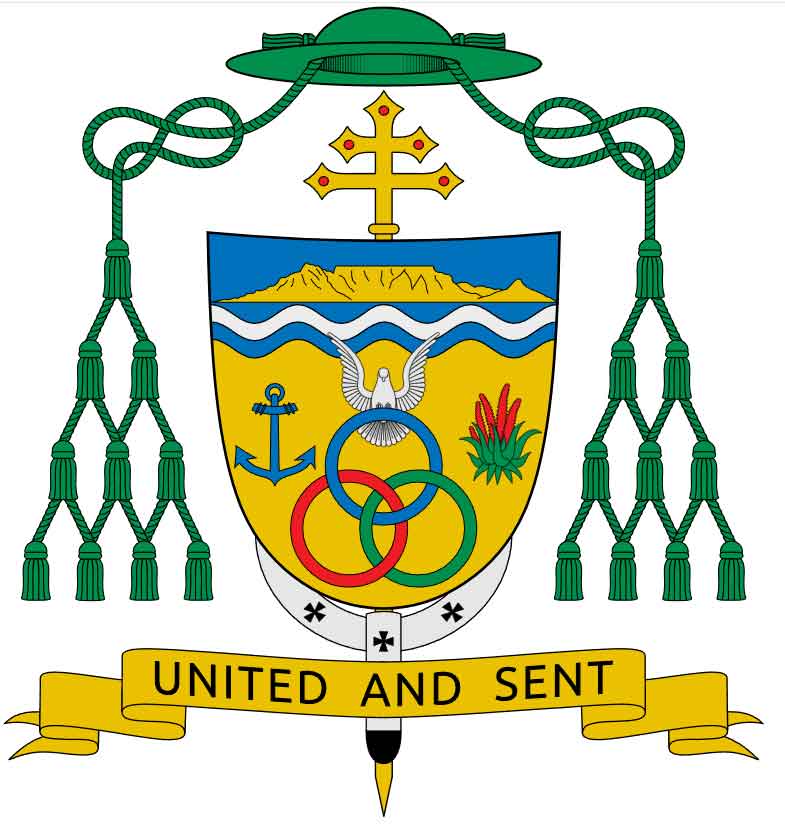
Archbishop Sithembele Sipuka Coat of Arms
Explaining his coat of arms
Archbishop Sipuka’s pastoral vision is reflected in his episcopal motto: “United and Sent.”
The motto, rooted in Jesus’ prayer for unity and his call to mission, summarises the archbishop’s hope for the Church in Cape Town. Christians, he said, are called to unity across differences of race, language, culture and social background. Yet this unity is not meant to remain inward-looking. Instead, it must inspire believers to go out and serve the world through evangelisation and acts of compassion.
Coat of Arms:
- Table Mountain, the iconic landmark of Cape Town, represents the archdiocese and its identity as a place of hope at the Cape of Good Hope.
- The waves beneath it symbolise the meeting of the Atlantic and Indian Oceans, reflecting the convergence of cultures and peoples in the city.
- An anchor recalls Cape Town’s history as a harbour and symbolises the Christian hope anchored in Christ.
- At the centre are three interlocked rings, representing the diverse people of Cape Town united as one Body of Christ and reflecting the unity of the Holy Trinity.
- Above them appears the dove of the Holy Spirit, reminding believers that unity and mission are sustained by God’s Spirit.
- Finally, the aloe plant symbolises the Eastern Cape, Archbishop Sipuka’s birthplace and the region where he ministered for many years as bishop of Mthatha. The plant represents resilience and healing, reflecting the spiritual roots he brings into his new mission in Cape Town.
A shepherd for the Church and society
Beyond his responsibilities as archbishop, Sipuka plays an important role in broader church and civic life. He currently serves as president of the South African Council of Churches and is a member of the Dicastery for Interreligious Dialogue at the Vatican.
Within the Southern African Catholic Bishops’ Conference, he also serves as chairperson of the finance committee and president of the Catholic Board of Education.
These roles reflect his longstanding commitment to dialogue, education and cooperation between faith communities and society.

- Blessed Benedict Daswa Pilgrimage at Mother of Mercy Shrine - March 25, 2026
- Archbishop Sipuka Takes Possession of St Mary’s Cathedral - March 16, 2026
- Young designer from Ratanda wins Archdiocese of Johannesburg youth logo competition - March 10, 2026