Hollywood’s official religion
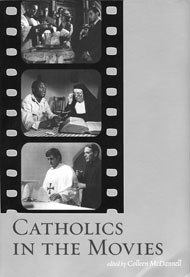
CATHOLICS IN THE MOVIES, edited by Colleen McDannell. Oxford University Press, New York. 2008. 362pp
Reviewed by Günther Simmermacher
 For a quarter of a century the Catholic Church ruled Hollywood, throughout what is known as its “golden age”, to the point that Catholicism could be called American film’s official religion. No movie could be made without first going through the offices of the Legion of Decency which prescribed what was morally acceptable for depiction on film. The censorship imposed by the so-called Breen Office (later Johnston Office) was backed up by the threat of a hierarchy-backed Catholic boycott not only of a condemned film, but of all cinemas exhibiting it.
The power of the Legion of Decency, which could become virulently nasty, represented the affirmation of Irish Catholics in the American mainstream. Just half a generation earlier, the urban Catholic immigration classes — Irish, Italian, Polish — were marginalised and condescended to by America’s Anglo-Saxon Protestantism. It is at this point in US history that this erudite collection of essays of Catholics in the movies begins. Charting the evolution of Catholic depiction in and influence on American cinema — and thereby the social progress of US Catholicism — in 14 chapters, the journey begins in 1915 with the film Regeneration.
It is tempting to reduce the silent movie era to the comic antics of Charlie Chaplin and the Keystone Cops, flapper hedonism and over-emoting mugging. But the era also produced an abundance of sophisticated religious and social issues films. Regeneration, directed by Raoul Walsh (a disaffected Catholic), was a bit of both. Based on the memoirs of a Catholic, its message of redemption was profoundly Catholic, but presented Anglo-Saxon Protestantism as the agency for social and spiritual rehabilitation, quite at odds with the experience of the urban underclass of early 20th century New York City.

By the end of the silent era, American Catholicism had begun to assert itself in society, standing at the cusp of the mainstream. A Catholic, Al Smith, ran for the presidency in 1928, and Irish-American Catholics protested vigorously against defamatory portrayals of their own, such as the now lost and forgotten The Callaghans and the Murphys. Indeed, by now Catholics and Protestants frequently joined forces against, as one newspaper had it, “the Jews [who] control the film industry and…are using their power to demoralise this Christian country.”
By the mid-1930s, the studios censored themselves through their Production Code and externally through the Breen Office. Both demanded puritan morality in the movies, to the absurd extent that even married couples could not be shown in bed unless both partners kept one foot on the ground. And under the Legion’s moral guardianship, crime could never be seen as profitable. The book’s essay on 1938’s Angels With Dirty Faces, starring Pat O’Brien as a priest and close friend of James Cagney’s gangster, expands on these shifts in cinematic morality and spirituality in the 1930s.
A flurry of Catholic movies followed Angels With Dirty Faces and, from the same year, Boys’ Town, for which Spencer Tracy, who played Fr Flanagan, received an Oscar (beating the nominated O’Brien). The Song of Bernadette (1943) saw an unlikely convergence of Catholics and Jews in the production of this most devotional of mainstream films, based on the script by the Jewish writer Fritz Werfel who with his wife Alma (Gustav Mahler’s ex-wife) had found refuge in Lourdes before coming to America.
A year later, the Oscar-winning Going My Way, starring Bing Crosby as the hip, finger-snapping priest, redefined how US Catholics saw themselves by dispelling — alone by the set design — many old prejudices against the Church. Catholics in the Movies posits that Going My Way so much cemented the Catholic Church in the American mainstream as to help facilitate the election of a Catholic president 16 years later.
By the time Kennedy’s brief presidency had been cut short, the Legion of Decency was dead and its notion of moral guardianship discredited. Pompous movies such as The Cardinal, a paean to Catholic triumphalism, were now passé. Instead, fortuitously coalescing with the nascent spirit of Vatican II, a simple movie of deceptive depth offered a new brand of Catholic spirituality. In Lilies In The Field, the itinerant Sydney Poitier (an Oscar-winner for his performance) spars with a group of German nuns in their desert convent, arriving at an ecumenical, cross-racial understanding.
In the ’70s, Catholicism slowly mutated from being at the centre of a story to serve as an allegorical device, as it did in The Godfather trilogy. The Godfather chapter requires two readings — one before (re-)watching the movies, and one after watching them — to digest Carlo Rotella’s energising interpretative examination. This may sound excessively scholarly, but the chapter is peppered with wit (Rotella delightfully describes the third, and rather abysmal, Godfather film as “the Fredo of the litter”). The Godfather films also awakened a revival of ethnic consciousness in which the Catholic Church served as a marker of cultural identity, albeit often divorced from faith and redemption (for example Saturday Night Fever).
The most Catholic film of the era was 1973’s The Exorcist, which, as Timothy Meagher argues, has at its Jesuit core the Eucharist and self-sacrifice. At the other end of the spectrum, True Confessions (1981) almost relentlessly attacked Catholicism (or, at least, its perceived hypocrisy)
Some might argue that Kevin Smith’s Dogma (1999) was a blasphemous denunciation of the Church. In essayist Amy Frykholm’s view, Dogma is profoundly Catholic even as, or especially because, it calls for the reform, not the obsolescence, of the Church. Mel Gibson’s The Passion of the Christ, on the other hand, was warmly embraced by many in the Church and beyond. Described here as Gibson’s ex-voto offering, The Passion and Dogma essentially are both personal testimonies and reflections by two very different types of Catholics.
Catholics in the Movies, superbly edited by Colleen McDannell (a professor of religious studies who also contributed the chapters on The Exorcist and The Passion Of The Christ), works as a study in film scholarship and as a social history of American Catholicism in the 20th century. The level of analysis and research as well as theological insight is almost invariably imposing (one muddled discourse on papal infallibility apart). Though clearly aimed at an academic level, it is a thoroughly accessible collection.
Catholics in the Movies can be ordered in South Africa from Oxford University Books at (021) 596-1222 or

- Vocations and Easter - April 6, 2026
- Shrines around the World: Our Lady of Beauraing - March 21, 2026
- St Patrick: From Slave to Apostle - March 17, 2026