Pope to Angolan youth, women
By John Thavis
Meeting with nearly 30,000 Angolan young people, Pope Benedict XVI urged them to be wary of today’s dominant social culture and to shape the world according to the values of the Gospel.
The encounter in a Luanda soccer stadium March 21 was marred by a stampede that killed two young women and injured 89 others, hours before the pope arrived. The pope was informed of the tragedy later that evening and he expressed his condolences at a Mass the next day.
Participants at the rally did not learn until afterward of the deaths, and the festive encounter went on as scheduled. It had a little bit of everything: native dance and song, testimonials from young Catholics, conga ensembles and, above all, tons of enthusiasm among the participants.
The focus of the pope’s talk was a simple lesson on how to live the good life. “My young friends, you hold within yourselves the power to shape the future,” he said. But it won’t happen without an encounter with God, he said. “The dominant social culture is not helping you to live by Jesus’ word or to practice the self-giving to which he calls you in accordance with the Father’s plan,” he said.

Instead, he said, they need to build their lives around the renewal that begins with a personal encounter with Christ. That’s especially important when it comes time to make decisions that involve a lifelong commitment, like marriage, that can seem to represent a loss of freedom, he said.
“These are the doubts you feel, and today’s individualistic and hedonistic culture aggravates them,” he said. But he urged them to find inspiration in their faith.
“Life is worthwhile only if you take courage and are ready for adventure, if you trust in the Lord who will never abandon you,” he said.
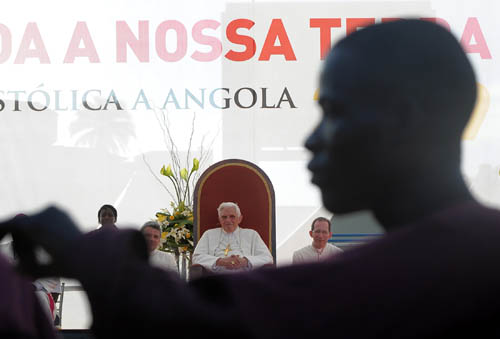
Pope Benedict XVI watches a dance performance by Angolan youths during a rally at Coqueiros Stadium in Luanda. (CNS photo: Alessia Giuliani, CPP)
The pope also greeted a group of young people who were left orphaned or disabled by Angola’s 27-year civil war, and said he could imagine the conflict’s devastating effects on all the country’s young people.
“I think of the countless tears that have been shed for the loss of your relatives and friends. It is not hard to imagine the dark clouds that still veil the horizon of your fondest hopes and dreams,” he said.
The pope spoke from beneath a large yellow tent in Coqueiros Stadium, under a hot late afternoon sun. He looked uncomfortable in the heat, and several youths who had spent hours awaiting his arrival suffered heat exhaustion and had to be taken away by stretcher.
The 81-year-old pontiff watched costumed dancers kick up a storm as a conga group pounded out the rhythm, their long yellow wigs shaking to the beat. Then a group of barefoot young women performed a hip-thrusting dance on the grass in front of the papal platform.
In the stands, youths held up pieces of coloured cardboard in synchronized patterns, spelling out “God is love” and depicting the pope’s own smiling face.
Several young Angolans spoke about their own spiritual paths and experiences, including detours into drugs and alcohol use, discouragement and loneliness. One of them told how he was welcomed into the church after a life of stealing and addiction, and later became a priest.
One young woman, Elsa Montenegro, said that even those active in the church don’t have an easy time putting the faith into action. The challenges, she said, are many and can seem overwhelming: unemployment, corruption, drug use, prostitution, AIDS, abortion and dishonesty.
“Holy Father, we are asking you to enlighten us, help us, advise us, orient us,” she said.
After delivering his talk, the pope greeted many of the performers individually. A final, haunting song was sung directly in front of the pope by a young man in a wheelchair. The pope embraced him warmly after the performance.
The young people presented the pope with several gifts, including a carved ebony statue of a gazelle and a wood-and-gourd balafon, the xylophonelike instrument popular throughout Africa.
The encounter was broadcast live throughout Angola, and organizers considered it one of the most important events of the papal visit. About half of Angola population is under age 15, and church leaders said many are deeply worried about their future.
The stampede occurred when authorities opened the gates of the stadium about four hours before the pope’s arrival. The two women, both 20 years old, died after being taken to a hospital, and news of the tragedy was made public late in the evening.
At an outdoor Mass the next day, the pope prayed for the victims, their families and the injured. Cardinal Tarcisio Bertone, Vatican secretary of state, visited relatives one of the victims at a Luanda hospital March 22, expressing the pope’s sympathies. The woman, named Celine, was a catechist at a Luanda parish who had held her last lesson the morning of her death. At the time, the other victim had not been identified.
In a meeting with women’s organisations the next day, Pope Benedict strongly defended women’s rights and praised the many “silent heroines” of Africa who are holding families and society together.
African women in particular are working under adverse conditions that are often caused by the “behavior and attitudes of men,” the pope said.
“History records almost exclusively the accomplishments of men, when in fact much of it is due to the determined, unrelenting and charitable action of women,” he said.
“Think of all the places afflicted by great poverty or devastated by war, and of all the tragic situations resulting from migrations, forced or otherwise. It is almost always women who manage to preserve human dignity, to defend the family and to protect cultural and religious values,” he said.
The pope’s remarks touched on a huge issue in Africa that has increasingly drawn church attention. He spoke to members of Catholic movements working for women’s promotion in St. Anthony Church in Luanda, where a mostly female audience greeted him with lively African singing.
Church and human rights agencies say women in many parts of Africa are still treated as property, lack legal rights, suffer intimidation and beatings by their husbands, and are subject to sexual violence and human trafficking.
The pope appealed for everyone to pay greater attention to these situations, and especially to “ways in which the behavior and attitudes of men, who at times show a lack of sensitivity and responsibility, may be to blame.”
“This forms no part of God’s plan,” he declared.
The pope said there is a natural “captivating charm that radiates from woman” because of the grace God has given her. Man is enlightened by this quality, he said.
“We must therefore recognize, affirm and defend the equal dignity of man and woman: they are both persons, utterly unique among all the living beings found in the world,” he said.
The pope said men and women are called to work together for the common good through the complementary aspects of masculinity and femininity. He said such differences are important and good, especially in our increasingly mechanized culture.
“Who today can fail to recognize the need to make more room for the ‘reasons of the heart’? In a world like ours, dominated by technology, we feel the need for this feminine complementarity, so that the human race can live in the world without completely losing its humanity,” he said.
While no one should doubt that women deserve the right to be active in all areas of public life — a right that should be guaranteed through legislation — that doesn’t detract from women’s unique responsibility in families, the pope said.
In fact, he said, the presence of a mother within the family is so important for family stability that it should be recognized and supported in every way. For the same reason, he said, “society must hold husbands and fathers accountable for their responsibilities toward their families.”
The pope said that among the unsung heroines of Angola were two church figures. The first, Teresa Gomes, was a mother of seven who defended the local church’s right to operate during the turbulent days of the country’s independence movement in 1975 and 1976, he said. Gomes became the leader of local Catholics who “refused to bend under pressure,” he said. She died in 2004.
During the period following Angolan independence from Portugal, the church lost half its foreign missionaries when they fled the country, and it was persecuted throughout the ensuing civil war.
The second example was Maria Bonino, an Italian pediatrician who volunteered in several Catholic missions in Angola and became head of a children’s ward in a provincial hospital. During an epidemic of Marburg hemorrhagic fever in 2005, she succumbed to the deadly disease.
Bonino’s mother, who was in Angola to mark the fourth anniversary of her daughter’s death, attended the papal encounter in Luanda.
The pope sat on a red throne, wiping his brow in the heat, as he listened to two women describe their work to help women break free from domestic violence, illiteracy and other forms of injustice.
Many in attendance belonged to the group PROMAICA, which stands for Promotion of Angolan Women in the Catholic Church. Founded in 1990, it fights discrimination and advances women’s rights by offering micro-credits and teaching skills in cooking, sewing, agriculture and office work.
The pope drew a cheer when he unveiled a gift to the church: a 4-foot-tall wooden crucifix that had been donated to Pope John Paul II during Holy Year 2000.
© Catholic News Service
- When was Jesus born? An investigation - December 13, 2022
- Bishop: Nigeria worse off now - June 22, 2022
- St Mary of the Angels Parish puts Laudato Si’ into Action - June 17, 2022