
‘Covid-19 Bishop’ On His First Months
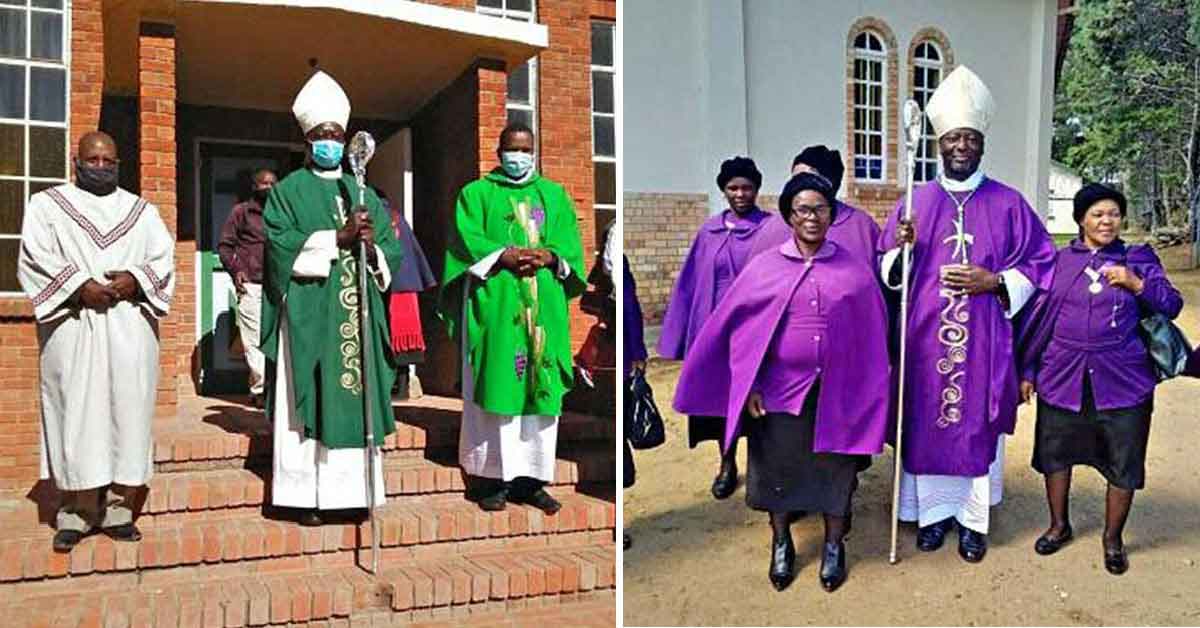 Ordained to lead the diocese of Aliwal North in the Eastern Cape just a few weeks before Covid-19 hit South Africa, BISHOP JOE KIZITO reviews his first few months in office.
I have been nicknamed, a “Covid-19 Bishop”. I was ordained on February 15.
Three weeks later there was a call for coronavirus lockdowns around the world, and soon this also hit South Africa.
Every new bishop looks forward to going around his diocese for the first few months, visiting priests and the faithful in different parishes. Unfortunately, this was not to be for me.

I had also been looking forward to my first Easter liturgies. This turned out to be another experience for me, one I never expected.
Moreover, the initial few weeks were marked by some sorrow.
During my preparation for the episcopal ordination I was busy with one of our priests, Fr Boniface Kasali Isaho, who was extremely sick.
I had planned to accompany him back home to the Democratic Republic of Congo so that he might get a kidney transplant. This was not possible due to the visa processes.
Fr Boniface left by himself, and within two weeks he died, on Sun-day, April 26, in his home diocese of Butembu-Beni. His funeral took place the following day.
Fr Boniface served in South Africa for 17 years. I, as his bishop, the priests and the people of Aliwal diocese shall miss him very much since one could count on him for any issues on pastoral work.
On a happier note, we were able to launch the new Pastoral Plan, “Evangelising Community Serving God, Humanity & All Creation”, in the diocese before lockdown.
This Pastoral Plan is going to take ten years of implementation. During these years we shall have study days by using the different Church documents, the Bible, diocesan policies, the Code of Canon Law, discussions, workshops, prayers and pilgrimages.
To run this Pastoral Plan we will use the various pastoral structures within the diocese: the diocesan pastoral council meeting, regional meetings, the senate of priests, sodalities, Small Christian Communities (SCCs), youth groups, parish councils and committees, and so on.
Once the Pastoral Plan’s eight focal areas have been dealt with, we will have an evaluation and chart a way forward. Each focal area is led by a priest and a lay person (in the case of “Care of Creation and Environment” a priest and religious Brother).
This Pastoral Plan, we hope, will bring a new life, spirit and attitude after the Covid-19 pandemic. We need to respond to the needs of the Church by offering hope and new insights.
Letters to the people
In a period of just two months after my ordination, I wrote three pastoral letters to the priests and the faithful.
All these pastoral letters gave updates on how to keep the faithful in prayer in their homes.
During the first month of my episcopal administration there had been feelings of emptiness and sadness, since one could not feel the joy of Easter.
Conversely, however, there have been new pastoral insights and experiences that we, as the Church, should capitalise on.
One of my first experiences was family prayer in the domestic Church. The lockdown of Covid-19 called me to look at families with new eyes. They are the Church, what we call the domestic Church.
This Easter experience reminded me of the SACBC’s pastoral directive of 1994 about coresponsibility in the Church.
It came up with the topic “We are the Church”. This is the reality which in our daily pastoral programmes we have overlooked for
many years, until Covid-19.
It is the family Church that has kept us going in the diocese of Aliwal. We did not go for online Mass and prayers but we asked families to pray in their homes.
Yes, there are a lot of people who went to virtual Mass through livestreamed liturgies, but we had to turn to the domestic Church, and we called on it to take its rightful place.
We offered the domestic Church guidelines on how to celebrate their own home liturgies. By reinforcing the domestic Church, we are able to look at family theology.
Covid-19’s opportunities
The priesthood of the baptised was realised by empowering them to keep their Sunday obligations.
The Covid-19 crisis has been an opportunity to minister to families spiritually. It has opened many ways for priests to work and relate to the laity.
This is one of the focal areas in the new Pastoral Plan. Covid-19 did open up the vocation of the laity, more than before. They were to take up a lot of family initiatives to make Easter 2020 a reality in their homes.
We, as priests, empowered the faithful with the use of WhatsApp, a very simple way to be in touch with them. This gave our priests and families a sense of identity and spiritual creativity.
We became partners with equal responsibility to make this Easter a joyful home celebration by complementing each other. Families were able to reflect on the word of God together by sharing different roles and experiences.
The missionary theme of “Baptised and Sent”, as a family, was also experienced. Every person in the Church has a role in bringing the Gospel to others.
Looking at our Xhosa hymn and prayer book, one finds that there is not a well-developed morning prayer. So it is the family which must be the first house of prayer formation.
There has been also a call for families to become more generous with their gifts, and works of both spiritual and material charity.
The baptismal priesthood of the faithful has been exercised at its best. Covid-19 has made it easy for them to see how their family prayers can transform their daily prayers.
One of the questions that I got from a family was: “Can a single mother lead the Sunday prayers?”
Most of our people are still thinking that Sunday prayers should be led by men — just like what they see in the Church.
I had to assure them that family prayers are not based on one’s gender. It’s a role bestowed on both the father and the mother by the sacrament of baptism.
It was an experience for me to see that there was change of old and outdated attitudes among families.
This was also a good moment for the families to raise up their own family petitions. Apart from their Sunday obligations, families were also able to look at other devotions, such as the Sacred Heart of Jesus and the Rosary.
It is very important to me that I could support families to look at the different devotions.
I did call upon the priests to pay a special attention to the pastoral care to these families via their social media.
The Covid-19 lockdown has taught me that the family is and should be the grassroot-basis for our evangelisation.
Pope Paul VI said that the family has a role in evangelising itself. Parents must do their part to communicate the Gospel to their children. Likewise, children must also evangelise their parents.
Furthermore, Pope Paul VI encouraged families to help other families to know Jesus.
Challenges must be faced
But there were some challenges in the domestic Church which will need our pastoral attention.
The reality is that most of our families do not pray together as families. This is a call for us now to ask fathers and mothers with all the children to have a family prayer. It may be something new to them, and for some it may even be uncomfortable.
One mother shared with me that when it was prayer time, the father would refuse to come out of the bedroom to join the family.
Families are used to waking up on Sunday and just going to church. Not much preparation is needed from their side. It is all about a few leaders on the roster, and the rest is the work of the priest and the choir group.
When it comes to family prayers, it has always been the role of the mother, and sometimes the children.
Now, during lockdown, since the father has been around, this role was transferred to him, as the head of the family.
It should worry us if men feel that it’s not their responsibility to lead the family prayers. We need to give support to our men.
Men should not be reduced to the role of providing only materially to the family. There is a need for the Church to dig deep into the cultural aspects of faithful.
Men need to feel that they are of value in the family prayer. We are to support and empower them, to see how they can learn to distribute the family roles.
One family shared with me that after some Sundays, the father of one of the houses agreed to share in the family prayers. This was a very new way for this family.
They were all full of joy to see that there is a new way of building and living a revitalised spirit. This was a new way of family evangelisation, which was called for by Pope Paul VI in his encyclical Evangelisation in the Modern World (18).
Formation is everybody’s job
Family faith formation is another challenge that the Covid-19 pandemic has exposed to us.
Most of faith formation in the family has been seen as the task or job of the mothers, but this responsibility must be shared by all family members. All families must help and support each other in passing on the faith.
In the centre of my coat of arms is the image of the Small Christian Community. This is one of the ways in our pastoral work in the diocese to share the word of God.
It should also be applied to the prayer model.
The SCCs are our number-one instruments of teaching the faith in families. They are also the way to live and practise the faith in a well-lived daily family set-up.
It is our duty, therefore, to remember the call of Vatican II to support the domestic Church. Families must feel that role in their wider Church.
I have been able to live under this “new-normal” reality with a transformed attitude that I should not be afraid of letting the laity in their families transform the Church.
Reading in the Second Vatican Council that “the laity have got a very special secular character” and the synod document on the Vocation and Mission of the Lay Faithful (15), I believe that we are to take care of the Church in a coresponsible way.

- The Angelus Prayer - March 25, 2026
- Palm Sunday Prayer - March 24, 2026
- Pope: We Cannot Remain Silent - March 24, 2026



