
All-Star Lineup: Why a Canonisation in 1622 Still Draws Attention
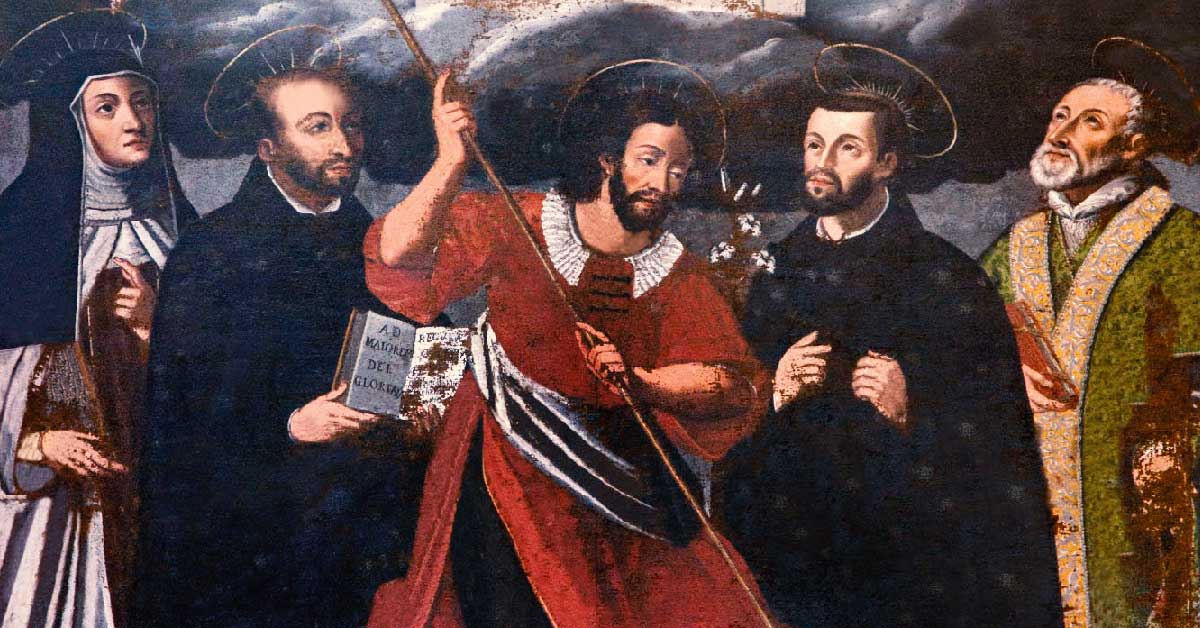
Part of an aerogramme released by the Vatican’s stamp and coin office marks the 400th anniversary of the joint canonisation ceremony of Ss Teresa of Avila, Ignatius of Loyola, Isidore of Madrid, Francis Xavier and Philip Neri. (CNS photo/Vatican stamp and coin office)
By Cindy Wooden – The Vatican has hosted many massive and moving canonisation ceremonies over the centuries, but a rite held in 1622 continues to be commemorated by devotees and studied by scholars.
At a ceremony in St Peter’s Basilica March 12, 1622, Pope Gregory XV formally recognised the holiness of Ss Teresa of Avila, Ignatius of Loyola, Isidore of Madrid (also known as Isidore the Farmer), Francis Xavier and Philip Neri.
Pope Francis will mark the 400th anniversary of the canonisations with a Mass at the Jesuit’s Church of the Gesù in Rome, and the Vatican Philatelic and Numismatic Office has reproduced a 17th-century painting of the five saints for its 2022 aerogramme.

The canonisations were a boon to what were then new religious orders: the Discalced Carmelites founded by St Teresa; the Jesuits founded by St Ignatius with St Francis Xavier as one of his first companions; and the Oratorians founded by St Philip Neri.
But the four religious were late additions to the ceremony, which was prepared for the canonisation of St Isidore, who would be the patron saint of Spain’s new capital, Madrid.
King Philip IV of Spain had paid for the canonisation “teatro” – a structure erected in St. Peter’s Basilica and decorated with scenes from the life of St. Isidore and illustrations of miracles attributed to his intercession – “so the others were, technically, piggy-backed onto this ceremony” with a banner for each hanging in the transept, Simon Ditchfield, a professor of history at the University of York, England, who has written extensively on the 1622 ceremony, told Catholic News Service.
For historians, art historians and theologians, the 1622 canonisations are a case study in the “modern” sainthood process, the consolidation of papal power, the missionary expansion of the Catholic Church and the use of art to support that outreach.
“This was the most explicit and theatrical example of papal power and universal papal relevance,” Ditchfield said.
While previous popes had attempted to regulate the recognition of saints, he said, it was a slow process with many holy men and women being proclaimed and venerated simply as a result of the devotion of the local Catholic faithful.
On the heels of the Protestant Reformation and to bring order and investigative rigour to the Catholic Church’s process for declaring saints, Pope Sixtus V in 1588 set up the office that would become the Congregation for Saints’ Causes. Over the next three decades, though, only nine people were canonised and none of them at the same ceremony.
The 1622 five, Ditchfield said, were the first saints to be beatified before being canonised, an intermediate step that is now standard.
The ceremony also “was groundbreaking in being the first-ever canonisation of multiple holy people on the same day. That meant that there were more decorations in St. Peter’s, five canonisation bulls rather than just one, and an unprecedentedly large body of documentation,” Pamela M. Jones, a professor emerita of art history at the University of Massachusetts in Boston, told CNS.
The bulls, or decrees of canonisation, and the banners and other art used to decorate St. Peter’s, she said, “underscored their distinctive contributions and similar virtues. The saints’ celebrations also show that they were perceived useful to the Roman Catholic Church as defenders of the faith against ‘heretics’ and ‘infidels’ and as disseminators of the Catholic faith in a turbulent era of world expansion.”
The consolidation of the sainthood process also served to underscore in a very practical way the authority of the pope affirmed by the Council of Trent, Jones wrote in “A Companion to Early Modern Rome, 1492-1692,” a book she co-edited with Ditchfield and Barbara Wisch.
“Because saints’ cults were universal, the pope, whose jurisdiction was universal, had the exclusive right to canonise,” Jones wrote.
But the festivities marking the canonisations, even those of 1622, were global, she said. After the canonisation rite, Rome was the site of processions, fireworks, concerts and plays. Similar events took place around the world: in Madrid to celebrate St. Isidore’s canonisation, but even further afield to honour the new religious-order saints across Europe, in Asia and in the Americas where Discalced Carmelites or Jesuits ministered.
Ditchfield said the whole process, first completed for the five saints in the 17th century, was a mechanism that emphasised the church as both local and universal: then and now it begins with an investigation in the diocese where the sainthood candidate lived and died, then it is verified at the Vatican, beatification and canonisation are proclaimed by the pope and his decision is celebrated again on a local level.

- Pope Leo mourns tragic New Year fire in ski resort bar; 40 presumed dead - January 3, 2026
- Pope: Take Time to Review the Past Year with God - December 31, 2025
- Vatican’s 2025: Year brings new pope, Focus on Unity and Peace - December 31, 2025



