Our Grief is Mary’s Grief
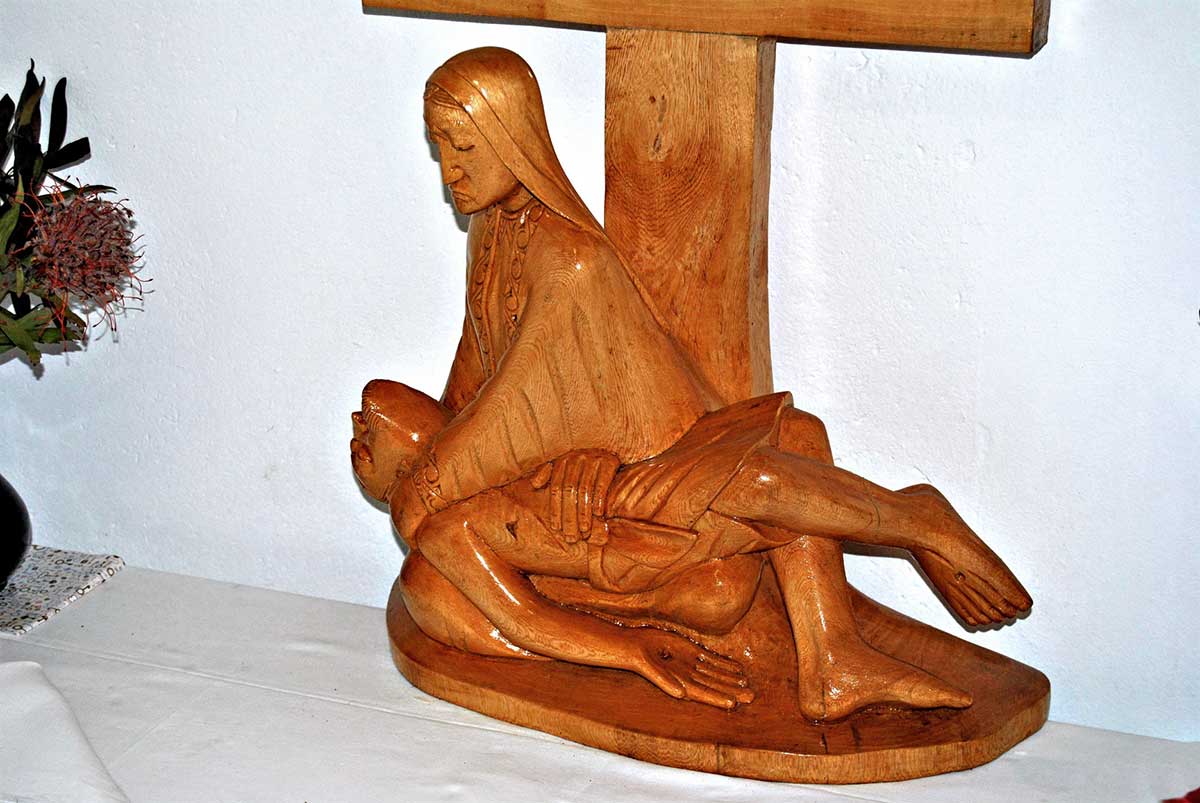
Mother Mary holds the lifeless body of her son in this artwork by Zimbabwean sculptor Artwell Dzinopana
Contemplating an image of Mary holding her lifeless son, Fr Oskar Wermter SJ suggests that we offer our grief to Our Lady of Sorrows, whose feast is on September 15.
Statues like the one shown on this page — depicting Mother Mary holding the dead body of Jesus, just taken down from the cross, on her lap — have been rather frequent in the history of Christian art. The one shown here was created by one of Zimbabwe’s best artists, Artwell Dzinopana. He grew up in the country’s Midlands, and now resides in Harare.
Mary is shown as a brave woman. She is facing death with open eyes. She is strong and upright. The catastrophe of losing her only son has not struck her down. Her face, showing deep pain, is focused on the body of Jesus. She cannot turn to anybody else. Her eyes are on the face of her slain son. But she is still alive, she keeps control of herself — there is no desperate crying or mourning.

The body of her son is slack, loose and limp; death holds him, all life is gone. The mother holds his head. There is no one to support his arms that have fallen loose, no longer in control of anything. The eyes are still open, but don’t see anything.
Countless mothers in Southern Africa have been through heartrending moments like this one in “wars of liberation”, or losing children and husbands in times of pandemic.
Identifiable sorrow
A much larger version of this relatively small sculpture can be seen in New St Peter’s church in Mbare, Harare. The women in that township have taken to this image of Mary and her son. They identify with this woman and her indescribable misery. You see them kneeling in front of this image which seems to ask them to leave all their pain and grieving at the feet of this mother.
In the image, it is really her son’s pain and grief which the mother sees and feels. So there is nothing grieving parents cannot take to this mother, and to this son. He has seen it all and was burdened with it everywhere in his life and death.
At the end of Zimbabwe’s War of Liberation, wives were waiting for their husbands to come back from the war, and mothers were longing for their children, whom they had last seen ten years before, to send a sign of life, to let parents know that they were still alive. It’s the way of war. I remember my own mother who was not sure if our father was still alive. Then one day a letter came from a doctor who notified her that our father had died the year before of typhoid.
Healing from suffering
This happened all the time, and still does. How could anyone comfort and console a grieving mother who was left with five children, but no husband and father? In such personal tragedies, a wife and mother needs another mother to help heal the wounds she suffered in war and merciless battles, in times of pandemic, in societies where the social fabric is torn, and so on.
We need healing for such grievous suffering. Mother Mary, under the cross with the body of Jesus on her lap, is such a healer and compassionate companion in the tragedies of today.
Artwell Dzinopana’s sculpture of Mary, who has nothing left, except the bleeding body of her son, is an image that may console us; there we may see the body of the son of Mary who has gone through our pain and grief before, and is still with us as we feel the pain of his wounds even today.
Fr Oskar Wermter SJ writes from Harare. The feast day of Our Lady of Sorrows is on September 15.

- The Angelus Prayer - March 25, 2026
- Palm Sunday Prayer - March 24, 2026
- Pope: We Cannot Remain Silent - March 24, 2026