The Peasant Pope: St John XXIII
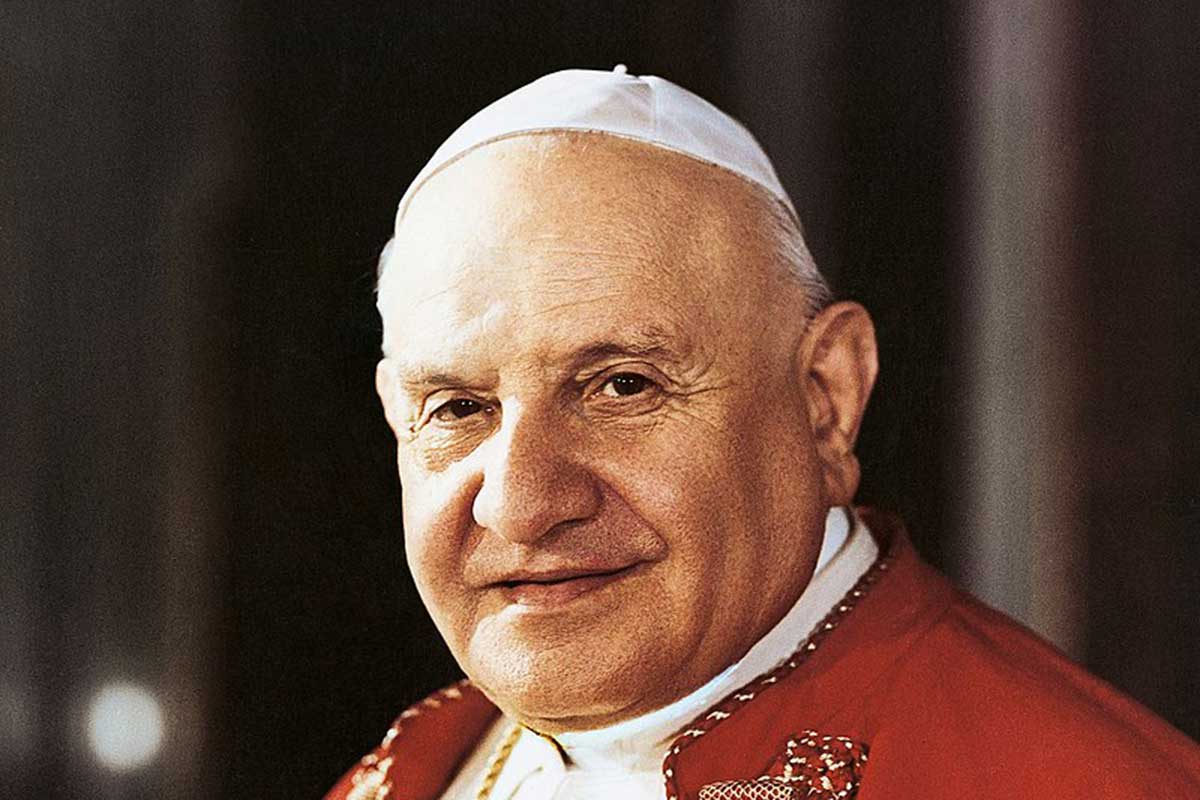
Pope John XXIII (1881-1963) Who Reigned As Pope From 1958-1963
St John XXIII at a glance
Name at birth: Angelo Giuseppe Roncalli
Born: November 25, 1881, in Sotto il Monte, northern Italy
Died: June 3, 1963, aged 81, in the Vatican
Elected pope: October 28, 1958
Beatified: 2000
Canonised: 2014
Feast: October 11
Patronages: Papal delegates, Second Vatican Council, Christian unity
Most saints’ feast days correspond with the date of their death, give or take a day. The feasts of popes, however, usually falls on the date their pontificate began. But when Pope John XXIII was beatified in 2000, his feast was set on October 11, the day on which he convened the first session of the Second Vatican Council in 1962 — almost four years after he was elected pope to succeed Pope Pius XII.

When he was born as Angelo Giuseppe Roncalli in the northern Italian village of Sotto il Monte, near Bergamo, on November 25, 1881, nobody would have thought that the fourth of 13 children in a family of sharecroppers would one day become an archbishop, a cardinal and eventually the most influential pope of the 20th century. While the Roncallis had roots in nobility, their branch of the family had been impoverished for generations. Still, the family had a small vineyard and cornfields, and kept cattle.
Angelo’s intellect and piety stood out at an early age, so when he was 11, a priest enrolled him in a seminary in Bergamo. At 15, the boy joined the Secular Franciscan Order. In 1904, still 22, he earned his doctorate in canon law in Rome, and on August 10 that year, Roncalli was ordained to the priesthood in Rome’s church of Santa Maria in Montesanto in Piazza del Popolo. The bishop of Bergamo recognised the young priest’s talent and from 1905-14 Roncalli served as the bishop’s private secretary.
The bishop died just a couple of weeks after World War I broke out. When Italy joined the conflict in 1915, Fr Roncalli was drafted to serve in the medical corps as a stretcher-bearer and chaplain, with the rank of sergeant. In late 1921, Pope Benedict XV named him president of the Society for the Propagation of the Faith in Italy.
Less than three years later, Roncalli was appointed apostolic visitator (or nuncio) to Bulgaria, with the title of archbishop. He served there for the next nine years until his appointment as nuncio to Turkey and Greece in 1934.
Saving Jews from Nazis
Based in Istanbul, the avuncular Roncalli was popular and widely known as “The Turcophile Pope”. But once World War II began to rage in 1939, Roncalli became deeply involved in rescuing Jews from the Holocaust — in Hungary, Bulgaria, Romania and Slovakia. He did so by using his influence of intervention, which even reached into some concentration camps, and his bureaucratic powers, by producing documents of passage that could save lives. Thousands of Jews were rescued through his intervention.
In December 1944, Roncalli was appointed nuncio to France, holding that prestigious position at a difficult time when the country was dealing with wartime collaborators with the occupying Nazis, which included clergy and bishops.
After eight years in France, Roncalli was named patriarch (or archbishop) of Venice, taking that office in February 1953. At the same time, he was named a cardinal. But his time as patriarch of Venice was cut short by the death of Pope Pius XII on October 9, 1958.
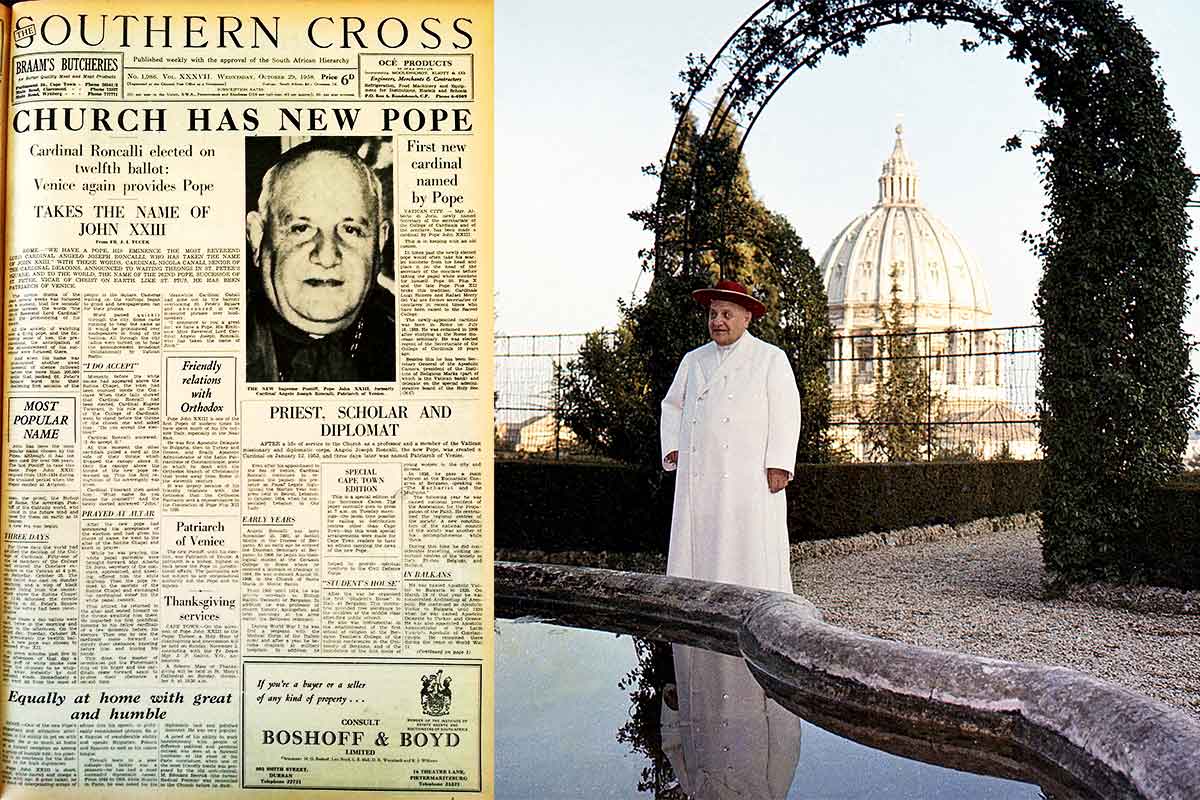
(Left) The Southern Cross issue in 1958 introducing the newly-elected Pope John XXIII. (Right) The pope in the Vatican Gardens.
A couple of weeks after the pontiff’s death, Cardinal Roncalli left Venice to help elect a new pope. His name had been mentioned as a papabile — one who is “popeable” — but there was another man whom many saw as the perfect successor to Pius: Archbishop Giovanni Montini of Milan. The problem was that the 61-year-old wasn’t yet a cardinal — and convention (though not canon law) demands that a new pope should already have the red hat. So the electors had a decision to make: Cardinal Giuseppe Siri of Genoa, the young conservative, or the more liberal Giacomo Lercaro of Bologna, or maybe Roncalli as an elderly compromise candidate to hold the place for Montini?
After the fourth ballot of voting, Siri and Lercaro were out of contention, and it was clear that the conclave wanted a “caretaker pope”. On October 28 at 16:30 they had elected him: 76-year-old Angelo Roncalli, who took the name John XXIII. That caused some confusion because there had already been an anti-pope John XXIII (see our October 2020 issue). Dressed in his new papal vestments, the newly-elected Pope John looked at himself in the mirror and said: “This man will be a disaster on TV!”
At 76, he was the oldest pope to be elected in more than 200 years, and John was expected to keep the seat warm for his successor, who, as it would turn out to be, was Montini, elected in 1963 as Pope Paul VI.
Not a seatwarmer pope
But John was no seatwarmer. In his five-year papacy, he changed the Church. Inspired by the Holy Spirit, the elderly pope surprised the world in 1959 when he announced his intention to call a council to help the Church deal with a rapidly changing world, and to “open the Church’s windows to the world”.
The Second Vatican Council opened on October 11, 1962 — hence St John XXIII’s feast day — and closed in 1965, after his death. Archbishop Montini, the man who as Pope Paul VI would guide the council to its completion, was as surprised as the rest of the world by the announcement of the council in 1959. “This holy old boy doesn’t realise what a hornet’s nest he’s stirring up,” the future pope remarked.
With his humility, gentleness and courage, Pope John reached out to the marginalised and the world. He was the first pope in nearly a century to make pastoral visits to Rome’s parishes. He visited the ill in hospitals, the youth in reform schools, and — a sensation at the time — the incarcerated in prison.
Pope John’s good humour was underpinned by a keen intellect. In less than five years of his papacy, he wrote eight encyclicals, including two that are considered landmark documents: Mater et magistra (1961), on Christianity and social progress, and Pacem in terris (1963), on the need for global peace and justice.
By the time the Second Vatican Council opened, Pope John knew that he wouldn’t see its completion. On September 23, 1962, he was diagnosed with stomach cancer. The illness was kept secret, and even through it the pope barely slowed down. At 19:49 on June 3, 1963, Pope John XXIII died at the age of 81, just as a Mass for him finished in St Peter’s Square below his bedroom window.
John XXIII was beatified alongside Pope Pius IX in 2000, and canonised alongside Pope John Paul II on April 27, 2014, witnessed by a group of Southern Cross pilgrims.
John XXIII was our Saint of the Month in the October 2021 issue of The Southern Cross magazine

- Holy Thursday Prayer - April 2, 2026
- Scorsese Series on Saints comes to SA TV - April 1, 2026
- Easter Prayer - March 31, 2026