
The Pandemic that Remains
Once again on the first day of December, we commemorated World Aids Day. It might sound a bit uncaring, but in a sense it has become “once again” — an annual mark on the calendar taken as seriously, or not, as Women’s Day or All Souls or a wedding anniversary.
The day will be signalled by some portentous pronouncement by politicians, probably a revelatory report by an NGO hoping to get some media attention, maybe a special bidding prayer at Sunday Mass.
At one level, the general lack of notice now given to World Aids Day could be a good sign. For decades, the spectre of Aids hung over families — indeed over this whole country — like the Sword of Damocles, hanging on a hair’s breadth and threatening to wipe out whole swathes of the population with its deathly smite. As recently as 2006, Aids was the underlying reason for 40% of deaths in South Africa!

And then there was a miracle discovery. Well, it might have been miraculous, but it was also the result of hard work, international collaboration, and the investment of billions of dollars. We now have antiretroviral drugs (ARVs) so that someone with HIV need not get sick; an HIV+ pregnant woman will not pass on the virus to her newborn baby; someone exposed to HIV need not become infected; someone at high risk of being exposed can be protected in advance. We do not yet have an antidote or a vaccine, but science means that what was once life-threatening, and then life-limiting, now mean just a small daily inconvenience.
But Aids has not gone away. When you go to the supermarket, about one in five of the adults you see are HIV+. The children who lost parents a few years ago are now grown up and have become parents themselves. Gogos who have had to bring up two generations of children are struggling with old age. And, regrettably, people are still dying of Aids-related conditions: a UCT estimate for the Department of Health puts it at 52000 deaths in 2021. That means in each of the last two years, Aids has been the cause of as many deaths in South Africa as Covid.
Even the ARV story is far from perfect. Free and easily available medication means that South Africa has the largest ARV programme in the world. But of the 7,9 million people living with the virus, only about 70% are on ARVs — which means that 2,3 million people are quite unnecessarily at risk.
There are some people who have difficulty accessing ARVs and who also struggle to stay adherent. Before we point fingers at people who “can’t be bothered” to take one tablet a day, we might remember how often we fail to complete just a three-week course of antibiotics, even though the doctor insisted we must see it through to the end!
The importance of trust
The clinic team at the Denis Hurley Centre in Durban, which I serve as director, works with hard-to-reach groups. Homeless people come to our clinic because they know they can trust us. We test people and, if positive, immediately initiate them on ARVs. Thanks to a dedicated team of community health workers, we can also chase up people — daily, if necessary — to make sure that they are sticking to their medication.
The refugee community with whom we work poses different challenges. While the stigma of Aids has greatly diminished among South Africans, it remains prevalent among people from other parts of the continent who have settled here. And sadly, sometimes it is religious leaders who further marginalise people.
There are, for example, some Congolese churches in Durban which require an HIV-negative certificate before they will conduct a marriage — but only from the bride, not the groom! In a culture like this, it is not surprising that refugees (and especially women) are reluctant to test, are more unwilling to accept a positive result, and slower to start on ARVs.
We rightly should point to the ways in which our political leaders have failed us in the response to HIV. One of the reasons for the gap in take-up of ARVs is that there is still completely irrational suspicion about whether or not they are a good thing.
It seems almost bizarre now to remember that we had a president and a health minister who refused to implement ARVs and recommended potatoes, beetroot and garlic instead. It would be funny were it not for the evidence that their denialist policies led to probably 330000 avoidable deaths, according to a Harvard study. That’s as many people as Idi Amin butchered in Uganda.
I think there is a lesson for the Church in this. Thankfully we have not had (too many) bishops who are Aids denialists. But we have had senior Vatican officials who argued — against all scientific knowledge — that condoms have little holes that let the virus get through. And, of course, we still have a theology taught, if not always received, that tells couples that they cannot use a condom when one of them is HIV+. This is despite the fact that St Thomas Aquinas’ principle of “double effect” long ago established that a “lesser evil” (in this case, condoms) can be risked as a way of preventing a greater evil (HIV-infection).
The Church can be proud of some of the extraordinary ways in which it has responded to Aids; but there are also reasons we should be ashamed. In our region, the bishops included the principle of double effect in their 2001 pastoral letter on Aids. I have been told that they were not unanimous on that question, and most Catholics are unaware of this teaching, but its mere inclusion was prophetic.
The stigma sticks
Meantime, the stigma has not entirely disappeared. Despite the prevalence of HIV, it is still relatively uncommon to know someone’s status. While privacy means that no one should have to declare, fear of judgment means that most people do not. If someone in your parish has cancer, chances are that everyone will know and there may be prayers, some community fundraising, or health education activities. But that rarely happens with Aids.
Are our parishes places where people feel that they can be open? Or is there still a fear of stigma and judgment — that, somehow, people with HIV are blameworthy or immoral? When thinking of someone with HIV, are we really willing to say: “There, but for the grace of God, go I”?
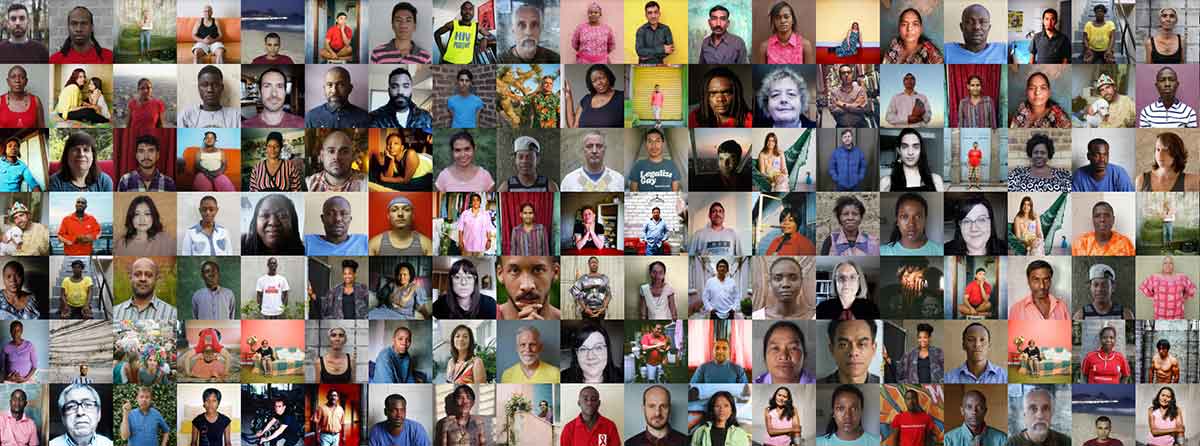
I have recently been engaged in an interesting activity with young people to increase empathy. At the Denis Hurley Centre, we have on display a panel which shows the faces of 100 people living with HIV. It was created by the South African artist Gideon Mendel for the 2016 World AIDS Conference in Durban. The image illustrating this article is from Gideon’s Through Positive Eyes website, and you can see the images for yourself at www.throughpositiveeyes.org.
I invite people to select one face “that speaks to them”, and then go away and imagine that they are that person: “How old am I? Who do I live with? What is my life like? Whom have I told about my HIV status and what was the reaction?” The responses have been really deep and insightful and this raises all kinds of questions about the virus. I then give them cards so they can read the real stories of these individuals (and you can do the same on the website).
Jesus was able to get close to people because he was not afraid to imagine what their lives were really like. North American indigenous culture challenges us to “walk a mile in another person’s shoes”. In the Incarnation — which we are about to celebrate at Christmas — Jesus took this to the most extreme: God becoming human.
We cannot, as people of faith, have any meaningful comment to make about someone else’s life unless we are willing to see the world through their eyes.

- The Gift of the Irish - March 10, 2026
- Catholic Schools in the Market - February 10, 2026
- Ring the Bells for the New Year - January 5, 2026



