Catholic Bavaria and the Passion Play

Crucifixion scene at the Oberammergau Passion Play. Photo: Günther Simmermacher
The Catholic faith is still everywhere in Bavaria, as Southern Cross pilgrims to the Oberammergau Passion Play saw. Günther Simmermacher shares his impressions of Germany’s largest state.
Catholicism infuses life in Upper Bavaria, the southern part of Germany’s largest state, which always regards itself as a bit apart from the rest of the country. You hear it in the common greeting, “Grüß Gott” (roughly, “Greetings in the name of God”); you see it on the many beer labels that bear the names of Catholic orders and cloisters; and you are reminded of it as you pass the abundant roadside shrines.
The active practice of the faith may be diminishing even in conservative Bavaria, but Catholicism is ever-present — perhaps nowhere more so than in Oberammergau, site of the famous Passion Play. As they have done every ten years for almost four centuries, the villagers of this small town of just over 5000, about 90km southwest of Munich, came together this year to stage an extravagant and moving narrative of the Lord’s Passion. Only people born in Oberammergau or long-standing residents may take part in the play. About half of the village gets involved in performing it.

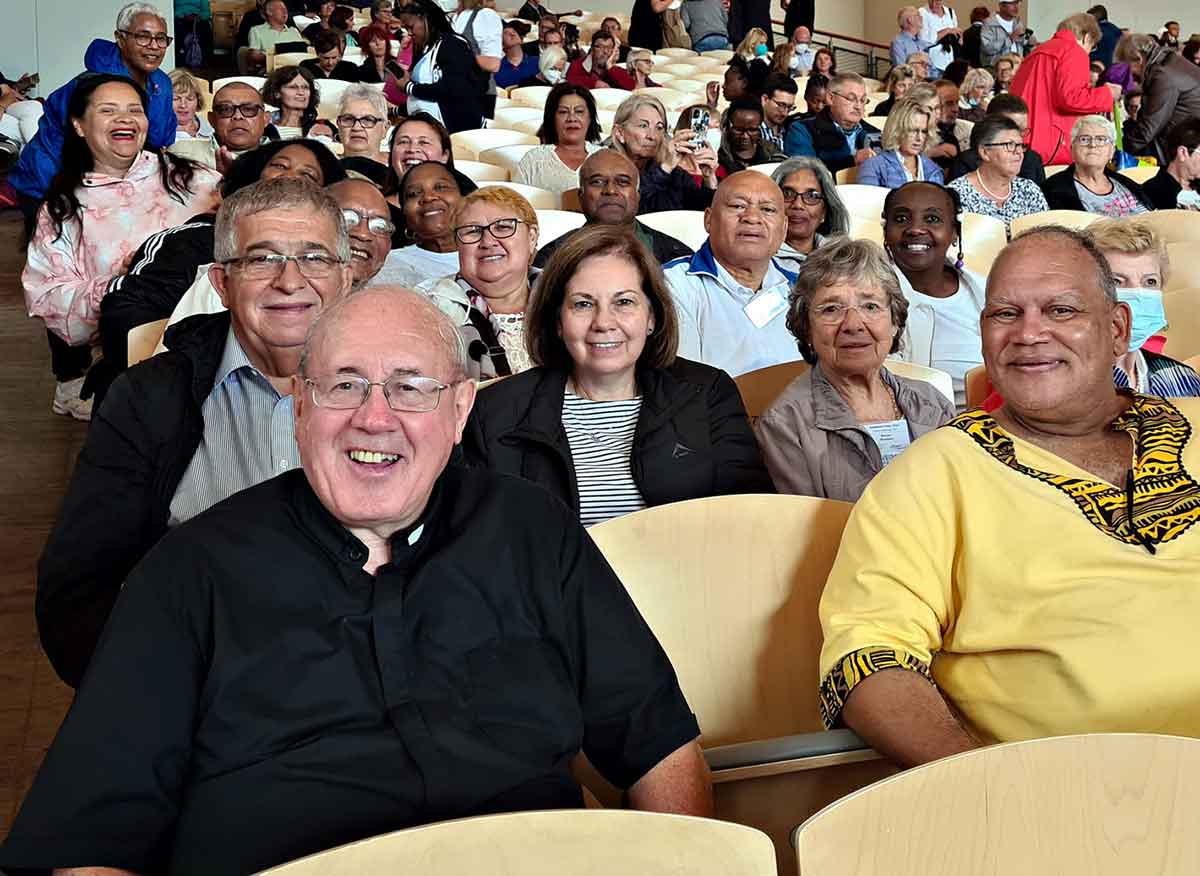
Southern Cross pilgrims inside the Passion Play theatre in Oberammergau, with Archbishop William Slattery at left in front. Photo: Günther Simmermacher
The Passion Play’s scale goes beyond a mere stage performance: this is an expansively crafted spectacle on a 45m-wide stage, with a huge cast (which includes a donkey, horses, sheep, doves and two dromedary camels), a superb choir, and tableaux vivant — living pictures featuring perfectly still actors — linking the Old Testament to the Holy Week narrative.
The Southern Cross pilgrims who saw this year’s play enjoyed an advantage over other spectators, having seen the actual places of Jesus’ Passion in Jerusalem just a couple of days earlier — they even had a Mass inside the tomb in which Our Lord rose from the dead.
As it was when a Southern Cross group saw the Passion Play in 2010, this year’s pilgrims saw Jesus portrayed by Frederik Mayet, who featured on the cover of our April issue and was interviewed by us in May.
During the break in the performance, Archbishop William Slattery and I met up with Mayet and Christian Stückl, the play’s accomplished director and playwright. The cast members having a smoke outside the canteen joked that the director’s stressed demeanour was his normal state.
It would be understandable: this play requires exact choreography and discipline from its lay actors. Pulling all this together so seamlessly almost daily borders on the miraculous.
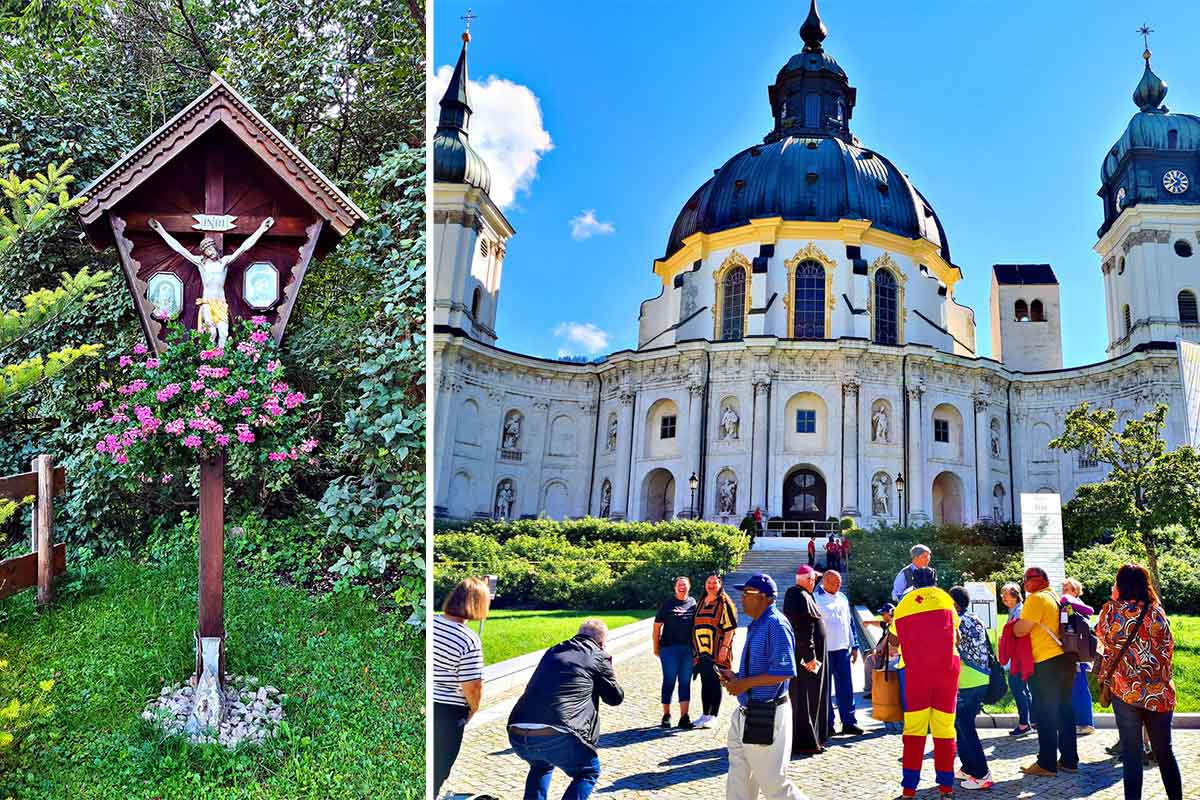
(Left) Roadside shrine in Weissbach (Right) Southern Cross pilgrims outside Ettal Abbey. Photos: Günther Simmermacher
Masterful script
Stückl has crafted a masterful script. He has translated important discourses in the Gospels from Galilee to Judea to communicate the nature of Jesus before we see him killed by men. Judas in this account is a tragic figure who didn’t act out of greed and treachery, but in a foolish, misjudged bid to politically radicalise Jesus. The scheming high priests Caiaphas and Annas are presented as being concerned more with the political than theological impact of Jesus of Nazareth. The real villain of the piece is Pontius Pilate, ahistorically dressed to look like a fascist strongman (as are his soldiers).
The viewer is left even more shocked at this show of the “banality of evil” than one might be at the parade of villainy in the more traditional presentations of the Passion. At a time when peace and democracy are under real threat worldwide, the Passion Play conveyed a potent message.
The next Oberammergau Passion Play will be held in 2030, and again in 2034, for a special run to mark the 400th anniversary of the first staging.
The day after seeing the Passion Play, our group visited the Benedictine Ettal Abbey and had Mass there. An architectural marvel, Ettal Abbey is a tourist and pilgrimage destination. The Benedictine motto “Ora et Labora” is evident here. The 50 resident monks pray here, but they also run a brewery, a distillery, a bookstore, an art publishing house, a hotel, and even a cheese factory. Its boarding school, however, will close soon. The abuse scandal also hit that part of the world.
The pilgrims then visited one of Bavaria’s most popular pilgrimage destination, the gorgeous Rococo-style Wieskirche, built in the 1740s to serve the many pilgrims to its miraculous statue of the Scourged Christ (which, of course, tied in with the pilgrimage’s Passion theme). The Wieskirche’s ground used to be restrained in its commercialism. In 2010, there were still only two huts accommodating tourist shops. There are more now, though they are not yet invasive in number. In any case, pilgrims want to buy souvenirs and ice-creams; the vendors provide for that need.
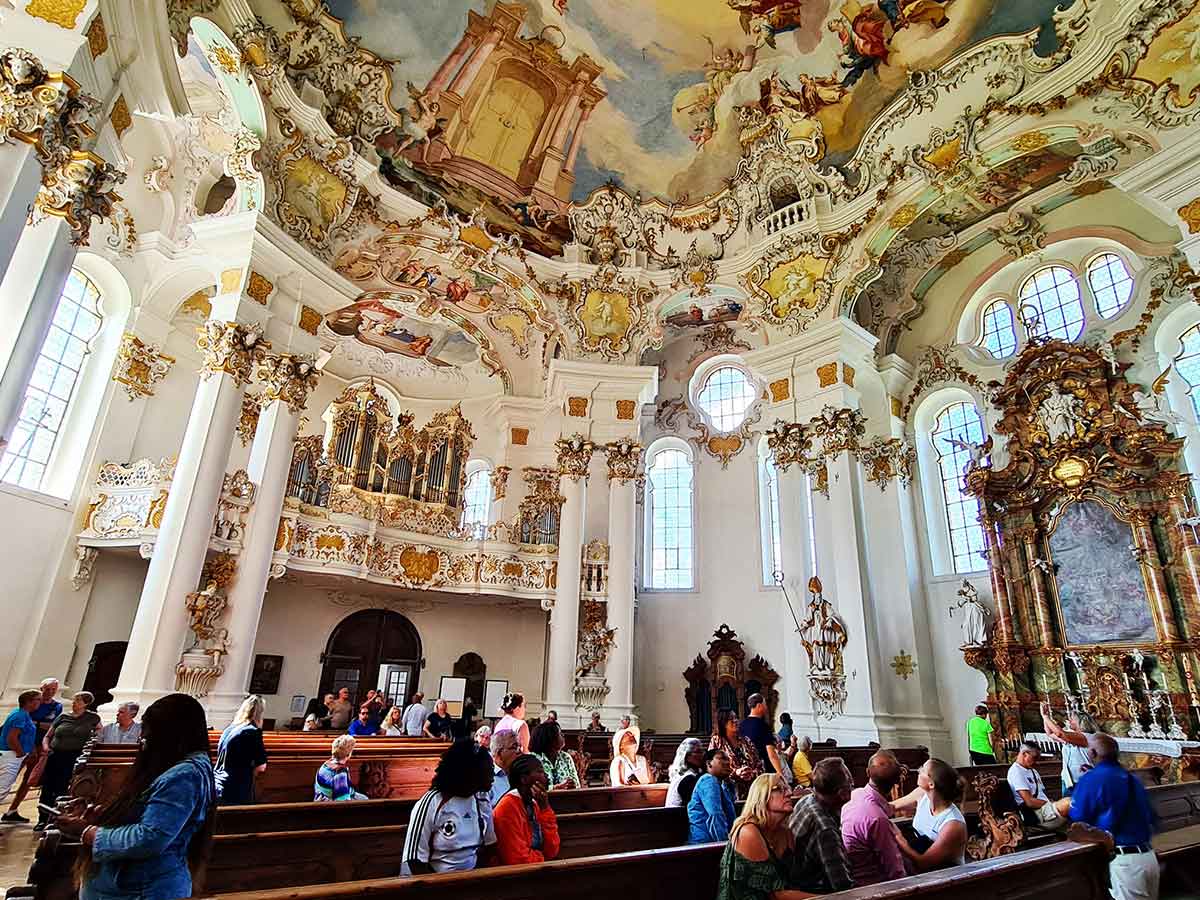
Southern Cross pilgrims in the Wieskirche (note the door to heaven we have yet to open in the ceiling’s fresco). Photo: Günther Simmermacher
Germany’s Lourdes
Souvenir shops were also in ready supply in Germany’s most important Marian shrine, Altötting, which my wife and I visited privately after the Passion Pilgrimage. The shrine is located near the Austrian border, and only 12km from Marktl-am-Inn, the village where Pope Benedict XVI was born (which we, of course, also visited). The object of pilgrimage in Altötting is the wood-carved statue of the Black Madonna. The story goes that in 1489, a mother placed the drowned body of her three-year-old son before the statue of the Virgin Mary on the altar of the local chapel, whereupon the child was revived.

(Left) St Bartholomew church at the Königsee. (Right) The Black Madonna of Altötting. Photos: Günther Simmermacher
Today, Altötting has several pilgrim churches, all clustered around the chapel of the Black Madonna. One of them is dedicated to Capuchin Brother Konrad (1818-94), who over his four decades of curating the shrine established a reputation for holiness, prophecy, and miraculous healings. He was canonised by Pope Pius XI in 1934.
Bavaria has many sites of pilgrimage, most of which are utilised by locals, such as the Franciscan monastery of Maria Eck near Traunstein, where my wife and I had an open-air Mass on the day of our departure. The abbey can still guarantee Masses; but many parishes, especially in the more rural areas, suffer from shortages of priests, resulting in Communion services increasingly becoming a norm.
Nature in charge
Some churches are popular destinations for secular tourists, too. One of them is the 17th-century chapel of St Bartholomew, which can be reached only by (strictly electrically-powered) boats on the majestic and clear lake Königsee, near Berchtesgaden.
The red-domed St Bartholomew’s sits within a nature reserve which is unmanaged by human hand. In the forest lie many trees that were brought down in an avalanche in 1999. They will eventually rot away while the forest keeps regenerating itself. It is a good place for contemplating the urgent message of Pope Francis’ encyclical Laudato Si’. The management of the Königsee and the nature around it gives a good example of how we ought to care for Creation.
Coming from South Africa — where the Catholic Church is at the margins and carnivals are celebrated at any random time of the year — the ubiquity of Catholic expression in lands where the faith is at the centre, at least nominally, provides for a pleasant culture shock. It manifests itself in the great churches, such as Munich’s Frauenkirche (which our pilgrims visited), and it also does so in the small shrines on lonely roads.
This article was published in the November 2022 issue of The Southern Cross magazine

- Shrines around the World: Our Lady of Beauraing - March 21, 2026
- St Patrick: From Slave to Apostle - March 17, 2026
- New Cape Town Archbishop Calls For Unity and Prophetic Courage - March 14, 2026