From Alienation to Confirmation: A Journey with Autism

Sarah Pyoos with her sons Michael (left) and Gerard, and husband Gerald.
For years a family struggled with the autism of their sons. Sarah Pyoos writes about that journey, and how it ended in spiritual joy.
From a very young age I knew that there was something very special about that little light that shone continuously near the altar steps of Sacred Heart church in Mangete, KZN. I was always curious about that light, especially how it kept shining in its simplicity yet magnificence all at once. I was so drawn to it that I managed to find the courage to run up the dusty hill that led me to it more often than I was allowed to.
It all fell into place for me the day our parish priest told me: “Sarah, you must love Jesus. He is there waiting for you day and night. Never pass by without stopping to say ‘hello’ to him.” That light came to represent love, hope, friendship — Jesus. Little did I realise that these words, inextricably linked to my childhood simplicity, were to become the bedrock of my faith walk, a lamp unto my feet and a single thread of hope in my endeavour to raise my two boys with autism, and lead them to the sacraments of Holy Communion and Confirmation.

Gerard, named after St Gerard Majella, patron saint of expectant mothers, was a healthy, undemanding toddler. At around 18 months, something changed. The loving, bubbly, bouncing little boy became more and more detached. He stopped responding to his name and at times seemed unaware of people around him. From singing nursery rhymes and saying basic words to silence. We thought he was hearing-impaired, but his hearing appeared to be perfectly normal.
No matter how hard we tried to engage him, he just would not interact with us. It was his rejection of all our love that brought me to tears on many occasions. Why wouldn’t my soft, cuddly baby respond?
Poor Gerard was dragged, sometimes literally kicking and screaming, from specialist to specialist. No one could help. In between the frenzy, Michael, my 4kg bundle of joy, made a quiet entry into our world. For a while, my nagging fear around Gerard’s unexplained condition dissipated in the joy of my newborn son.
Michael seemed far more interested in our world than Gerard was. He would make eye contact, smile and laugh appropriately, and take an interest in some of his toys. But Mike did not progress at the expected pace. He took too long to walk, and by two, he still had no speech.
I felt as if my heart had been ripped out of its socket. “Oh please, God,” I cried, “not Mike too.” Despair engulfed me. It strangled all faith and hope. I cried like a baby over my babies, consumed by fear as to how I, their mother, was to lead them to adulthood in a world which they neither cared for nor understood.
A heartbreaking checklist
After many exhausting visits to an array of healthcare professionals, I started doing my own research about childhood medical disorders. I froze as I went through the checklist in a book titled Mothers and Their Children: no eye contact; strange, fixative behaviours; lack of social skills; no concept of danger; not responding to their name; walking on toes; aggression; spinning objects; lack of speech — yes to all. I couldn’t breathe as the following words flew straight at me: a lifelong, irreversible, untreatable, permanent condition — autism. I wept. Where would I even start being a mother?
A week later, a psychologist’s words ripped out my heart: “Mother, save yourself all the pain, institutionalise him and don’t look back. There is no cure for autism and the future is very, very bleak.” That was 26 years ago. Those heartless words shook me to the core, but they also propelled me to choose to love.
As my husband Gerald and I drove home that rainy Friday afternoon, not a word was spoken, each of us weeping silently in our hearts. However, the words of Jim Sinclair, an adult living with autism, put me into action: “Grieve for us if you must, for your own lost dreams, but don’t mourn for us. We are alive. We are real, and we are here waiting for you.” I made a conscious decision to mourn no more.

Gerard and Michael Pyoos
Since the health department had failed the boys, we turned to our education department. Very little was available for children with autism at this time, and we battled to find placement for Gerard and Michael in the state schooling system. As door after door closed to Gerard, and the more Michael was exhibiting autistic symptoms, the closer I came to complete despair. Yet, no matter how cold and indifferent the world seemed in those moments, there were many angels just waiting to help us.
That’s when Lungile entered our lives. Family and friends rallied to support us, but it was Lungile who would make the biggest impact on our boys’ lives. This angel landed on our doorstep by divine intervention. Lungile was patient, kind, considerate, the childless daughter of a mother who died of alcoholism, sister to a mentally handicapped sibling, and adoptive mother to her sister’s son. She brought with her a peace we had yearned for, a calmness and patience.
Lungile became my boys’ lifeline to our world. She entered the mind of my sons and spoke with them there, the language of love, the only language they could understand. Through her body language, the tone in her voice, her determination and constancy, she made them feel safe.
Lungi taught me acceptance. It took this woman, who had no formal education, who had never given birth to a child of her own, to teach me valuable lessons in love and acceptance. A few years later, after months of ill health, Lungi died. Just like Nanny McPhee in the book Nurse Matilda, she had come for a purpose, and when her job was done, she disappeared.
Today, Mavis has taken Lungi’s place. Because of Mavis we can enjoy a relatively normal life, knowing that our boys are well looked after, and well cared for.
Eventually we managed to find a place for Gerard and Michael at a private school. Michael received private tutoring, and from being totally non-verbal at four-years-old, he began to speak, and continues to express himself very well.
Going to Mass
Initially it was relatively easy attending Sunday Mass with the boys. They were toddlers and their strange behaviour was less noticeable. Those cry room days filled me with faint hope that maybe the professionals were wrong. Maybe, just maybe, by interacting with other children, the boys would snap out of their place. But this was not to be.
After a while it became virtually impossible to continue taking the boys to church. Gerard especially became very anxious as we approached the church building. The tall steeple, the high ceilings and the clay-coloured bricks might have added to his reluctance to enter. Gerard, like many people with autism, struggled immensely with spatial and depth perceptions. He is still incredibly wary of high buildings and finds stairs a menace.
For Michael, the length of time in a confined space proved too much; he would fidget and squirm and shriek at the top of his voice. This kind of behaviour from a 10-year-old didn’t go down well with some parishioners, understandably so. I cried silently in my heart thinking that there was no room big enough for my family in my spiritual home. That light in Sacred Heart church which had once beckoned me, that had called my name, became a withering flame of despair.
Our trips to Mass became less frequent. Eventually we gave up taking the boys to Mass completely. I was deeply conflicted by this and yearned for a time when we could worship God as a family. It felt like a betrayal of God’s love for me. Hadn’t he always waited for me with open arms? Hadn’t I always run to him, drawn to the inexplicable pull of his light and love from the altar stairs?
Many people offered comfort: “God understands, Sarah. Your children are perfect, their souls unblemished. It is us who need Our Lord more.” These sympathetic answers did little to ease the trepidation in my heart. My gut told me that I should be doing more.
Life-changing retreat
In 2011, Gerald and I attended an ACTS retreat. The experience had a profound effect on us. We were filled with renewed hope and courage to listen to that still small voice which seemed to say: “Be not afraid, have no fear. I go before you. I have called you by your name and I love you. Seek first the Kingdom of God and all the other things will be added unto you.”
Soon after this, we somehow plucked up the courage to take our boys to church, at Holy Trinity in Musgrave Road, Durban. By now, Gerard was 20 and Michael 17. We decided to start in the side chapel at the Sunday evening Mass. We felt this Mass would be perfect as our boys love music and would instantly feel at home. Still, we were anxious. I had visions of Gerard screeching out during the consecration at the top of his voice or Michael running onto the altar to try to straighten Father’s vestments.
Through the grace of God, our first visit to church as a family in 15 years was better than we had ever imagined. The song in my heart that carried me through the week had to be “He makes all things beautiful in his time.”
Feeling unburdened and free from the guilt that had plagued me for years, I mentioned in passing to the priest how anxious I had felt at the thought of bringing the boys to church. “Sarah,” he said in his matter-of-fact tone, “your boys were angels. I never heard a sound from the side chapel, apart from your singing.” I’m still not sure if he was just trying to be kind, but the very next week, the whole family had moved to the choir loft to join the folk group. Being part of the band was most rewarding for the boys.
Of course, there would be good days and not-so-good days. But above all, there was acceptance by a community of fellow worshippers who embraced the diversity of my sons.
As time went on, I knew a next step had to be taken. I just didn’t know what it was. I was afraid to even think about the possibility of my boys receiving the sacraments of Communion and Confirmation. But I knew that the Holy Spirit always completes what he starts.
The seed is sown
And so, the Holy Trinity SPRED group was born. SPRED is an acronym for Special Religious Development, and its aim is to aid people with an intellectual disability to participate fully in the liturgical life of the Church.
The seed was a little notice posted by Holy Family Sisters in the parish’s Sunday bulletin. I must admit, I didn’t have much hope that people would respond. When I walked into the first SPRED meeting, I could not believe my eyes, and it was hard not to be overcome with emotion. We quickly introduced ourselves to each other and SPRED was born. The first meeting was made up of “companions”, the name given to the people who accompany the group of “friends” on the road to receive the sacraments. Companions, friends — it didn’t get more beautiful than that. I was all too aware of how lonely the boys felt, how the only friends they really had were their parents. Now their companions would refer to them as “my friend”.
Every companion was allocated a special friend. The meeting room was cheerfully set up, with a beautiful pot of fresh flowers resting softly on a warmly coloured tablecloth. Light music was playing in the background and a single candle cast light on the arrangement around it.
On their first day, the boys were warmly greeted by their companions. They were given little activities to do, with the help of their loving companions who were patient and kind as they lovingly guided their friends through the activities.
Next, each companion gently led their friend to a small bowl of warm water with sweetly-scented soap. Non-verbal Gerard loved the feel of soap on his skin, lathering gently. It was comforting for him in a very peculiar way.
Then came the sharing of the Word. The friends sat quietly and listened. We shared a phrase with each other, both companions and friends. As the companions held the hands of the friends, they looked lovingly into their eyes and said: “My friend [friend’s name], Jesus wants to say to you today, he loves you very much.” The friends were beaming with delight.
I will never forget Michael’s face — it was as if he had seen, heard and touched Jesus all at once in this moment. His eyes danced with joy just like King David. I thought my heart would explode as I saw my son being completely immersed in the immeasurable love of Jesus. We then all sang a beautiful song together to end this time. Jesus was everywhere.
Then it was the Agape session. Friends and companions alike really loved this part. Over juice and biscuits, the companions chatted casually about many things. It became a time when we really shared with each other, from the heart. We listened and loved together.
This was a special moment of grace. It was strange how speaking in the company of our friends — who could only listen and not respond, who accepted and never judged, who could only love and not condemn — was most comforting for the companions. For our friends, I would imagine, the feeling was mutual.
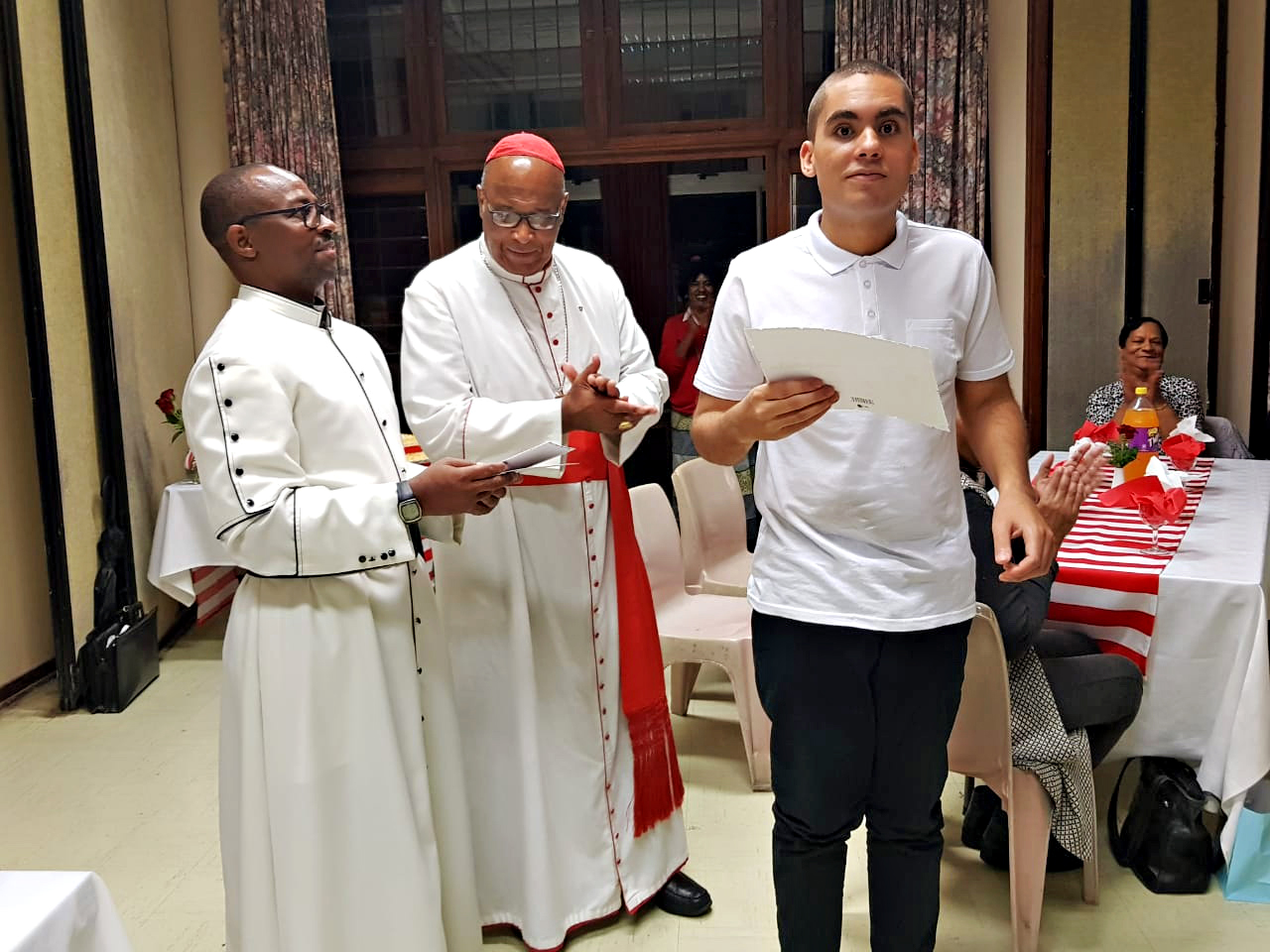
Michael Pyoos at a reception following his confirmation. At left are Fr Francis Cibane and Cardinal Wilfrid Napier.
Confirmation Day
The day finally arrived for our dear friends to receive their sacraments. One could feel the excitement in the air. The companions accompanied their friends every step of the way as we moved into the church to familiarise them with the surroundings. They were ready, completely ready, to receive Jesus. Our practice went off well. Our friends were very excited and couldn’t keep still. I had to pinch myself a few times and hold back my tears as Father helped us through the practice. He was gentle and reassuring.
The church was packed that Sunday evening, September 22, 2019. All our family and friends and the community of Holy Trinity gathered to share with us our great joy. The Mass started with the beautiful hymn “Bless the Lord, Oh My Soul”.
The folk group band led the singing, their joyful sounds ringing throughout the church. Cardinal Wilfrid Napier called the group one by one to receive the sacraments. It was beautiful, pure, simple love, uniting with the love of Jesus. It had finally happened and our friends beamed with delight as they received their sacraments.
After Mass, we all met in the hall and shared in a great celebration. The parish of Holy Trinity served with love and kindness. I don’t have enough words to express my gratitude to Our Lord Jesus. I never thought I would experience such joy in my lifetime.
That light which I had witnessed many years ago was shining brighter than ever before. Thank you Jesus!
Published in the September 2022 issue of The Southern Cross

- Rachel’s Vineyard Healing Ministry - April 8, 2026
- Pope Leo: Christ is Risen! - April 7, 2026
- Easter Prayer - April 5, 2026