
Was Pope Pius XII a Nazi stooge?
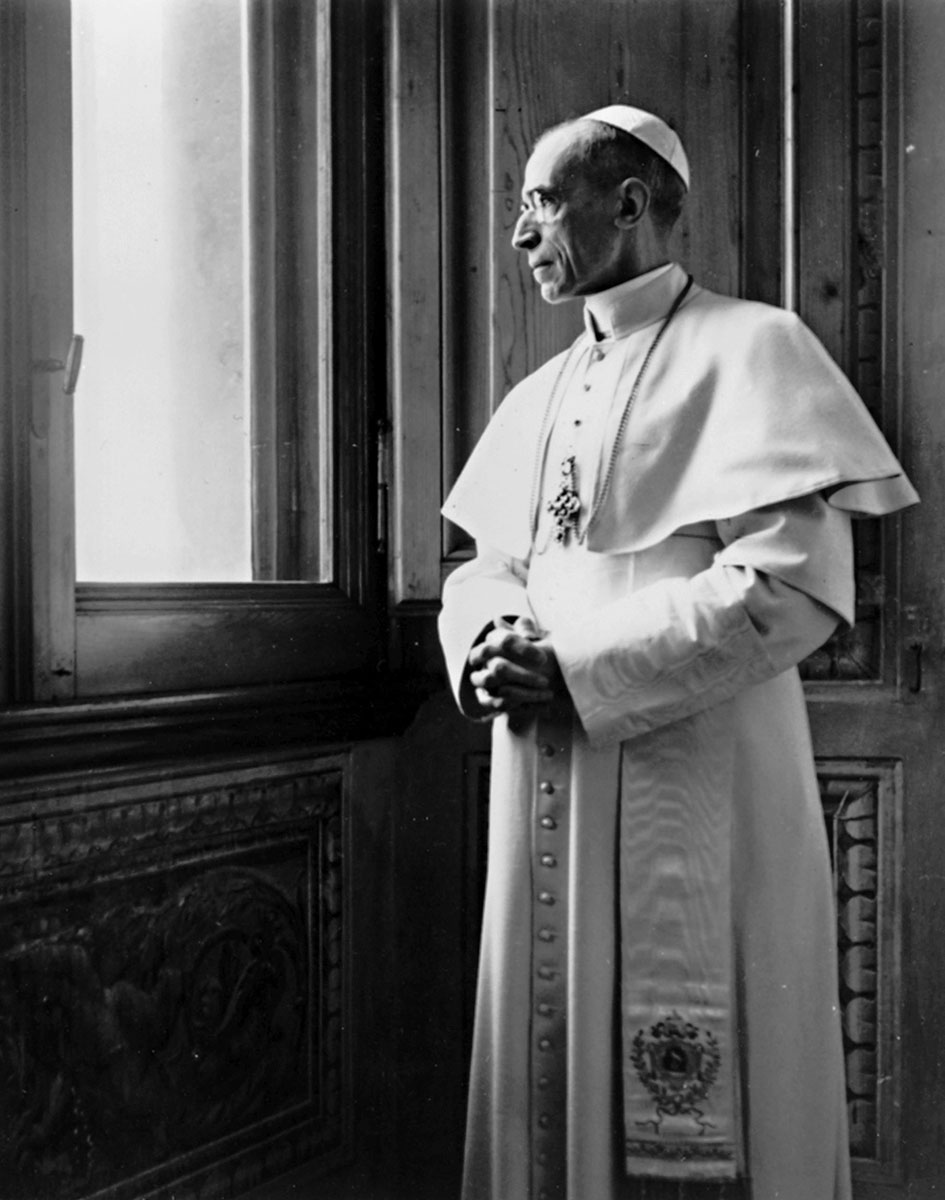
Pope Pius XII is pictured at the Vatican in a file photo dated March 15, 1949. The Vatican announced it will put online documentation detailing Jewish people’s petitions for help to Pope Pius XII during World War II. (CNS photo)
Question: In a documentary I watched on YouTube, it was alleged that Pope Pius XII was complicit in the Holocaust by not speaking out against it. Is there any truth to that?
Answer: The war-time record of Pope Pius XII may still need further study, but it is demonstrably untrue that the pope was indifferent to the persecution of Jews, never mind being some kind of Nazi stooge. The whiff of the latter still clings to the memory of Pope Pius thanks to a polemical book from 1999 by John Cornwell titled Hitler’s Pope, which sometimes still serves as a convenient stick with which to beat the Catholic Church. I suspect the video you watched was of that nature.
A recently-published book by historian David Kertzer, The Pope at War, draws from research in the Vatican Archives and offers a more sober but also unflattering analysis of the pope’s war-time record. Kertzer is critical of the Vatican and the pontiff, but finds that Pius was neither anti-Semitic nor “Hitler’s pope”. Rather, he writes, Pius was concerned about staying neutral — and being surrounded by Mussolini’s fascist regime, fear of reprisals was a reasonable concern.

Another new book based on research in the Vatican Archives, The Pope and the Holocaust by Michael Hesemann, even considers Pius a defender of Jews.
It is true that Pope Pius issued no explicit condemnation which named the perpetrators or the victims of the Holocaust, though he did speak out once. In his 1942 Christmas broadcast, he said: “Humanity owes this vow [of working towards a just society] to those hundreds of thousands who, without any fault on their part, sometimes only because of their nationality or race, have been consigned to death or to a slow decline.” Everybody knew what he meant. Reinhard Heydrich, a leading Nazi, rebutted that Pius “makes himself the mouthpiece of the Jewish war criminals”.
For Pope Pius’ defenders, his reluctance to speak out more trenchantly was a prudent decision, intended to prevent further tragic Nazi reprisals for Church criticism, such as the round-up of Jews and non-Aryan Catholics in the Netherlands after the region’s bishops condemned Nazi persecutions. For his critics, these concerns at best showed moral cowardice and at worst some sort of complicity.
Pope Pius was a diplomat by training, and diplomats don’t like unpredictability. Pius believed for a long time that the Nazis might win the war — and he feared that they then would persecute those who opposed them. Pius also adopted a policy of neutrality in the hope that he might be called to broker peace negotiations.
It is academic whether or not Pius XII’s restraint in speaking out was a prudent decision or a grave error. We cannot know whether condemnations would have tempered the Nazis’ genocidal policy, especially when such censure came from a man whom that regime considered an enemy. After they occupied Rome in 1943, the Nazis reportedly debated whether to imprison or to assassinate the pope.
Whichever conclusion one may arrive at, the notion that Pius XII was indifferent to the Holocaust is not sustainable. Pope Pius is said to have approved some Catholic initiatives in saving Jews, especially in Italy as well as through papal nunciatures such as those in Budapest and Istanbul. Indeed, the Church’s ostensible neutrality might have been a key to these efforts.
In Rome, around 5200 of the city’s 6730 Jews escaped the Nazis’ round-up on October 16, 1943, most of them because they were given refuge in Church institutions, though Kertzer’s research found that some officials were more interested in saving Jews who had converted to Catholicism.
Historians may argue to what extent Pope Pius was involved in those rescue operations, and others like them throughout Italy, but it is inconceivable that it would have been possible without at least papal knowledge and, indeed, his approval.
Post-war Jewish leaders such as Golda Meir, Albert Einstein and Roman Chief Rabbi Israele Anton Zolli needed no such proof: they hailed Pope Pius as a “righteous gentile” for his lifesaving efforts on behalf of Italian Jews.
(Günther Simmermacher)
Asked and answered in the November 2022 issue of The Southern Cross magazine

- Shrines around the World: Our Lady of Beauraing - March 21, 2026
- St Patrick: From Slave to Apostle - March 17, 2026
- New Cape Town Archbishop Calls For Unity and Prophetic Courage - March 14, 2026



