Hero and martyr: St Joan of Arc

Joan of Arc at the stake, painted by Hermann Stilke in 1843.
For many, Joan of Arc is a legendary teenage war hero. For Catholics, she is a saint. Günther Simmermacher looks at the life and death of the ‘Maiden of Orléans’.
St Joan of Arc at a glance
Name at birth: Jehanne d’Arc (or Romée)
Born: c. 1412 in Domrémy, Duchy of Bar, France
Died: May 30, 1431 (aged c.19) by execution in Rouen, Normandy
Beatified: 1909
Canonised: 1920
Feast: May 30
Patronages: Martyrs; captives; prisoners; military personnel; people ridiculed for their piety; France
There is no other saint like St Joan of Arc: a teenage war hero who was put to death for political reasons, by a kangaroo court disguised as a Church tribunal, on grounds of “heresy” — including the crime of wearing men’s clothing. Today, the Church regards the Maiden of Orléans as a saint, France holds her to be a national hero, and cinema has found her a frequent subject for films.

Born around 1412 in Domrémy in western France as Jehanne (the precursor of the modern French Jeanne and the English Joan) to the fairly well-off peasant farmers Jacques d’Arc and Isabelle Romée, she was the third-born of five children.
Those were terrible times for her region. France was entangled in the Hundred Years War with England and its ally Burgundy, which had started in 1337 as an inheritance dispute over the French throne. Domrémy was right on the border between the two sides, but loyal to France — in a region that was mostly under English control after their victory in the Battle of Agincourt in 1415.
So Joan grew up in an atmosphere of war, and when that war started to reach the region around Domrémy in 1425, she had the first of a series of visions. She saw St Michael, the slayer of dragons, in her father’s garden. More visions would follow — of St Michael as well as of St Catherine of Alexandria and St Margaret of Antioch. The visions instructed her to leave Domrémy and help the French dauphin, Charles, be crowned king.
In May 1428 she made her first petition to go to the royal court to offer her services. Twice she was rebuffed, but with the help of influential supporters, she and her escorts finally arrived at the royal court in the town of Chinon in early 1429. By then she had adopted the name Jehanne le Purcell, meaning “Joan the Maiden”, or “virgin”. The maiden must have made an impression at the court, with her reports of those visions and the promise that she intended to end the English siege of the strategic city of Orléans and lead Charles to Reims for his coronation.
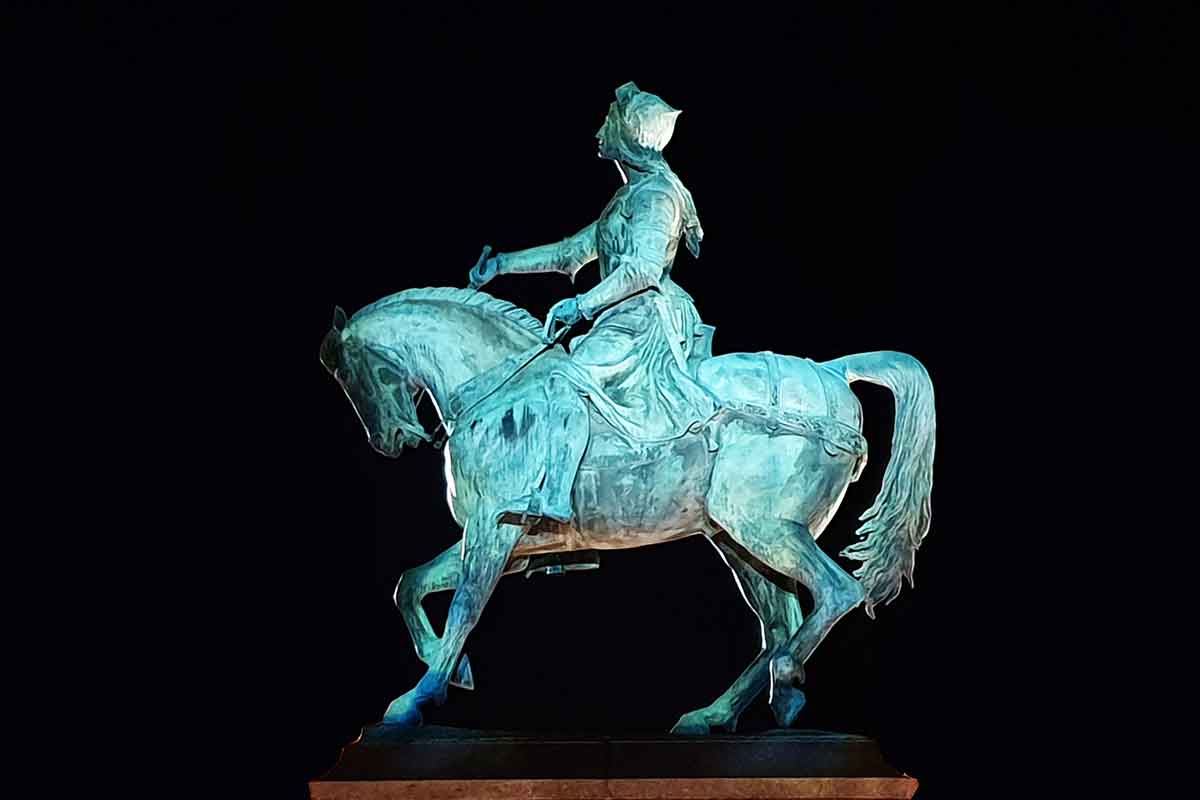
Joan of Arc monument in Orléans (Photo: Günther Simmermacher)
Battle of Orléans
If nothing else, the royal advisors found that Joan — by now something of a celebrity — could be used to inspire the troops, a sort of mascot. After theological and physical examinations, she was assigned a banner, and then led the French forces into battle in Orléans.
She was not involved in combat, nor in strategy (though she gave good advice which the commanders often heeded), but when Orléans was successfully liberated, Joan received the credit. More military victories under Joan’s banner followed. And Joan unnerved the English not only by her leadership but also by her letters, in which she warned them forthrightly of their eventual defeat.
The military successes under Joan turned the long war. It was far from over, but France was in such an ascendancy that on July 17, 1429, Charles VII was crowned in Reims cathedral, just as Joan had promised. Charles later ennobled Joan and her family.
The capture of Joan
But the French also suffered setbacks. And in one of those lost battles, at Compiègne in May 1430, Joan was captured by the Burgundians. After two unsuccessful attempts to escape — one involving a leap from a 21m-high tower — the Burgundians sold their captive to the English, and Joan was moved to Rouen, the seat of the English occupation in the northeast of France. There she was subjected to a politically-motivated Church court trial.
Starting at Rouen on January 9, 1431, the point of the show trial was to eliminate a popular political enemy, preferably while also causing embarrassment to her supporters. A heresy conviction would meet both objectives. There was no evidence of any kind on which to charge Joan, but that didn’t stop the English and their Burgundian collaborators. Joan was not allowed a lawyer, and the bench of judges was stacked in the prosecution’s favour. Even the French vice-inquisitor objected to the obvious miscarriage of justice that had been set in motion; he reportedly changed his tune when he was given the choice between keeping his ethics or his life.
As a Church trial, it broke virtually every legal rule. This was a sham trial, and yet the illiterate Joan, armed with the truth and holiness, evaded all the sophisticated theological traps set to catch her in a heresy — any heresy. When a focus on her claimed apparitions and accusations of various crimes was not effective, the court caught her on a point of garments, based on Deuteronomy 22:5 (“A woman shall not wear a man’s apparel, nor shall a man put on a woman’s garment”). Her crime against the faith was wearing long trousers, that is, dressing as a man — for which she actually had legitimate reasons.

The house where Joan grew up in Domrémy. Today it’s a museum.
Threat of rape
While imprisoned (irregularly in the keep guarded by men, not by nuns, as was her right), Joan wore male soldier’s clothing, including hosen (trousers), specifically to protect herself from soldiers who had repeatedly attempted to rape her. She refused to hand over these garments because she feared that the court would confiscate them, thus leaving her vulnerable to rape. Joan was right to be afraid. When she was eventually forced to wear women’s dress, she reported that “a great English lord” had entered her cell and tried to rape her.
When her male garments were returned to Joan — it is not clear whether this was by her request or by force when her women’s attire was taken from her — she resumed wearing them in her cell. That gave her accusers an opening: she was “relapsing into heresy” for cross-dressing. And with Joan having repeatedly committed the “heresy” of wearing men’s clothing, the court now could impose the sentence of capital punishment.
But had Joan been given a lawyer, he might have pointed out that the Church also taught, as per St Thomas Aquinas, that cross-dressing could be allowed in some circumstances — for example to prevent being raped. That threat had been ever-present for Joan, on her travels and on the battlefield. When there was no such threat, Joan was happy to wear women’s clothes.
Condemned to death, Joan of Arc was burned at the stake on Rouen’s marketplace on May 30, 1431. Although convicted of heresy, she was granted reception of the sacraments. On the stake she held a cross. Her ashes were thrown into the Seine river.
Joan’s military successes had turned the tide against the English, though the conflict simmered on until 1453. By then Joan’s widowed mother had been campaigning for years to clear her daughter’s heresy conviction. At the end of a retrial that ended in 1456, ordered by Pope Calixtus III, following two previous inquests, the court declared in Rouen’s cathedral that the original trial was unjust, malicious, slanderous, fraudulent and deceitful, and Joan was cleared of all heresy.
Although much revered in France, Joan was beatified only in 1909, and canonised in 1920. She is a patron saint of France and of soldiers, but given the circumstances of her captivity and death, she might well be invoked in cases of gender-based violence.
Published in the May 2022 issue of the Southern Cross magazine

- Vocations and Easter - April 6, 2026
- Shrines around the World: Our Lady of Beauraing - March 21, 2026
- St Patrick: From Slave to Apostle - March 17, 2026