God’s Patience is the Best: 16th Sunday in Ordinary Time
Sermon by Emmanuel Suntheni OSB – Sixteenth Sunday In Ordinary Time
Sermon And Christian Act In The Word
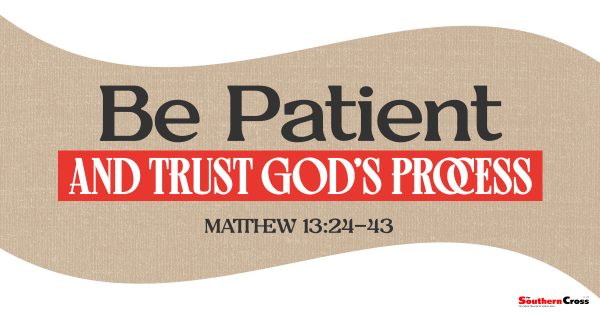
Theme: “God’s patience is the best! Be patient and trust the Process!

Point of Reflection: What are the weaknesses and faults in myself that I dislike most? Am I patient enough not to allow these to depress and dominate me? How do I think about and respond to the wrongdoers in my family and in my community?
First Reading: Wisdom of Solomon 12:13, 16–19
Psalm: Psalm 86:5–6, 9–10, 15–16
Second Reading: Romans 8:26–27
Gospel: Matthew 13:24–43
Sermon (Reflection): Where is the perfect place? The world is not a perfect place, and neither is the Christian community. Some question why God allows trouble-makers, the unrighteous and the wicked to exist, and negatively affect others and the world. Today’s liturgy answers this question by pointing out God’s patience.
Today’s liturgy describes a patient God. The author of the book of Wisdom teaches that, despite his unlimited power and sovereignty, God acts with patience and moderation, even towards his enemies. St Paul points to God’s patience with human limitations, while God also helps his faithful to remain in union with himself, by sending the Holy Spirit to sustain them in prayer. The evangelist Matthew explains that the Christian community contains the good, the wicked and all in-between these two opposites, because God wishes that all should coexist till the end. The common theme that runs through all today’s reading is that of God’s patience with the wicked, aimed at providing the possibility for repentance. God is patient so that the “weeds” might become more like “wheat”.
The psalmist understood this well when he described God as “slow to anger and abounding in steadfast love and faithfulness”.
In the first reading of today, the author first affirms that God has the autonomy and authority to act as he wills; God does not have to explain his actions and judgments to anyone, and there is no God besides him. Yet, God does not take delight in displaying his powers and does not use his strength capriciously. He acts with righteousness and uses his overwhelming power only when people doubt, reject, or question his authority as the one true God. Second, although sovereign over all creation, God acts with moderation. The author states that “although you are sovereign in strength, you judge with mildness, and with great forbearance you govern us”.
Restraint and moderation in the use of the absolute power reveal a patient and kind God, who is neither capricious nor vicious. Furthermore, God’s gentleness and patience extends even to the wicked inhabitants of the land (Cf. Wisdom 12:8-12). Instead of destroying them suddenly and utterly with a single blow, God is lenient, giving them both the time and the possibility to come to recognize him as the true God, and to amend their wicked ways (Cf. Wisdom 2:20). The author concludes that God’s leniency and patience with the wicked is a lesson for the righteous. Like God, they must treat each other with patience, meditating on God’s mercy and patience (Cf. Wisdom 12:22).
The second reading of the last Sunday referred to the longing for the fullness of life which awaits the faithful in eternity. Paul continues this reflection in today’s reading stating that “in hope we were saved” (Rom 8:24). Being saved “in hope” means that salvation has already been accomplished through the death and resurrection of Jesus. However, its completion still lies in the future, because not all of its effects are now felt and visible. There is still sin, death and evil to confront, before the salvation process will be completed at Christ’s parousia. Christians are on the way towards that completion, but they are not there yet, which Paul acknowledges, writing, “if we hope for what we do not see, we wait for it with patience” (Cf. Romans 8:25).
This situation leads the apostle to look again at the Holy Spirit and the role the Spirit plays. He states that the Spirit helps the faithful in their weakness. Weakness is a fair description of the human experience in the present world, where mortal bodies are subject to sin, decay and death. One aspect of this weakness is the inability to pray, that is, the difficulty with coming into and maintaining close contact with God. In this situation of weakness and isolation from God, the Spirit comes to help through intercession with “sighs too deep for words”. Paul refers here to the Spirit’s work within the innermost part of a human being which makes his or her prayer, though at times inarticulate, effective and powerful. This prayer is effective because the Spirit, knowing God intimately, aligns the prayer of the faithful with God’s will. And God, who knows the Spirit intimately, approves this prayer, since it is delivered according to his own will.
Let us be patient always as Christians and allow the will of God to intervene in our life.
In the Gospel of today, we read yet another parable which utilises the agricultural setting. Similarly to the parable of the sower from last Sunday, the main attention of today’s parable rests on the seed being sown. However, in this story, there is only one soil, while the difference lies in the seed. There are only two kinds of seeds (wheat and weeds), two sowers (the master and the enemy), and two possible responses of the householder (letting everything grow or destroying the weeds). The householder sows the good seed which becomes nourishing wheat, while the enemy sows bad seed which grows into destructive weeds. The result is a mixed field of good and bad plants. Still the householder – God – does not permit the early destruction of the useless weeds, but commands that separation of the two kinds of plants should wait until the final harvest. God allows his field to be a mixed assembly of the good and the bad.
The parable applies to and illustrates the situation of the Matthean community and, in fact, every Christian community ever since. All human communities, including Christian communities, are a mixed collection of the good and the wicked, the kind and the arrogant, the helpful and the harmful.
The parable teaches its hearers that God allows and tolerates such a situation, at least for the time being. The reason for such tolerance is to give a chance for change and repentance to those who require it. The righteous must accept this state of affairs and be patient, imitating God’s patience, in order to give the chance for the wicked to amend their ways and be transformed from the useless and harmful weeds into nourishing wheat.
Christian Act in Word of God “God’s patience is the best! Trust the Process”
Today’s liturgy summons us to reflect on the theme of God’s patience and tolerance towards us. Jesus saw fit to use parables to put across the message about the Kingdom of God. The kingdom of God is prepared for all people, because God created every human being in his own image and likeness. God desires that everyone be saved and live with Him eternally. However, everyone is free either to accept his invitation or not. Still, this seemingly obvious choice does not come easily and is often difficult to make. The good news is that God is willing to wait for our response. A few points will help us to absorb the message about God’s patience.
As we live in an imperfect world, and we ourselves are imperfect, God is a patient sower who continues to sow his seed in our hearts through his Word.
However, there is another “sower”, one who sows the bad seed to transform us into harmful weeds. Our hearts are like the field in which both of these seeds grow. While we will never be completely rid of the weeds within us, we have to be able to cultivate those seeds which will make such fruits as love, peace, joy and self-control. We have the power to keep on “watering” and nurturing those good seeds so that they grow faster and taller than the bad seed, and overshadow the bad plants and fruits our heart produces.
In today’s parable, Jesus urges us to be cautious when it comes to judgment, punishment and exclusion. Its core message is that it is God’s business to know who is in or out of his kingdom. We do not know or decide who will be saved and enter heaven. It is beyond us to determine how God judges the good and the wicked, or whether they will be welcomed or rejected. God’s example teaches us the patience that we need to show in dealing with others.
All too often we make hasty moves, judging this or that person to be bad seed, without the proper understanding of the bigger picture of life and history.
There is a huge difference between condemnation and calling for responsibility. As Christians we certainly cannot be indifferent in face of wrongs and evil in our midst, but, at the same time we need to be patient and tolerant. To be patient like God, therefore, means patience with others but also with ourselves, and not allowing our weaknesses to overcome and depress us.
Action: I will purify my heart by purging judgments and condemnatory thoughts from my mind, and showing patient and kind attitude to those who dislike me or respond negatively to me.
Prayer: Merciful and gracious God, we thank you for forgiving us our sins and being patient with us. Your care and abounding steadfast love extends to all human beings, good and evil ones alike. Grant us the Holy Spirit so that we may be patient and tolerant with one another and may the Spirit guide us to walk along the path to your kingdom. We ask this through Christ our Lord, Amen.

- Palm Sunday of the Lord’s Passion Year A - March 27, 2026
- God’s Call to Life: 5th Sunday of Lent - March 20, 2026
- Laetare Sunday: 4th Sunday of Lent - March 12, 2026