
Is this the Next African Saint?
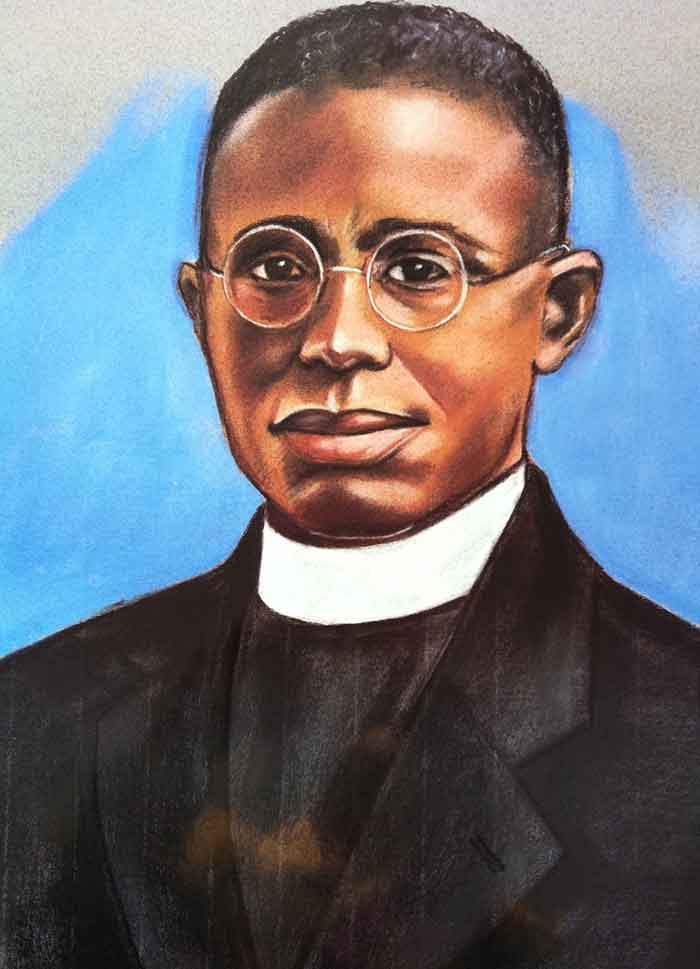
Bl Cyprian Michael Iwene Tansi
A priest in Nigeria and monk in England, Bl Cyprian Michael Iwene Tansi once taught a future cardinal. Günther Simmermacher looks at the life of the man who may become Africa’s next canonised saint.
Bl Tansi at a glance
Name at birth: Iwene Tansi
Born: September 1903 at Igboezunu, near Aguleri, Southern Nigeria Protectorate
Died: January 20, 1964, in Leicester, England
Beatified: March 22, 1998
Feast: January 20
As Blessed Benedict Daswa is to Southern Africa, so is Bl Cyprian Michael Iwene Tansi to Nigeria. While Daswa is a layman and martyr and Tansi was a priest and monk, both will hopefully join the still sparsely populated ranks of Africa’s canonised saints.

Like Daswa, Tansi was a convert to the Catholic faith. He was born as Iwene Tansi in 1903 to non-Christian parents in Igboezunu, near Aguleri in southern Nigeria; his birth-name means “Don’t let malice kill”. He grew up in a region that was oppressed by colonial exploiters, the ruthless and sometimes murderous Royal Niger Company (RNC; now part of the Unilever group).
Tansi’s family was determined that their first-born son would be well-educated, so that the family could escape the clutches of poverty and colonialism. That education was provided at Holy Trinity School in Onitsha, run by the Holy Ghost Fathers. There Tansi was baptised at the age of nine, and christened Michael. Tansi, who was blind in one eye as a result of a mud-fight with other children, was precocious and studious. He became an altar-server and later a catechist. After his schooling, Tansi became a teacher in Catholic schools, but he was already hearing the call to the Catholic priesthood.
Call to priesthood
As in many parts of Africa, the local Church had no great interest in an indigenous clergy, seeing even converted Igbo like Tansi as still being steeped in paganism. Local men were allowed to enter the seminary, but they were held to strictest standards. Most candidates were eventually expelled or left the seminary.
Tansi’s family was also opposed to their eldest becoming a priest. He had received a good education so that he would become a successful businessman and thereby pull the family out of poverty. Nevertheless, in 1925 Tansi entered St Paul Seminary in Igbariam. It took 12 years before he was ordained for the vicariate of Onitsha-Owerri, in the cathedral of the Most Holy Trinity on December 19, 1937. He was only the second indigenous priest of the diocese.
Unlike most other priests, local or missionary, Tansi opted for an austere lifestyle, living the poverty of the people he served. A talented builder, he helped locals construct their homes, and organised relief for the poor.
As parish priest of Dunukofia, in the Umudioka region, Fr Tansi took a particular interest in marriage preparation. A tough disciplinarian, he set up women’s groups to police the ban on premarital relations and abortion. He was also strict with the children of the parochial school — among them was the future Cardinal Francis Arinze. Fr Tansi successfully established a League of Mary, and promoted devotion to the Sacred Heart, Our Lady, and the Rosary.
Fr Tansi, whose preferred mode of transport was a bicycle, tirelessly visited villages in the area to catechise and evangelise. The many prayer centres he set up went on to become parishes. He fought paganism by disproving superstitions and by condemning witchhunts.
He actively opposed what we today call gender-based violence. On one occasion, he intervened in the attempted gang-rape of a parishioner. Fr Tansi helped the woman fight off her four attackers, and then supported her in a court case against the assailants. Her court victory was a milestone in the development of women’s rights in Nigeria.
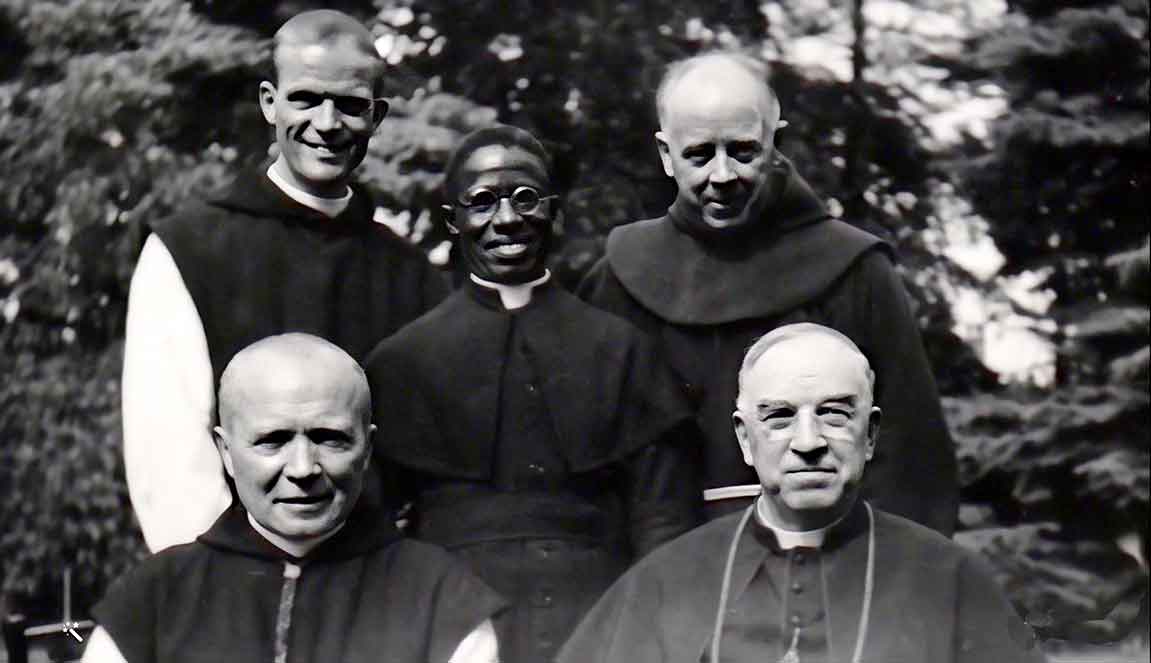
Bl Tansi with fellow Cistercian monks in Leicestershire, England.
Call to monastic life
By 1949, Fr Tansi discerned a call to the monastic life. There were no contemplative monasteries in Nigeria, but his bishop saw value in sending locals to cloisters in Europe, with a view of their returning to Nigeria to help establish monasteries there. Fr Tansi was sent to the Cistercian (or Trappist) monastery of Mount St Bernard in Leicestershire, England, to begin his novitiate. Having first taken a group of parishioners on a pilgrimage to Rome, he arrived there on June 8, 1950, and took the religious name Cyprian, after the Roman martyr.
It surely was not easy for a man of 47 who had been in charge of parishes for more than a decade to submit to the strict disciplines of the novitiate. Indeed, he came to realise and even regret his own disciplinarian excesses as a parish priest in Nigeria. But he lived his monastic life with discipline, dedication and humility, and on 8 December, 1956, was solemnly professed. He worked in the monastery’s vegetable gardens, refectory and bookbindery.
Living in England came as a culture shock to Fr Tansi. While he did not experience much of the racism he had feared, he initially struggled with the weather. He got used to the winter’s cold eventually, and later made gentle fun of new African novices who were experiencing snow for the first time, jokingly advising them to catch the snowflakes and mail them home to Africa.
Plans for Africa
In the early 1960s plans were made for Fr Tansi to return to Africa as a novice master in a Cistercian monastery. Political tension following Nigerian independence — the Igbo would by 1967 try to secede, leading to the genocidal Biafran war — prevented the very disappointed Fr Tansi from being posted to his home country. Instead he was to go to Cameroon, but poor health kept him in England.
On January 19, 1964, Fr Tansi was found unconscious and was rushed to a hospital in Leicester. The doctors there were confounded by the priest reporting just “a little pain” when his diagnosed thrombosis should have produced excruciating agony. He died the following morning, January 20, of an aortic aneurysm at the age of 60. Two days later he was buried at Mount St Bernard monastery. In 1986, Fr Tansi came home. His body was interred in the priests’ cemetery near the Onitsha basilica where he had been ordained half a century earlier.
By then, devotion to the holy priest and monk was already widespread in Nigeria and England. In 1998, he became the first West African to be beatified, during a visit to Nigeria by Pope John Paul II. Following the beatification his remains were translated to the parish church at Aguleri. His feast day is on January 20.
Published in the January 2023 issue of The Southern Cross magazine

- Shrines around the World: Our Lady of Beauraing - March 21, 2026
- St Patrick: From Slave to Apostle - March 17, 2026
- New Cape Town Archbishop Calls For Unity and Prophetic Courage - March 14, 2026



