Pray with the Pope: The terrible price of rattling sabres
Every month Fr Chris Chatteris SJ reflects on Pope Leo XIV’s prayer intention –
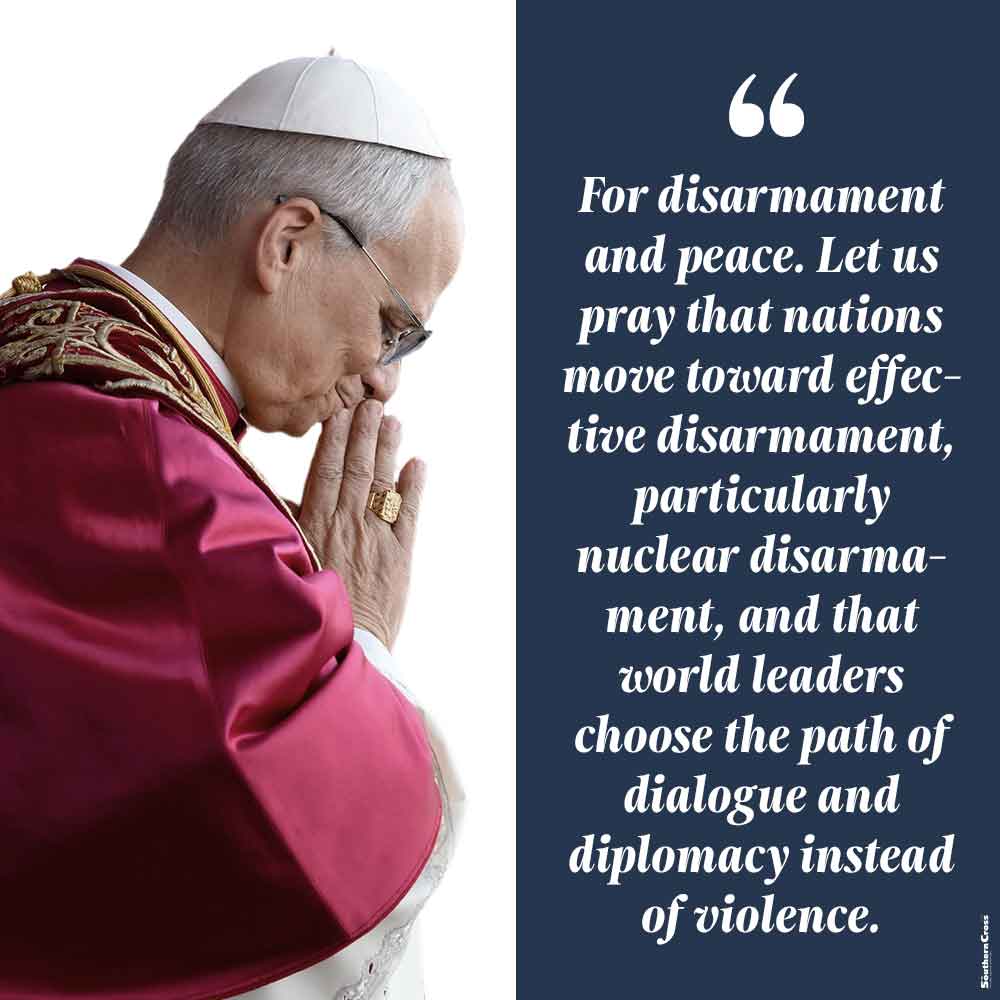
Intention: For disarmament and peace. Let us pray that nations move toward effective disarmament, particularly nuclear disarmament, and that world leaders choose the path of dialogue and diplomacy instead of violence.
A deep concern around the Russian invasion of Ukraine, and the grinding war there, has been whether Vladimir Putin would resort to the use of nuclear weapons. Mercifully, he hasn’t, yet. However, some commentators have pointed out that the destruction wreaked in this war looks eerily similar to that visited upon the Japanese cities of Hiroshima and Nagasaki in World War II.

Gaza too looks like it has been hit by a nuclear bomb, and indeed in terms of kiloton equivalents of TNT, Hiroshima and Nagasaki have been long surpassed in both Gaza and Ukraine. One can conclude therefore, that while the focus on nuclear weapons is understandable given the unimaginable destruction the world would suffer as a result of a full-scale nuclear war, we need to keep a keen eye upon the other so-called “developments” in the area of conventional weapons.
Robots choose targets
For example, a most worrying development in the technology of weaponry is the use of artificial intelligence to guide and target the drones, artillery and missiles, which are the weapons which currently cause the most casualties among soldiers and civilians. In fact machines are already deciding what and whom to target, and this raises enormous questions about the morality of modern, industrial-scale, mechanised warfare conducted by robots.
Another issue, so clearly illustrated by the invasion of Ukraine, is that military technology is changing at a dizzying rate. How ethical and moral reflection can keep up with this pace is a major problem. Things on the battlefield evolve so quickly that ethicists and moral theologians are in danger of always discussing yesterday’s moral problems.
We cannot flinch from the bleakness of our contemporary situation with regard to armaments. For the world is rearming because, as Pope Leo XIV, recently warned, “War is back in vogue.”
The European nations, whose political experiment of the European Union was so successful in preventing conflict in Europe, is now spending more of its GDP on arms than at any time since the Second World War. The problem with increasing stocks of weapons is that there will always be people who will be tempted to put them to work.
Arms race costs the poor
The wider implications are economic. At the beginning of the Russo-Ukraine war, the Israeli intellectual Yuval Harari said that this war is not just a tragedy for the belligerents but also for wider society. As the world spends ever-greater sums on arms, it spends less and less on healthcare, education and human development generally. It is the poorest of the earth who suffer most from the increased spending on killing technology.
A time will come when the present round of conflicts will end, and hopefully God will have spared us a Third World War, or a nuclear one. We pray that at that point there will be much global introspection about the folly of what was allowed to happen.
Until then we continue to hope and pray for peace and that leaders and citizens will hold back from the worst excesses which are enabled by the terrible weapons we now possess and instead choose the path of dialogue and diplomacy.

- Pray with the Pope: Understand and back our priests - April 6, 2026
- Pray with the Pope: The terrible price of rattling sabres - March 3, 2026
- Pray with the Pope: For the Suffering of Children - February 2, 2026