St Frances of Rome: The Reluctant Wife who Became a Saint
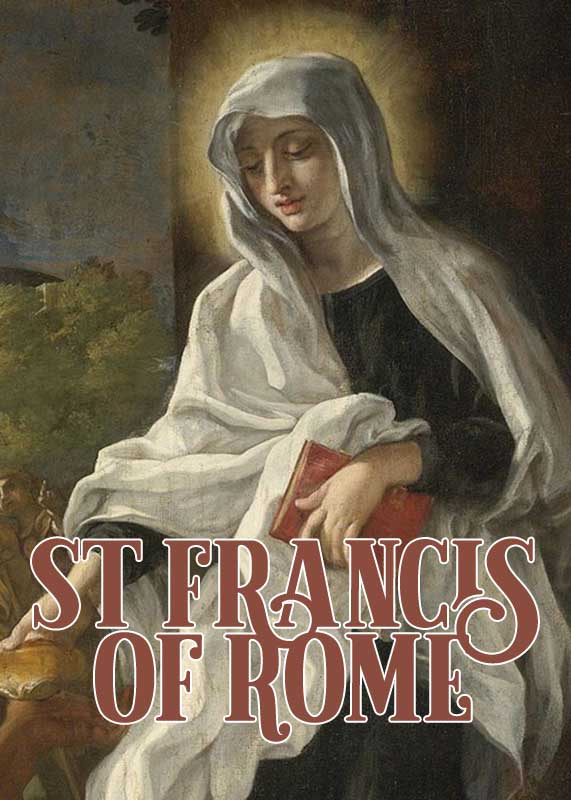
When 13-year-old Frances of Rome was told to get married, she thought God called her to be a nun. But the Lord had other plans for her.
The Church is nothing if not inventive in assigning patronages to saints. In 1925, Pope Pius XI declared St Frances of Rome the patron saint of automobile drivers, even though she was born half a millennium before its invention. Why? Because a legend had it that an angel used to light the road before St Frances with a lantern when she was travelling, thus keeping her safe.
Born in 1384 as Francesca Bussa de’ Leoni to a wealthy noble family in Rome, Frances was baptised in the church of St Agnes on the city’s famous Navona Square. She was a quiet girl with a deep devotion to God, but also strong-willed. By the time she was 11, Frances was convinced that God was calling her to become a nun.

Her father, however, had other plans, having promised his daughter to the son of another wealthy family. For Frances, the idea of matrimony was abhorrent — she wanted to be a Bride of Christ, not the bride of a man — so she prayed fervently to God that he might prevent the marriage. One day her confessor asked: “Are you crying because you want to do God’s will or because you want God to do your will?” Reluctantly, Frances consented to matrimony. She was 13 years old, at the time a normal age for marriage.
Parties instead of penance
It was a match many other girls would dream of. The groom, Lorenzo Ponziani, was noble, wealthy and kind, and he genuinely cared for his bride. But the shy girl was thrust into a whirlwind social life of parties and entertaining which didn’t suit her introverted temperament. It was a far cry from the life of fasting and penance she had pictured for herself.
Soon Frances was exhausted and collapsed. For months she was ill, unable to eat, speak or even move. A vision of St Alexis, a 5th-century nobleman who had renounced worldly life to become a beggar when his family tried to force him to marry, finally lifted the girl from her malaise.
St Alexis told her that God was giving her an important choice: “Do you want to recover or not?” After praying, eventually she whispered a response: “God’s will is mine.” St Alexis replied: “Then you will live to glorify his Name.” Frances’ recovery was immediate and complete.
Lorenzo became even more devoted to Frances, but her in-laws still expected Frances to entertain and socialise, living the good life which she sought to shun. The family wondered why Frances could not be more like her joyful sister-in-law Vannozza, a natural socialite.
One day, Frances confided the source of her unhappiness to Vannozza — and learned that her easy-going sister-in-law too had longed for a life devoted to the Lord. From then on, they became close friends.
They agreed to prioritise their family obligations. So Frances dressed according to her status, made and received visits, and performed all her duties cheerfully. She said: “A married woman must, when called upon, leave her devotions to God at the altar to find him in her household affairs.”
But she and Vannozza also attended Mass together, visited prisons, served in hospitals, and engaged in acts of charity, even as people gossiped about these two noble girls fraternising with the poor. They even set up a secret chapel in an abandoned tower of their palace where they could pray.

Madonna and child, St Frances of Rome and St Benedict on a door fresco in the monastery di Tor de Specchi, painted by Antoniazzo Romano (1430-1510)
The mistress of the house
With the dawn of a new century, Frances gave birth to her and Lorenzo’s first son, named Battista after John the Baptist. Soon afterwards, her mother-in-law died, and Frances, now 16, was tasked with managing the large Ponziani household. Even as she was thrust even deeper into social responsibilities, Frances turned out to be an excellent administrator and mistress of the house.
She had five more children — son Giovanni Evangelista and daughter Agnes, and three who died in infancy.
When a devastating flood brought disease and famine to Rome, Frances ordered that no one asking for alms should be turned away. She and Vannozza ventured out to distribute grain, wine, oil and clothing to the needy. Her father-in-law, however, was furious at such generosity during a famine, and sold off their surplus provisions, leaving just enough for the family.
In their desperation to feed the poor, the two noblewomen even resorted to begging on the streets. When Lorenzo and his father saw that provisions had run out, not least because Frances had diverted some to feed the needy, they were not pleased. After praying, Frances led the family to the cellar, and miraculously the wine cask was full and the store was filled with choice grain.
These miracles converted both men, and Frances was free to pursue her charitable calling. She sold her jewellery and finery, distributing the proceeds to the needy and adopting a simple dress of coarse green cloth instead.
Caught up in civil war
Soon after that, civil unrest engulfed Rome, as the pope and rival anti-popes vied for power. Lorenzo remained loyal to the pope in Rome. According to one account, their son Battista was to be delivered as a hostage to the commander of the Neapolitan troops, the cruel Count Troja. Frances tried to flee with her son, but on the way she encountered her spiritual advisor, Don Andrea, who urged her to trust God and comply with Troja’s order. On their way, she stopped at the church of the Aracoeli to entrust her son’s life to the Blessed Mother.
When they reached the designated site, the soldiers attempted to place Battista on a horse for transport to captivity. However, the horse refused to move, as did all others. Recognising this as a sign of divine intervention, the soldiers returned the boy to his mother.
Yet troubles continued. After Lorenzo fled Rome to evade capture, Frances was left alone to face the attackers. Drunken invaders broke into her home, tortured and killed her servants, tore the palace apart, and took Battista to Naples. This kidnapping likely saved his life, as a plague soon struck, claiming many lives, including Frances’ nine-year-old son Evangelista, and a year later daughter Agnes.
Charity amid wreckage
The home in ruins, her husband in exile, two children dead and another a hostage, Frances could have given up. Instead, she cleared the wreckage from the family’s palace, and transformed it into a makeshift hospital and shelter for the homeless.
Eventually, the war ended, and both Battista and Lorenzo returned home. However, while her son came back as a charming young man, her husband returned broken in mind and body. One of the most challenging tasks of Frances’s life was restoring Lorenzo to his former self.
All the while, Frances was under the protective company of an angel — the one which lit her way in darkness and protected her from harm. In a vision, the angel instructed Frances to cease her self-mortifications.

The tomb of St Frances in the crypt of the basilica of Santa Francesca Romana in Rome. (Photo: Kent Wang/Creative Commons)
Founding of monastery
With Lorenzo’s support, Frances founded the Oblates of Mary, a lay confraternity of pious women, under the authority of the Olivetan Benedictines. The date was August 15, 1425, the feast of the Assumption. The women lived in the world but pledged themselves to God and the service of the poor. Eventually, they bought a house where widowed members could live in community, the Santa Maria Annunziata a Tor de Specchi, near the Roman forum. That community still exists today.
Frances cared for Lorenzo until his death in 1436. His final words to her were: “I feel as if my whole life has been one beautiful dream of purest happiness. God has given me so much in your love.” After his passing, Frances moved into the house with the other Oblates and was appointed superior.
At the age of 52, she finally entered the life she had dreamed of since childhood. She had been correct in discerning her original vocation, but just had the timing wrong, for God had other plans for her in the intervening years.
Frances died four years later, on March 9, 1440. By the time of her death, she was revered by the Romans as a woman of great holiness and charity, a Mother Teresa of the 15th century.
She was canonised by Pope Paul V in 1608. Her long-lost grave was identified in 1638, and her remains were reburied in the church of Santa Maria Nova (now commonly known as the church of St Frances) in 1649, where they are now displayed, vested in the Oblate Sisters’ habit, in a glass coffin.
St Frances is the patron of widows, Benedictine oblates, and, as mentioned, motorists. She is also a co-patron of the city of Rome.
Published in the March 2025 issue of The Southern Cross

- Easter Prayer - March 31, 2026
- The Silent Strength of St Joseph: Why Men Must Take Their Place Again - March 31, 2026
- The Angelus Prayer - March 25, 2026