ANCIENT TALES FOR MODERN TIMES: Reflections on Abraham and his Children, by Chris N van der Merwe. Lux Verbi.BM, Wellington. 2008. 191pp. Reviewed by Michail Rassool 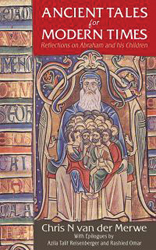 Afrikaans Professor Chris van der Merwe presents the stories of Old Testament patriarchs Abraham, Isaac, Jacob and Joseph in a refreshing way, showing them as flawed men highly favoured by God, expected to be heroic and honourable to those around them, despite their tremendous errors in judgment, derelictions, and so on. Ancient Tales for Modern Times contains 40 reflections, all from Genesis — the number is designed to facilitate Lenten reflections. Given that Van der Merwe comes from a Dutch Reformed background, this is a profoundly ecumenical endeavour.
The University of Cape Town academic presents the patriarchs’ human characteristics and their lived experiences in a way that ordinary readers can fully relate to. He shows how Abraham — whom Christians see as the “great champion of faith, the one who sacrifices everything for what he believes to be the commands of God” — is not always consistent in exercising that faith and makes major decisions without first consulting God. This meant that invariably things went wrong — something that may well resonate with many people. Yet he puts self-interest aside when those he loves are in trouble, coming to their aid against insurmountable odds, armed only with faith, invoking the name of his beloved Lord with success. Prefiguring Jesus, God’s relationship with Abraham, his chosen one, is experienced as a personal one. Many of life’s lessons for Abraham were hard, and often they were taught to him by God himself, directly. Van der Merwe points out that, even then, when the first organised people of God — already understood to constitute a nation — were really a band of tribal people led by their provident God through their leader Abraham, into a land that augured well for their survival, God did not just operate for their benefit but also for others. “The people of the covenant are not chosen because they are naturally better than others, but because God has a special purpose for them that will benefit the whole world,” Van der Merwe writes.
He shows that the same lessons for families in the 21st century apply to the time of Abraham’s son Isaac, when he and his wife Rebekah employ and encourage the earthly (read “ungodly”) values of favouritism, rivalry, envy, jealousy, even treachery, in the raising of their twin sons, Esau and Jacob. It is a pattern that is repeated in the next generation, also with long-term and far-reaching consequences. Esau, a robust, physically capable, gauche man’s man is his father’s favourite, while the quiet, shy and retiring, albeit cunning Jacob is his mother’s favourite. But as man’s — or rather, the world’s — standards do not necessarily translate into God’s standards, in the end it is the ostensibly weaker, more vulnerable one, Jacob, who assumes leadership over the Canaanites, God’s chosen people — again, prefiguring Jesus, God’s powerful son, the babe in the manger — however treacherously this may have come about. Van der Merwe shows that Jacob’s becoming patriarch is not founded on any sterling qualities of character either, and he is clearly in need of God’s mercy.
As he lurches from one complicated situation to another, often involving women, God guides him, teaches him, instructs him, in direct and indirect ways — something that may enable many believers who live complicated 21st-century lives to relate to him. In this way, Jacob had to learn that the presence of God was not restricted to his father’s house, but that he was present everywhere, and that whatever good fortune he has is ascribed to God alone. He was slow to realise that, and his journey to sanctification was long and hard. Joseph, the pompous, self-centred dreamer, is no less flawed than his forebears, and his own road to sanctification is experienced as life way outside of Canaan, among heathens. Being led to slavery in Egypt and rising in the ranks of Egyptian society, in the end he survives well in a society albeit as the perennial outsider, a situation that constantly forces him to take stock of the values of his fathers and apply them to his own situation. Two epilogues — by local Rabbi Azila Reisenberger and Imam Rashied Omar — reflect the patriarchs’ significance for Judaism and Islam. The book can be used for individual or group study and reflection during the 40 days of Lent, or be read as a whole at any time. Michail Rassool is a staff writer at The Southern Cross.

- When was Jesus born? An investigation - December 13, 2022
- Bishop: Nigeria worse off now - June 22, 2022
- St Mary of the Angels Parish puts Laudato Si’ into Action - June 17, 2022