
Pius XII: Not the full story yet
A Cross Too Heavy: Eugenio Pacelli, Politics and the Jews of Europe, 1917-1943, by Paul O’Shea. Rosenberg, Kenthurst, Australia. 2008. 392 pp
Pius XII: The Hound of Hitler, by Gerald Noel. Continuum, London. 2008. 220 pp.
Reviewed by Eugene Fisher
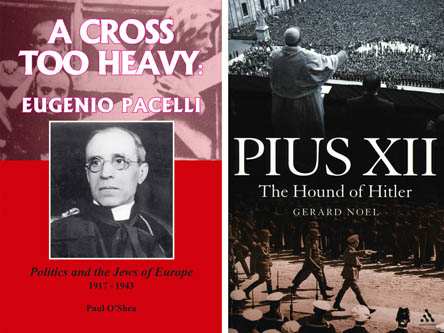 Since disaffected Catholic journalist John Cornwell published his high-rhetoric, low-research attack on Pope Pius XII, Hitler’s Pope, in 1999, some 20 books, pro and con, have been published on the subject of the pope and the Holocaust. Only a few of these volumes can be said to be balanced accounts written for the educated lay reader.
A Cross Too Heavy, Paul O’Shea’s solid historical study, in the main, falls in that category, though it has its weaknesses.

O’Shea sets Eugenio Pacelli, the man, the diplomat and the pope, within the context of the times that produced him and the time of great evil, World War II, in which he began his papacy. The former, O’Shea shows, did not equip him well for the latter, though virtually no one, including US President Franklin D Roosevelt and British Prime Minister Winston Churchill, was able to rise above that tumultuous, insanely violent and almost infinitely complex time to understand fully what was happening to the Jews, much less devise a way to stop it.
One of O’Shea’s weaknesses, from this reviewer’s point of view, is his presumption that Pope Pius could and should have been able to do both. But the book’s strengths are what should guide the reader to this—though, again, without accepting uncritically the author’s rather negative judgments on Pope Pius. O’Shea quite rightly eschews the “black-and-white” approach of Cornwell and Daniel Jonah Goldhagen, striving to do justice to the complexity of the central questions — whether the pope did all he could and whether, if he had done more, it would have made a difference.
To his credit, O’Shea affirms the many things Pope Pius did to help the Jews and to encourage others to help them, while maintaining the public posture of neutrality that allowed Catholics to work to save Jews.
O’Shea rightly notes that Pope Pius’ decision to allow Catholics to determine how they could best help Jews, since they would have to live with the consequences if the Nazis found out, is understandable. He feels, though, that a more forceful, less diplomatic statement at a crucial time, which he determines to be in the autumn of 1943, would have encouraged many more Catholics to risk their lives for their neighbours. Readers can make up their own minds on this.
The most serious flaw in this book is the author’s decision to cut off his considerations in 1943, with the round-up for deportation of more than 1000 of the Jews of Rome. Scholars debate the intent and impact of the warning to the Germans by Cardinal Luigi Maglione, Vatican secretary of state, that the pope would not want to have to go public denouncing the round-up. The Germans took this, O’Shea himself records, as a threat, and stopped the round-ups immediately, with the result that the large majority of Rome’s Jews were saved.
O’Shea feels the pope should have gone public even though he had stopped the deportations and provided for the Jews of Rome to hide (and so survive) in the Church’s convents and monasteries. He does not seem to be aware that food was brought to the sites hiding Jews by trucks owned and operated by the Holy See.
By arbitrarily stopping his study so long before the end of the war, O’Shea is not able to take into account significant deeds such as the saving of tens of thousands of lives quite directly by the papal nuncios in, for example, Budapest and Istanbul. While we still await a definitive and fully balanced study of Pius XII and the Jews, this book is at least a worthy beginning toward that end.
Gerald Noel’s Pius XII: The Hound of Hitler is harder to categorise. He seeks not just to tell the story but to examine the psychology of the pope. At times, Pope Pius is described as imperious, harbouring in secret a “great design” which would create a “world theocracy” with the pope as its dictator. At other times, however, his pope appears weak, neurotic and vacillating, easily manipulated by the nun who cared for him, Mother Pascalina.
Here, Noel relies much too heavily on the 1983 book La Popessa, which most historians would take with a grain of salt. I counted about 236 references to this book, with several chapters being, in essence, simply summaries of it.
It also is not helpful that Noel’s notes record almost 100 references to Cornwell’s Hitler’s Pope. And I noted several historical errors that research could have avoided, such as when Fr Charles Coughlin was effectively silenced by his bishop and the Holy See, which was a few years later than Noel records.
I believe that scholars may profit discerningly from this book, which does push the envelope of received assumptions from different angles. But I would not recommend it for the general reader.—CNS
Eugene Fisher is a retired associate director of the Secretariat of Ecumenical and Interreligious Affairs of the US Conference of Catholic Bishops.
- When was Jesus born? An investigation - December 13, 2022
- Bishop: Nigeria worse off now - June 22, 2022
- St Mary of the Angels Parish puts Laudato Si’ into Action - June 17, 2022



