Mind-blowing news
Without his resurrection from the dead, Jesus of Nazareth probably would have been a minor footnote in local Jerusalem history, one of many temporary would-be messiahs who came to an inglorious end.
Without the resurrection, there would have been no Church. After the execution of Jesus, the dispirited disciples had started to make plans to return to their old lives in Galilee (the only non-Galilean of the Twelve had by then committed suicide). Some, like Thomas, had already split, receiving the news that Christ was alive later, much to his incredulity.
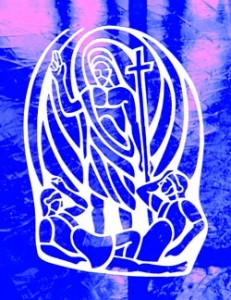
Christ rises from his tomb in this depiction by Teresa Wo Ye at St Ignatius cathedral in Shanghai, China. (CNS photo: Nancy Wiechec)
It was the discovery of the open tomb by Mary Magdalen, Mary, mother of James, and Salome that changed everything. The disciples began to understand the puzzling prophecies of Jesus; with the resurrection, the puzzle fell into place.

The birth and death of Christ are easy to understand. These events, the beginning and the end of a life, are common to every human being that has breathed on this earth. Some may quibble about the details, but it is not far-fetched to believe that Jesus was born in humble circumstances and died a violent death. The resurrection is more difficult to believe. People don’t tend to rise from the dead.
Remarkably, the late Jewish-Orthodox Rabbi and theologian Professor Pinchas Lapide argued that of all the extraordinary events described in the gospels, the resurrection is likely to be based in fact — the resuscitation of the dead by God is part of Jewish belief. However, like the noted scripture scholar Paula Frederiksen, also a Jew, he held that the apostles did not link the resurrection to Christ being the Messiah.
Nevertheless, something absolutely staggering must have had happened after Jesus’ crucifixion to explain the fervour with which those who believed proceeded to propagate the news of the Risen Christ, at a time when doing so was enormously dangerous.
The new religion grew quickly. Before too long, the Roman occupiers built a pagan temple above Calvary to dissuade the local Christians from praying at the site of the crucifixion and resurrection. Of course, this was a miscalculation: the temple pointed future generations of Christians to the location of the events it was meant to conceal.
We cannot overestimate the awe with which the very first Christians received the news of the risen Christ (never mind of actually encountering him). Indeed, we may be somewhat blasé about it, because for most of us the resurrection is an annual event. But we must not become casual about the meaning of Christ’s violent death and resurrection for humanity. Because of it, we have the choice of spending eternity in the presence of God.
That notion is awe-inspiring. Christ died and rose from the dead so that even the most abject of sinners may have the opportunity of being redeemed, as Jesus promised while he was on earth.
At the core of the Church’s mission is the mind-blowing knowledge that every human being can attain salvation through Christ. This is good news for those of us striving to live as virtuous a life as we can.
But it is also alarming news because even the most repugnant individuals can be saved. Even Adolf Hitler, with his final breath, might genuinely have sought redemption. In his mercy, the Church teaches, God would have had mercy on Hitler’s soul (in the event, it is unlikely that Hitler gave God any thought at all).
Something quite incredible happened in Jerusalem that Passover weekend almost 2000 years ago. And because of it, something incredible is happening every day. That is what we celebrate at Easter.

- The Look of Christ - May 24, 2022
- Putting Down a Sleeping Toddler at Communion? - March 30, 2022
- To See Our Good News - March 23, 2022