
Letters reveal saintly Dorothy Day’s mind
ALL THE WAY TO HEAVEN: The Selected Letters Of Dorothy Day, edited by Robert Ellsberg. Marquette University Press. 2010. 408pp. ISBN: 0767932811
Reviewed by Paddy Kearney
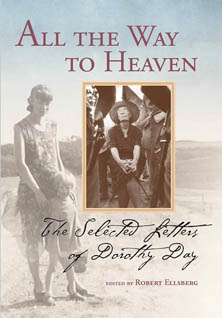 Dorothy Day was perhaps the most influential Catholic woman in the United States during the 20th century.
Twenty years after her death in 1980, Cardinal John OConnor of New York petitioned the Vatican for her cause of canonisation to be instituted. If Day is canonised one day, she will be a dramatically different saint from most of those recognised in this way, but in good company with Augustine of Hippo.
As a young woman, she had an abortion (which she regretted every day of her life thereafter), lived with a man and bore an illegitimate child, and after a year-long marriage to another man, walked out on him.

The rest of her life was what might be called repentance through good works, like founding and sustaining the Catholic Worker, a weekly newspaper, as well as numerous Catholic Worker (CW) houses where vast numbers of poor and troubled people found shelter. A noted pacifist she frequently went to prison for her anti-war activities.
Not that Day had any aspirations to be declared a saint in fact, quite the opposite. Rather cheekily she said that she didnt want to be trivialised by canonisation, and thought the money needed for the lengthy process should rather be spent on the poor.
Robert Ellsberg, who edited her letters, had already edited her diaries for a book entitled The Duty of Delight: The Diaries of Dorothy Day. He was able to start on these two magisterial works only in 2005 after the 25 years during which her papers had been sealed in accordance with her wishes.
As she had kept no copies of her letters, Ellsberg had to depend on those of her correspondents who preserved their letters and were willing to make them available.
It seems that Day spent a large part of her time writing letters so that by the time of her old age she wrote about the burden of an immense correspondence that I cannot keep up with. The burden must have been all the greater because, according to Ellsberg, in every case she connected intensely with the needs of her correspondents just as she did with the people close at hand. Some letters could only be written after an hour in the presence of the Blessed Sacrament.
The book begins with what Ellsberg entitles A Love Story, which covers 1922-32, the time of her relationship with Forster Batterham, a man she greatly loved, the father of her child, Tamar. Days relationship with Batterham, though passionate, was doomed to failure. He did not believe in marriage and she felt she could not continue to live with him if they were not married. Do I have to be condemned to celibacy all my days, just because of your pig-headedness? she wrote. Ultimately, however, she had to say: It is hard for me to take you seriously you despise so utterly the things that mean so much to me.

Once she had decided that she would not go on trying to persuade her beloved Forster, she threw herself into a completely different life, the catalyst for which was meeting Peter Maurin, described as a French peasant philosopher, a man 20 years her senior.
What they had in common, according to Ellsberg, was a passion to connect their faith with the pressing social issues of the day. She liked Maurins idea of starting a newspaper that would promote solidarity with the workers and criticise the social system from the perspective of the Gospel. Hence the well-known Catholic Worker newspaper came into existence as well as the network of Catholic Worker houses, which would spring up in cities across the US over the next decades, intended to hold up a Utopian ideal an actual Gospel view of life.
In the 1940s, Day insisted that a strictly pacifist position be taken by the Catholic Worker. Those CW communities that refused to distribute the paper for that reason, were told in no uncertain terms that they should disaffiliate from the movement. This made life difficult for Day, adding to all the problems caused by people (some of them very odd and some even with mental problems) who gravitated to the CW communities whether to assist as volunteers or as beneficiaries, including a number of priests with drinking problems. Day displayed what the Vaticans Congregation for the Causes of Saints would call heroic virtue in assisting all these awkward clients, but at least her letters gave her a chance to sound off about the problems they caused.
This made life difficult for Day. God be praised, I am deluged with many troubles and anxieties, she writes in one letter, and the work proceeds with the utmost difficulties. At least 75% of the CW movement is against me, and my feathers are torn out one by one. Not every letter, however, elicited that heroic virtue. Hows this for a frank opening line: I could curse and tear my hair out whenever I read one of your letters.
Among the most fascinating letters are those to the hierarchy. Though immensely respectful in such correspondence Day did not feel she needed the permission of bishops or clergy to start a [CW] house or to practise the works of mercyIf they do not like it, they can tell us to stop and we will gladly do so. She called herself an obedient Catholic and there was no doubt about her fierce commitment to the Church: … nothing would ever drive me from the Church. No pronouncement from the Pope or the Bishops, no matter how wrong I thought them, would cause me to leave the Church.
Catherine of Siena would have been proud of her bold approach to Cardinal Spellman of New York who was refusing to meet with Catholic grave diggers on strike: You are the outstanding Cardinal of the Church in America, a diplomat, a confidant of Pope and President. You are a Prince of the Church, and a great man in the eyes of the world. These your opponents are all little men, hard-working day labourers, hard-handed and hard-headed men, filled with their grievances. … Oh, I do beg you so, with all my heart, to go to them, as a father to his children.
To her arsenal of prayer and letters she added another weapon. It was not enough just to pray that people would change their attitude or behaviour (or to plead with them in letters). Penance should be added. In that spirit she gladly accepted the daily insults that came her way.
When she was frequently jailed for civil disobedience she was pleased that at least for a short time (a day, a week, a month) she shared a little of the misery of the poor. For the same reason she declined about 14 invitations to receive honorary doctorates from Catholic colleges and universities. I have a deep conviction that we must stay as close as possible to the poor, as close to the bottom as we can, to walk the little way, as St Therese [of Lisieux] has it.
During Vatican II she came to Rome with 50 other women from around the world to fast for ten days while they lobbied various bishops (Durbans Denis Hurley among them) to vote for a complete ban on nuclear weapons. The Gandhian technique adopted by the women fasting she said was actually the Christ technique…to transform others, to change their attitudes, instead of just winning a victory over them.
Robert Ellsberg has done a magnificent job in revealing the fascinating Dorothy Day through her letters.
- When was Jesus born? An investigation - December 13, 2022
- Bishop: Nigeria worse off now - June 22, 2022
- St Mary of the Angels Parish puts Laudato Si’ into Action - June 17, 2022



