Training Guide Dogs Costs R100 000 Each
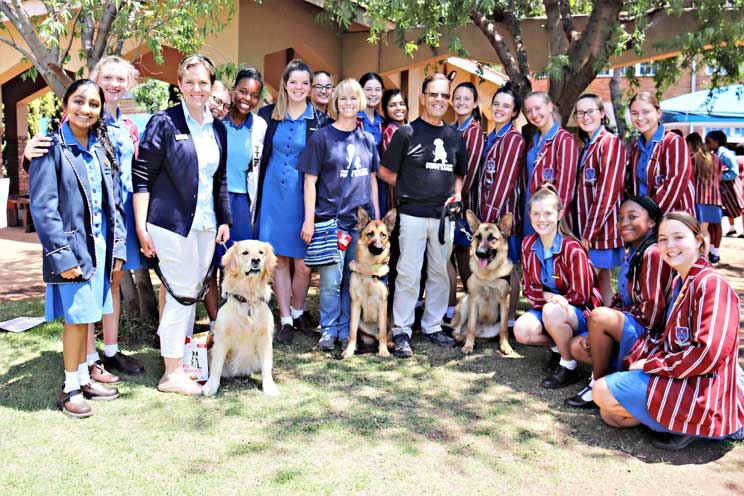
Holy Rosary High School in Johannesburg hosted members of the SA Guide-Dogs Association for the Blind and guide dogs for a talk on the work of the association. The school also raised R3000 for them.
It costs up to R100000 to train a guide dog for the blind, and the South African Guide-Dogs Association for the Blind (GDA) has various programmes to raise money for the training of the dogs.
The GDA receives no government funding, and relies heavily on a variety of sponsorships from different individuals and organisations.
Holy Rosary High School in Edenvale, Johannesburg, decided to help by raising funds for the GDA and creating awareness, and welcomed three guide and support dogs — Elizah, Eaton and Daisy — at the school with their trainers.

Melanie Nel of the association educated pupils on the importance of guide and support dogs in enhancing the independence and mobility of people who have visual, physical and developmental needs in South Africa.
The Guide Dogs Origin
The GDA is a registered non-profit organisation and was founded in 1953 by Gladys Evans. Besides training guide dogs, a programme started in 1990 also trains autism support dogs.
Ms Nel explained that guide dogs are used to help specifically those who are visually impaired, while support dogs are used for people who are partially or fully disabled.
“The support dogs are trained in special skills, for example to open and close doors, retrieve items, take off shoes, switch on lights,” she said.
“They help with daily skills, for example how to make coffee with boiling water in a safe way, or how to identify different types of clothing, thus enabling people to live independent and mobile lives,” Ms Nel said.
Support dogs for children with autism, she added, “act as companions, but also provide a way for family to manage going out of the house”.
The GDA also trains visually impaired people on how to use their long white canes.
“When dogs graduate [from their training], they are matched with our applicants based on personality,” Ms Nel said.
“We want working dogs to be available to any person, regardless of their financial position. Working dog owners need to be able to afford to care for a working dog on a monthly basis,” she said.
“The working dog owner is responsible for the feeding and routine veterinary care of the dog. The working dog owner pays R205 which includes a trained working dog, the training/accommodation, and equipment.”
Holy Rosary’s Contribution
Holy Rosary High hosted a civvies day and raised more than R3000 for the GDA.
Deidre Alcock, the school’s marketer, said that “it’s important to get involved with your community and to try to help people where you can”.
“The guide dogs do so much, and the dogs can’t do it themselves — they need funding. It is up to our community to help them,” she said.
Mmabatho Koena, in charge of marketing at the GDA, outlined the association’s fundraising initiatives. For example, in the “Sponsor a Working Dog” programme, a school, organisation or individual raises between R5000 and R100000 to sponsor a puppy or working dog for a “puppy scholarship”.
Members of the public are also welcome to volunteer at GDA. “Every little bit counts,” Ms Koena said.
For more information or to donate see www.guidedog.org.za/

- What Are Stole Fees? Why is There Such A Fuss About Them? - February 4, 2025
- Padre Pio: Holy and Controversial - September 23, 2020
- St. Augustine Of Hippo: 10 Facts Every Catholic Should Know - August 28, 2020