
Why St Dominic is Important Today

Dominican Father Albert Nolan in 2014 with then-novices Brs Boiketlo Mohlokoana, Sikhosiphi Mgoza, Ernest Mwape and Guide Marambanyika, wearing the distinctive black and white of the Dominican order.
Fr Joseph Falkiner OP looks at the many innovations that St Dominic, the founder of the Dominican Order, brought to the Church.
Name at birth: Domingo Félix de Guzmán
Born: August 8, 1170 in Caleruega (present-day Spain)
Died: August 6, 1221 (aged 50) Bologna (present-day Italy)
Founded Dominicans: 1216 in Toulouse, France
Canonised: July 13, 1234
Feast: August 8
Patronages: Astronomers; the falsely accused
The best way to remember St Dominic is to recall that he was an innovator of many things that we regard as common in the Church today. For example, Dominic established the rosary as a widespread prayer in the Church. Rosary beads existed before his time, but without the list of mysteries to be contemplated. That apparently came from Dominic, and we believe that he got the idea from Our Lady herself.

Another example: We take it for granted that when we go to church on Sundays we will hear a sermon. That was not common 800 years ago, when preaching was largely reserved for bishops. Dominic had to get permission from the pope to start a special Order of Preachers — the proper name of the order of Dominican friars, hence the letters OP after the names of its priests — and today every priest and deacon in the world preaches regularly.
Founding the Order of Preachers was not all Dominic did. He began devising new ideas for the Church at least ten years before his order was officially founded. It happened when he saw that huge change was necessary in the popular Church, at the grassroots.
His first innovation here was to bring about, in the long-term, a change in the way the Church treated the thousands of people who had strayed from the orthodox doctrines of Christianity and been declared heretics. The Church persecuted them atrociously. Dominic started a new method. He began discussions with grassroots heretics, with the idea of bringing them back gently to the faith.
He succeeded in only a small way because of the widespread persecution of heretics by others — ten years after Dominic’s death the Inquisition was set up in France — but one might say that his idea was the start of the ecumenism which today is accepted so widely in the Church.
Bringing back heretics
The Catholic Church at that time was seen by the heretics to promote violence, to be rich, corrupt and immoral. The heretics whom Dominic encountered in France promoted a pure spiritual life for both men and women. Dominic also noticed that, in their religion, they gave equal leadership roles to both genders. This might have been what attracted women to the heretical church in the first place.
He saw how valuable these women were in promoting piety. The first people whom Dominic brought back to the Catholic Church were women. He needed their backing if he was to bring about the further changes already simmering in his mind. Dominic was in no position to offer them equality in the Catholic Church, but he was able to create for them Catholic contemplative convents where they could run their own lives without being supervised by men.
Such convents have been protected by the Dominican Order to this day. Today the Catholic Church is still accused of allowing women no real roles in leadership, and the entire Dominican Order is trying to combat this.
Dominic was also able to bring back to the Church a number of heretics, among them men already accustomed to preaching. With them, he conceived the idea of a new religious order which would live a poor, simple lifestyle of contemplative prayer, but which would at the same time send its members out to preach correct doctrines to society at large. This meant further innovations to contemplative life and also to the value of study.
The innovation he made in contemplative religious life allowed contemplatives to venture out of seclusion to become preachers while still practising contemplation. Dominic strongly believed that all preaching needed to be based on a foundation of contemplative prayer. In his time, contemplative life was lived mainly by monks and nuns in rural monasteries, cut off from society. Dominic changed all that. His Dominican communities were to be placed at the heart of urban centres. They were to practise silent contemplation inside the house, but they were also to exercise a preaching apostolate outside of the house, reaching as many as possible.
The two activities were to go hand in hand. Out of this came one of the mottos of the Dominican order, “Contemplata aliis tradere”, which basically means, “to transmit to other people the results of our contemplation”. That was what Dominic meant by the word “preaching”. One of the greatest examples of putting this into practice 150 years later was a lay Dominican woman: St Catherine of Siena. Her relationship with Jesus through contemplation led St Catherine to become one of the greatest active reformers of the Church. She saw herself as a follower of St Dominic and always dressed herself in a Dominican habit.
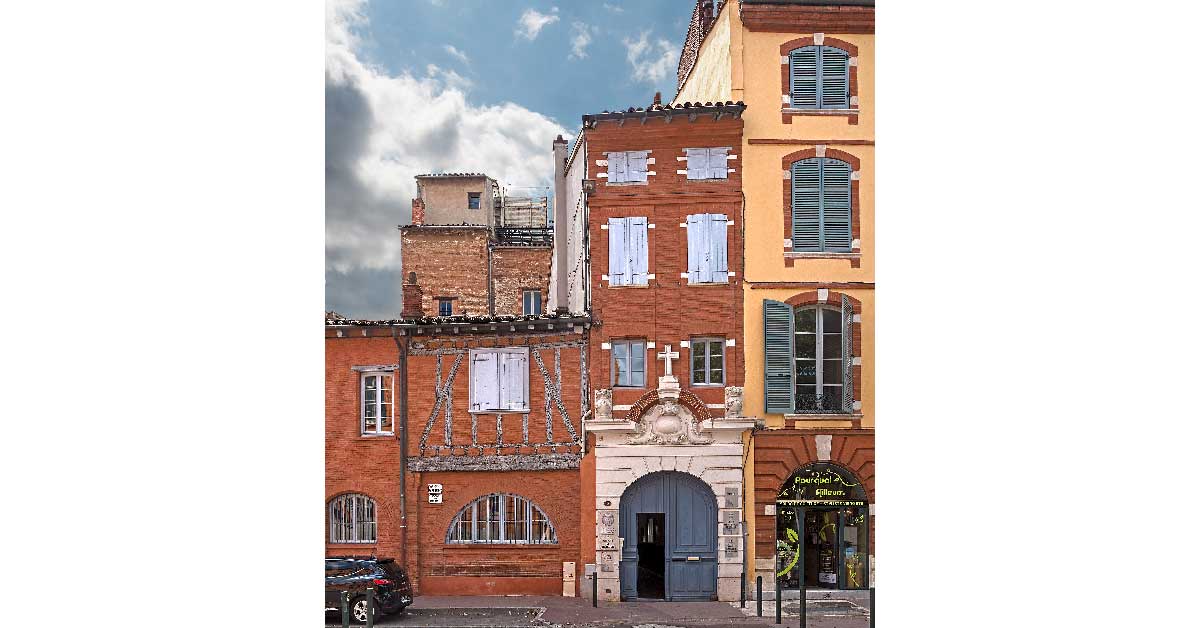
The house in Toulouse, France, where St Dominic first established the Order of Friars Preachers (or Dominicans) in 1216. Photo: Didier Descouens/CC BY-SA 4.0
The value of study
Regarding the value of study, Dominic saw an initial necessity for the ex-heretical preachers whom he had recruited to do a serious study of orthodox theology.
Part of their heretical theology had been that, while our souls were created by God, our bodily activities were the work of the devil. This had led them to condemn not only marriage and the begetting of children, but also to deny that Jesus Christ had a real body. They saw Jesus as a spirit of sorts, with only the appearance of a body. This was a denial of the Incarnation, a denial that Jesus was both true God and true man. So Dominic, before he sent them preaching on the road, directed them to the nearest city — the southern French town of Toulouse — to do the necessary studies. And he moved there with them.
From that moment he concerned himself with providing study houses for all his recruits, and not just for those who had been heretics. He established one such house in Paris and another in Bologna, near the universities already existing there. He wanted his followers to be well-educated not only in theology but also in contemporary issues, and then to preach about these matters in the light of God’s revelation. Contemplation, study, and preaching were to go together.
The search for Veritas
The search for God in daily life has gone on now for eight centuries, and Dominicans are encouraged to continue studying all their lives. It is called the search for Truth, and another of the Dominicans’ mottos is the Latin word for Truth: Veritas.
We have good South African examples of the search for truth — even our only Catholic radio station is called Veritas! Dominican men and women in our country are well-known for preaching on issues like apartheid, economic justice for the poor, class divisions in society, gender issues, women and child abuse, corruption, xenophobia, racism, the plight of refugees and similar issues. We have never had the resources to establish our own house of studies, but rely on what is taught in universities and in St Joseph’s Theological Institute in Cedara, KwaZulu-Natal. The brethren and sisters who have specialised in contemporary issues have often had to do their studies at the same time as working in parishes or schools.
For a follower of St Dominic, preaching does not mean only delivering homilies at Mass in a particular church. The transmission of what is learnt through contemplation and study can be carried out by living a certain way of life, by having discussion with people in a tavern (as Dominic himself did), by giving lectures, by writing articles and books, by visiting other towns and preaching there, by setting up a radio station, as the late Fr Emil Blaser OP did.
Dominic never allowed his brethren to live alone. They always live in a community house suitable for prayer and study. In such communities, brothers could share their lives, their ideas and their studies with each other and get support from their fellows. Community-life is important for Dominicans to this day.
This sums up Dominic’s greatest innovation, the Order of Preachers, which was founded only five years before his death. He wanted it to be poor with no landholdings or businesses to make it rich, with no fixed incomes, and to be dependent on God.
Democracy in action
One more innovation was to come. Two years after founding the order, Dominic called the first general chapter and announced that the delegates were to elect someone to be their master general. At that time, such a democratic process was unheard of in the Church (or, indeed, much of society). Dominic was introducing the Church to democracy. We celebrate him.
Today we live in the new normal of Covid-19, of the fantastic input of the Internet, of the terrible socio-economic division between rich and poor, of the rise in people making their own individual choices irrespective of what it does to others, of the threat of climate change, of the ongoing liberation of women from the domination of men, and notably of the fact that the Bible is now available in almost every language in the world for everyone to read.
We could ask ourselves what St Dominic would be promoting were he in South Africa today? We Dominicans, if we are to be true to our founder, have to face up to that question.
This article was published in the August 2021 issue of The Southern Cross
- Why St Dominic is Important Today - August 8, 2022
- We Are Still Choosing the Wrong Tree - July 19, 2022
- How St Antoninus Stood up to State Capture! - July 2, 2017



