
Is Church a Home for Homeless?
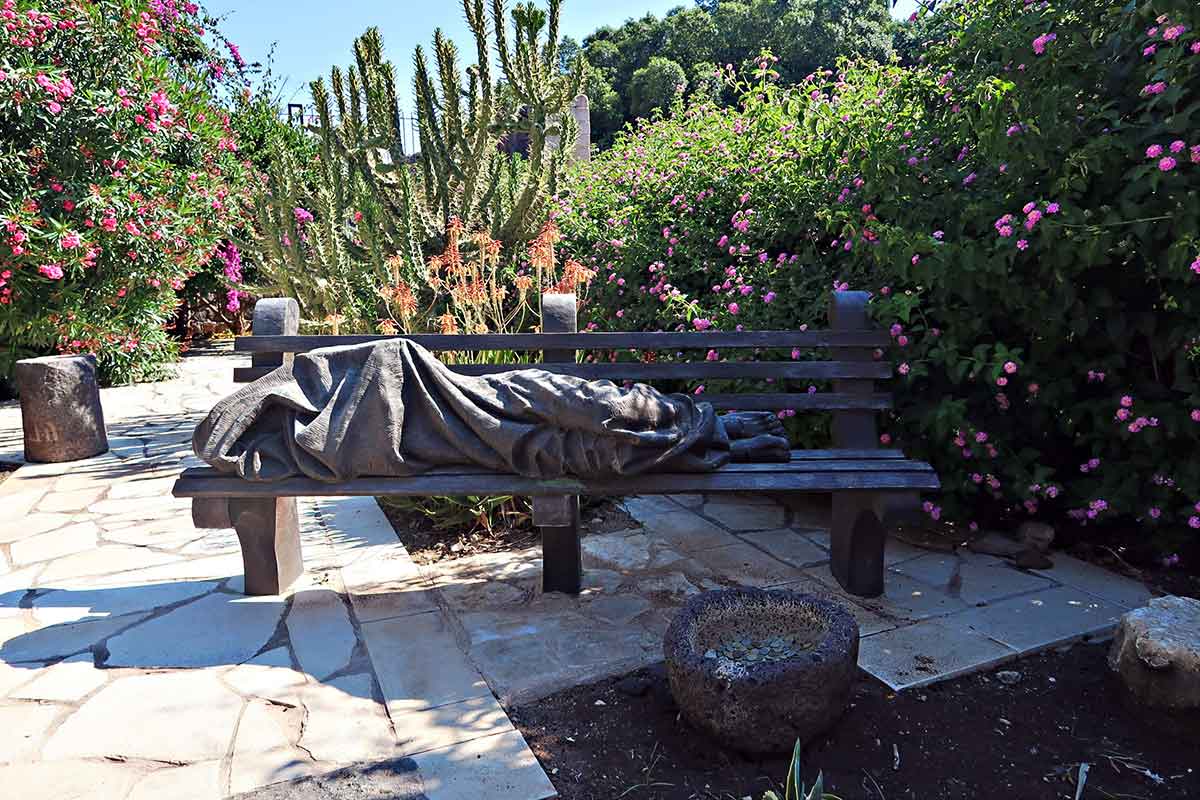
Sculpture of an anonymous homeless person in Caperrnaum, Holy Land, where Jesus ministered. (Photo: Günther Simmermacher)
Last month, I wrote about the synodality discussions that I hosted with leaders of other Christian denominations and other faiths. This month I want to look at people whom the Church should be serving but we often do not hear.
First, let me admit a failure. I had hoped to hear from two groups of people who, I feared, were feeling neglected or rejected by the Church: Catholics who have a disability (especially the blind and the deaf), and Catholics who identify as members of the LGBTQI community. Both are groups that know the Denis Hurley Centre in Durban, which I serve as director, and so I had hoped that an invitation from us might encourage them to want to talk.
However, in both cases there was an almost complete lack of interest in engaging. Perhaps they are already so disillusioned by the Church that they assume that there is nothing more to say.

I once asked a senior bishop why there was no sign-enabled Mass in any of the ten parishes in the city in his diocese. His words, without irony, were: “Well, as far as I can see, deaf people don’t come to Mass.” Exactly.
But one group that was keen to talk — perhaps because they are at the Denis Hurley Centre every day anyway — were homeless people. What they had to say was a chilling reminder to all of us who call ourselves Christians, whether Catholic or not. Their words are a direct challenge to how close we are to Pope Francis’ vision of being “the Church of the poor”.
They came from a wide variety of Christian traditions, but none of them felt they would be welcome in church now. “I last went 20 years ago — I would not go again,” said one. Another shared: “I used to look forward to Sundays, but not anymore.” Their main concern was the way in which other churchgoers would treat them. “It’s not what people say but the way they look at you. Or they just ignore you, or they shift to the side if you sit next to them.”
As they shared this, I was taken back to my own experience as a Jesuit novice, walking for four weeks across southern Germany — dirty, bearded and dark-skinned. I was helped by so many people on the way — but the only time I ever felt rejected was when I went into churches!
The parallels between their experiences and the parables in St Luke’s Gospel were striking. One person recalled being told to sit on the back row (Luke 18:10); one homeless woman was looked down on because she was not wearing high heels (16:19); one man was scared to go to church because he had nothing to put in the collection (21:1-4).
“We don’t feel that we are welcome… I feel like I don’t belong… there is too much judgment…They look at me as if I am in the wrong place… it’s in their faces, their eyes.”
Wary of going to church
One of the participants pointed out that when you are on the streets, you cannot cut your hair, you do not have nice clothes, you are not wearing proper shoes, you might not shower very often. “So a visit to church, instead of lifting you up, it just brings you down because of the way other people look at you.” No wonder they were wary of going back to church.
When asked if they would go into an empty church just to pray, most said no because they were worried about the security guards. “They assume that we are not there to pray but have some other agenda.” In any case, it was added: “The Church can be anywhere as long as the message is good.”
For those who had been in a church, it was not only the treatment by other churchgoers that they found off-putting. It was also felt that some denominations had lost touch with the basic truths, and “for them it is 120% about money”. One person specifically mentioned the appearance of QR codes on pews as a way of donating. “It shows that all they care about is the money.” Another described a church in which people went up to give in tiers, depending on how much they were donating. “Where does money fit into being at church?”
Their biggest reluctance was towards the churches where they grew up (regardless of denomination or location) for fear of the gossip. “It’s not that I have a problem with them but they have a problem with me.” Interestingly, they felt that, in Durban, it was the churches run by and for foreigners that were most welcoming.
They were asked to describe the kind of church which they would attend: “One where the sermon is not about money but about God.” “A place where they do not judge you.” “A church where people take a personal interest in me — as long as they ask in the right way.” “A place that will boost my confidence.” “A church that sees that I have talents and gives me a chance to use them.”
One man had had a positive experience of church when a pastor came and spoke to him: “He was not preaching at me, he just wanted to sit and listen — I felt a weight was lifted off my shoulders.”
They appreciated the efforts that churches put into providing food, clothes and other services. And they prefer the churches that do not make you pray in order to get food. “But I don’t just need to be fed physically! As a human I need to be fed spiritually; if I am dead spiritually then I know that soon my body will be dead as well.”
I felt shamed
That caused me to reflect on how well we serve them. I was especially shamed by this comment: “I know the doors are open for everyone, but perhaps if someone invited me, I would feel more welcome.” Though the Denis Hurley Centre is right next door to Emmanuel cathedral, we have never thought about how we can help homeless people feel that they can go in and be treated like everyone else. That is something that we and the Cathedral parish will now work on.
The group had not heard these words of Pope Francis but was very taken when they were quoted to them: “The Church should be the place that welcomes everyone and refuses no-one.” One homeless man used words that could also be words of Francis: “The work of the Church is to give people hope.”
I now know that we at the Denis Hurley Centre need to make that more clearly the focus of our mission. And, since every parish is the Church assembled, we can all think about how we can give people hope.
This column was published in the September issue of The Southern Cross magazine

- The Gift of the Irish - March 10, 2026
- Catholic Schools in the Market - February 10, 2026
- Ring the Bells for the New Year - January 5, 2026



