Who Will Crush the Serpent’s Head?

Question: My question refers to this line in the Douay-Rheims version of the Bible: “I will put enmities between thee and the woman, and thy seed and her seed: she shall crush thy head, and thou shalt lie in wait for her heel” (Genesis 3:13-15).
It has now become apparent that this was a translation error and the text should read “he shall crush thy head”, referring to Jesus, the seed of the woman. But this error has never been made public and is still quoted extensively to this day. It has given rise to vast theological disparities between Catholics and the rest of the Christian world. It was quietly changed in the current version we read at Mass, the RSV version, without anybody noticing, or worse, accusations of it “becoming a Protestant Bible”.
How did this happen and why is the Church silent about this?

Answer: This is a most interesting textual crux, and I am grateful to you for raising it. The facts are these: The Hebrew clearly reads, “he will strike your head”, though, interestingly the Jewish Publication Society translates it as “they shall strike at your head”, referring to the “offspring” (and thus avoiding any uncomfortable messianic implication).
As you point out, the Revised Standard Version (first published in 1952) — and the New Revised Standard Version (1989) and English Standard Version (2001), as well as the New American Bible (1970) — follows the Hebrew, and read “he”.
Likewise, the LXX (the Greek version of the Old Testament known as the Septuagint) reads a masculine pronoun, “he”; while the Jerusalem Bible, which is the version that in the UK we read at Mass, has “it”, which refers to the “offspring”.
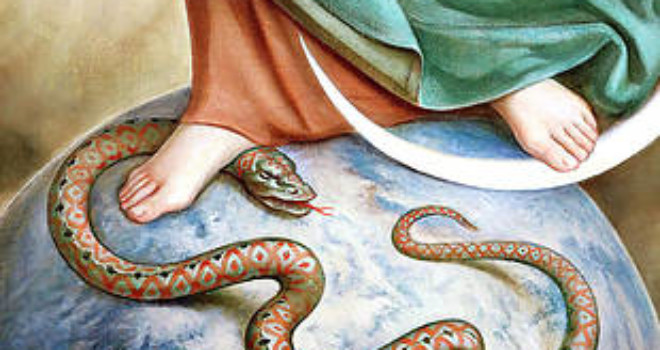
But as you quite correctly observe, the Douai-Rheims version reads “she”. The reason for that is that the Douai version set out to translate the Vulgate, St Jerome’s 4th-century Latin version; and the Vulgate reads “she”, which of course is frequently understood as referring to Our Lady, in this Messianic context. In that sense, this is not an error but simply a translation of what is in the text.
The question then becomes one of why the Vulgate reads “she”. To answer that question, alas, we simply do not have the evidence. So it is not accurate to claim that “it was quietly changed”, and that “the Church is silent about this”, as though something duplicitous had taken place. That is not how serious scholarship is done.
Equally, it is not the case that this variant reading “has given rise to vast theological disparities between Catholics and the rest of the Christian world”. It is undeniable that there are disagreements between Catholics and those of the Reformed tradition on the theology of the Mother of God; but they do not spring from this particular text.
Answered by Fr Nicholas King SJ in the January 2023 issue of The Southern Cross magazine

- The Angelus Prayer - March 25, 2026
- Palm Sunday Prayer - March 24, 2026
- Pope: We Cannot Remain Silent - March 24, 2026