
Can Apostolic Succession be Traced?
Question: The Church teaches that bishops and priests are the successors of the apostles. Can this line really be traced back to one or all of the original apostles?
Answer: The Twelve Apostles were the privileged eyewitnesses sent to proclaim the teachings of Jesus. The Gospel of Matthew (28:19-20) reflects the fact that Christ, following the resurrection, commissioned the apostles and guaranteed his help: “Go, therefore, and make disciples of all nations, baptising them in the name of the Father, and of the Son and of the Holy Spirit, teaching them to observe all that I have commanded you. And behold, I am with you always, until the end of the age.”
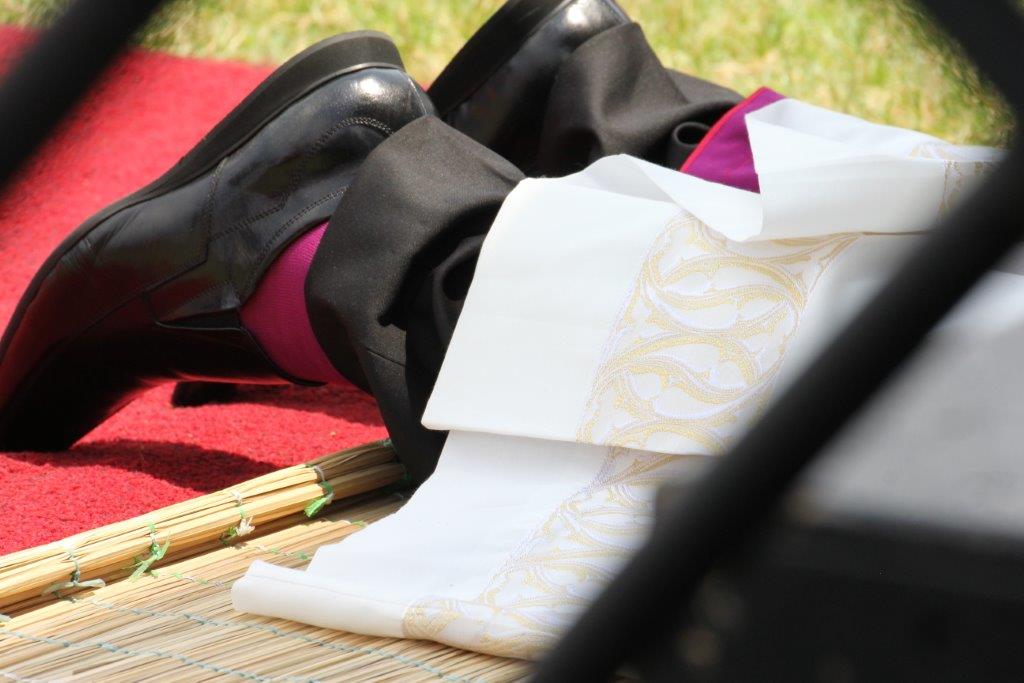
The feet of Bishop Victor Phalana during his episcopal ordination in Klerksdorp in 2015
It is the further belief of the Church, in what is known as the doctrine of apostolic succession, that bishops and priests (since they must be ordained by a bishop) are linked in an unbroken line to those same original apostles. It is the Church’s ancient belief that a bishop cannot have regular or valid orders unless he has been consecrated in this apostolic succession.

This means that every bishop throughout all ages was consecrated by other bishops, themselves consecrated similarly in a succession going back to the apostles. That is attested to in the First Epistle of Clement, which was written in the second half of the first century: “Our Apostles, too, by the instruction of our Lord Jesus Christ, knew that strife would arise concerning the dignity of a bishop; and on this account, having received perfect foreknowledge, they appointed the above-mentioned as bishops and deacons: and then gave a rule of succession, in order that, when they had fallen asleep, other men, who had been approved, might succeed to their ministry.”
Ancient office
The office of bishop existed from the earliest time. St Ignatius of Antioch — who lived from around 35 to 107 and is believed to have been a disciple of the apostle John — wrote: “For we ought to receive every one whom the Master of the house sends to be over his household, as we would do him that sent him. It is manifest, therefore, that we should look upon the bishop even as we would upon the Lord himself.”
The visible sign of ordination, from the New Testament onward, has been the imposition of hands. Thus, the transmission of the apostolic ministry is achieved by that ritual, together with the prayer of the celebrant that the ordinand be granted the gift of the Holy Spirit to accomplish the ministry for which he has been chosen.
Can apostolic lines be traced back to the original apostles? This might not be possible as documents have been lost over the past 19 centuries. However, there is no evidence of a point in history when the principle and teaching of apostolic succession was abandoned or disrupted. Available documented records tend to go back to the 16th century.
The photo illustrating this article shows the feet of Bishop Victor Phalana during his episcopal ordination in Klerksdorp in 2015. Bishop Phalana was consecrated by Archbishop William Slattery, who in turn was consecrated by then-Archbishop Wilfrid Napier, who was consecrated by Archbishop Denis Hurley, who was consecrated by Archbishop Martin Lucas, who was consecrated by Cardinal Pietro Fumasoni Biondi, who was consecrated by Cardinal Domenico Serafini, and so on, with the documented record going back to Cardinal Scipione Rebiba, who lived from 1504-77.
Published in the April issue of The Southern Cross magazine

- The Angelus Prayer - March 25, 2026
- Palm Sunday Prayer - March 24, 2026
- Pope: We Cannot Remain Silent - March 24, 2026



