
Pallottine Sisters’ First 100 years in South Africa
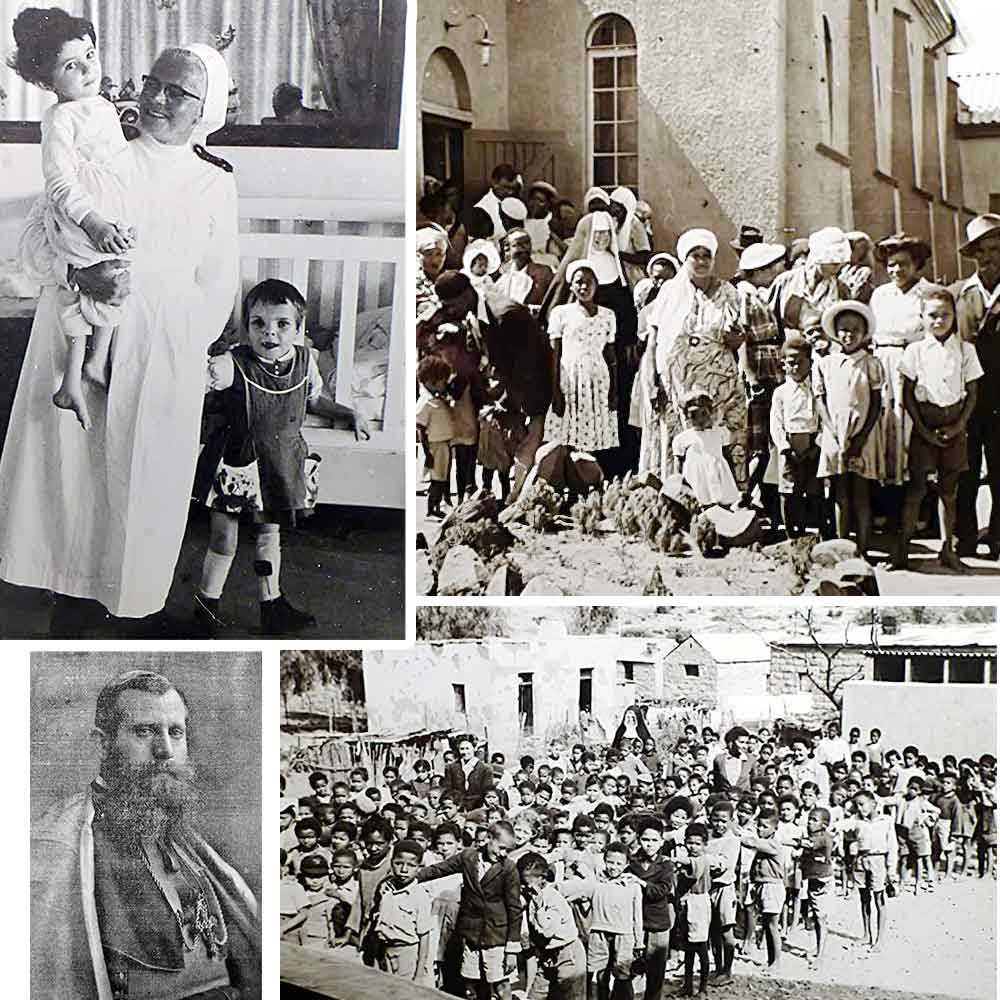
Top left: Sr Gizelinda SAC in Pinelands, Cape Town, in 1977. Top right: Sr Richmundis SAC with pupils in Beaufort West in 1958, and (below) Bishop Franziskus Hennemann in 1923 and The Pallottine Sisters’ school in Oudtshoorn.
In 1923, the first six Pallottine Sisters arrived in South Africa. Ronell Petersen tells their story.
In 1922, Bishop Franziskus Hennemann was sent to South Africa to take up the administration of the prefecture of Oudtshoorn. The Pallottine bishop, who had been expelled from the former German colony of Cameroon after World War I, saw the great poverty among the underprivileged in the area and decided to call for help.
Bishop Hennemann applied for missionaries to the superior general of the Pallottine Sisters in Limburg, Germany. The Pallottine Missionary Sisters of the Catholic Apostolate, as they are officially called today, answered the call, and the first group of six Sisters — Srs Pankratia, Apollonia, Julia, Liboria, Hieronyma and Rosa —boarded the ship Ussukuma for Cape Town on April 30, 1923. All but one of them had already known Bishop Hennemann from their time as missionaries in Cameroon.

On their arrival in Cape Town on June 1, they stayed with the Holy Cross Sisters before a train took them to George. There they were met by Bishop Hennemann who accompanied them on their way to Oudtshoorn, where they moved into the Sacred Heart convent. Their work in Northend could now begin.
In the morning they started school. Fourteen pupils were waiting in front of the convent, one room of which was to be used as a classroom. Two hours later, ten more children had arrived, and after two days their number had increased to 100. Soon two more classrooms were built, and a chapel was added.
Besides teaching, the Sisters visited neighbours and instructed those who wanted it in the Catholic faith. One of them, a trained nurse, visited the sick, distributed medicines, herbal tea and ointment, and gave instructions on personal hygiene and healthy nourishment.
The Sisters encountered adversities — such as people being suspicious of them, language, and the weather — but they steadfastly focused on addressing the great needs of underprivileged coloured people.
Second convent in Karoo
On August 1, two months after their arrival in the country, three Sisters travelled together with Bishop Hennemann to Beaufort West in the Karoo to open a new convent and to start a school in St Joseph’s parish. It was only on September 4 that the bishop managed to obtain a suitable house for them at an auction. On December 29 the Sisters could move into their new home, called St Joseph’s Convent. Already on October 8, they had opened their small convent school with 13 pupils, eight Catholics and five Protestants. With more Sisters arriving from Germany in the following years, their work grew and more ministries were taken on.
Among the pupils taught at St Joseph’s School were children from mixed-race marriages, which was “unacceptable” to the local white parents. The Sisters tried hard to keep these children but eventually were forced to dismiss them. In 1925 the government rejected Bishop Hennemann’s application to open a school for “non-white” children in Beaufort West. However, Sacred Heart School in Oudtshoorn was approved by the government and received a state subsidy. This meant a steady income for the community.
In June 1924 a little orphan boy had been placed into the care of the Pallottine Sisters in Oudtshoorn. By the end of the year, two more joined him. Soon the Sisters were asked to look after more orphaned children. Teaching in schools, religious instruction and pastoral care, nursing and health care, as well as the care of orphans were to be the main ministries of the Sisters in the coming decades.
Around 1930, four more convents were opened in the prefecture of Oudtshoorn. In 1929, the Sisters came to Rosemoor after Bishop Hennemann had negotiated with the municipality of George for permission to build a school, a church and a convent. These were dedicated to Mary, Queen of Apostles. Five years later, the connected orphanage was declared a state-subsidised institution.
In 1930, a second convent was opened in Beaufort West, at St John’s Mission near the coloured location.
In early 1931 the convent of the Holy Family was opened in Knysna. Finally, in 1935, the Sisters founded St Conrad’s convent in Waaikraal, 25km outside Oudtshoorn and inhabited by very poor people of colour.
However, after 1968, as in many other congregations, the situation of the Pallottine Missionary Sisters changed drastically. Very few new missionaries came from Germany, and of the seven South Africans who had entered, only four remained in the congregation. With the number of Sisters declining, St Joseph’s convent in Beaufort West was the first to close in 1970. St John’s in the same town and Knysna followed in 1979 and 1981, Oudtshoorn in 1995, and Rosemoor in 2000. With the closure of Waaikraal in 2007, the Pallottine Sisters ended almost 85 years of ministry in the diocese of Oudtshoorn.
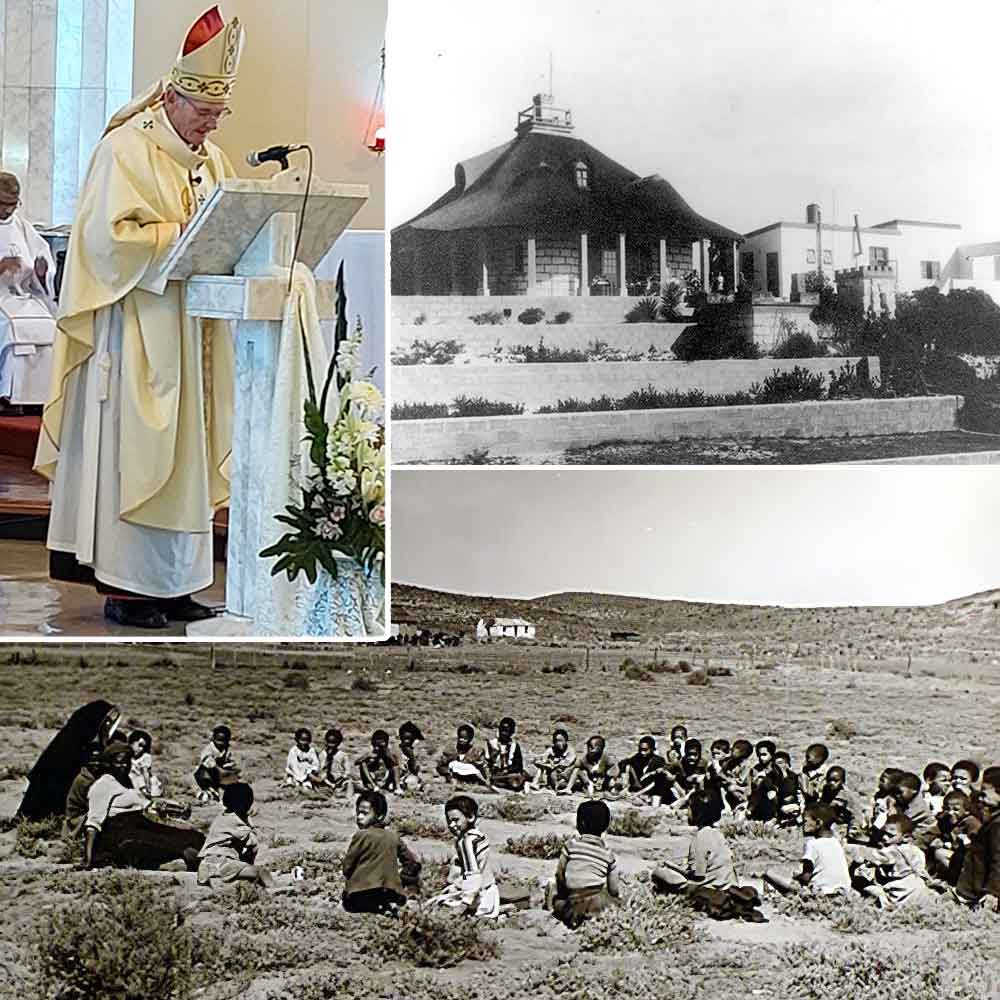
Top Left: Cardinal Stephen Brislin at the Mass marking the centenary of the Pallottine Sisters arriving in South Africa in St Joseph’s chapel, Montana, Cape Town. Top right: The first St Joseph’s Home in Philippi on the Cape Flats and below Sr Basildis SAC with children in Waaikraal, Eastern Cape, in 1960.
Outreach to Cape Town
In 1933, Bishop Hennemann was appointed vicar apostolic of Cape Town, and again he asked the Pallottine Missionary Sisters to come there. So in 1934, two Sisters started St Vincent convent at Koelenhof, near Stellenbosch, where they taught in the school. But when in 1953 it was decided to start a small hospital in George, the convent in Koelenhof was closed.
In April 1935, St Mary’s Children’s Home at Rosemoor had a government inspection. Being pleased with what he saw, the inspector asked the Sisters whether they could help in the outskirts of Cape Town, where tuberculosis was ravaging the population, and many children with bone TB were left uncared for. Bishop Hennemann was consulted, and he found fairly suitable accommodation on a big plot in Philippi on the Cape Flats. A state subsidy was promised from the beginning. On October 3, 1935, the first eleven sick children arrived at Philippi, and soon afterwards four more came. The patients were admitted irrespective of race or religion.
As more and more patients needed admission, the house soon proved to be far too small, and in March 1937 construction began on a new building. Eight months later it was blessed and opened. People from neighbouring parishes arranged joyous celebrations for the children and organised a bazaar to help to pay off the incurred debt.
St Joseph’s Home, as it was now called, continued to grow and has developed to become a widely admired intermediate paediatric care facility. Located on Pallotti Road in Montana, it is now the only institution still run by the Sisters.
A famous hospital
For a long time there had been calls for a small hospital to serve Catholics in Cape Town. However, negotiations dragged on, and more and more obstacles had to be overcome. Finally, in September 1937 the building of St Joseph’s Sanatorium started in Pinelands, and on June 4, 1938, the first patient was admitted. Two weeks later, the formal blessing by Bishop Hennemann and the official opening of the hospital by the mayor of Cape Town took place.
During the first year, the Sisters nursed 720 patients. Over the years, extensions were built and new wards were added to the hospital. By 1963, there were 120 beds, with 48 of them in the maternity section. In 1972, it was decided to change the name to Vincent Pallotti Hospital. As it developed into a top-class facility, the name of the founder of the congregation is better known in Cape Town than anywhere else in South Africa — even if most residents have no idea who Vincent Pallotti was.
In the 1990s, Afrox Healthcare in Johannesburg (today Life Healthcare Group) wanted to buy a hospital in Cape Town. Hearing that the Sisters were struggling with competition from the many private hospitals in Cape Town, they made an offer to buy the hospital from the Pallottines. The offer was considered at various levels of the congregation and with the hospital’s board. The sale took place on May 5, 2000, with the hospital retaining the name of the saint. The Sisters built a new convent next to the hospital.
After 2000, some of the old missionaries from Germany left South Africa and joined the German province of the Pallottines. Questions about the future of the South African province were raised, also at the global level of the congregation. And so, in August 2011 the first new missionaries arrived, now from India and Tanzania.
Today there are two international communities in Cape Town, with ten Pallottine Missionary Sisters — South African, German, Indian and Tanzanian. In St Vincent Pallotti convent near the hospital, elderly Sisters can be cared for, and at St Joseph’s Children’s Home one Sister works as a registered nurse and another in the social work department.
The centenary of the Pallottine Sisters was commemorated and celebrated on September 12, 2023, in the chapel of St Joseph’s, in the presence of Cardinal Stephen Brislin, who as archbishop of Cape Town is a successor of Bishop Hennemann.
Published in the January 2024 issue of The Southern Cross magazine

- The Angelus Prayer - March 25, 2026
- Palm Sunday Prayer - March 24, 2026
- Pope: We Cannot Remain Silent - March 24, 2026



