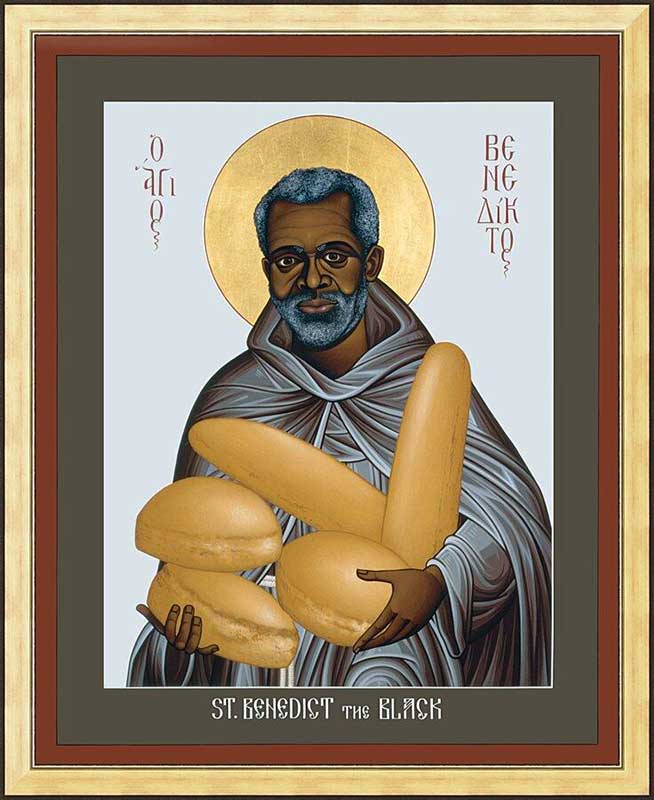
In the 16th century, the son of African slaves became the most beloved religious figure in Sicily, though all he really wanted was to pray and cook. This is the story of St Benedict the Black, or St Benedict of Palermo.
A man whose parents had been kidnapped from Africa to be enslaved in Italy became a much-loved Franciscan monk and eventually a saint.
St Benedict the Black — sometimes called “the African”, and previously even “the Moor”, despite having no North African heritage — was born in 1526 (other sources say 1524) on the estate of Chevalier de Lanza at San Fratello, near Messina in Sicily.

His parents were recently freed slaves, who had been given the names Cristoforo and Diana Manasseri after they had been taken from an unknown African country. While enslaved, they refused to sleep in the same hut because they did not want to have children born into slavery.
Cristoforo and Diana were converts to Christianity, and so Benedict was raised in the faith.
Like most peasants at the time, Benedict was illiterate and did not receive formal education. In his youth, he worked as a shepherd and farm labourer. He was known for his generosity, often giving away his earnings to the poor.
Racism and the humble status of his parents often subjected him to ridicule and scorn from others, but he endured these indignities with unwavering patience and courage.
When Benedict was 21, his patient response to public racial abuse caught the attention of Fr Jerome Lanza, the leader of a group of hermits living near Monte Pellegrino, who followed the Rule of St Francis. Impressed by Benedict’s humility, the leader invited him to join the community.
Benedict had felt a call to a life of deeper spirituality for a while, so after a brief time of reflection, he gave up all his possessions, including his valued oxen, and joined the hermits.
Becoming a monk
At first, he served as the community’s cook, but his devout nature, kindness, wisdom and spirituality stood out. At the age of 28, he succeeded Fr Lanza, who had died, as their leader. Benedict did not enjoy that position of authority but carried it out with humility and ability.
In 1562, Pope Pius IV disbanded all independent communities of hermits, and ordered them to be attached to an established religious order. Given their Franciscan spirituality, Benedict’s community joined the Order of Friars Minor. In 1564, Benedict was sent to the Franciscan friary of St Mary of Jesus in Palermo. Again, he started out as a cook, a role he relished.
Benedict’s humility and spiritual gifts, as well as his astonishing intuitive grasp of complex theology, led to his appointment as novice master. Later, in 1578, he was named guardian (or superior) of the friary in Palermo. Both appointments were special honours as these positions were rarely held by Brothers at the time, less so those who were illiterate. But Benedict accepted these promotions only under duress, strictly in obedience to the Franciscan Rule.
Humility in authority
Even in authority, Benedict showed a deep sense of humility, also in his relationships with others. Once, he corrected a novice and assigned him a penance. When he learnt that the young man had been innocent of the accusation, Benedict spontaneously knelt before the novice and asked for his forgiveness.
When his term as guardian ended, Benedict was initially appointed as an instructor, but at his own request soon returned to working in the friary kitchen, where he was at his happiest.
In the meantime, the local people began to seek his counsel. Legend says that even wild animals respected the cave where Benedict and his fellow Franciscans kept their vigils and fasts. Benedict also performed miracles, curing the sick through prayer and the Sign of the Cross. Word of his miraculous works spread quickly, and soon people came from afar to seek his intercessions. Even the archbishop and the viceroy of Sicily came to see him.
As Benedict continued to perform healings, the number of people seeking his help became overwhelming. At times, he would retreat into the bushes to pray secretly for those in need of healing, always attributing the miracles to the Blessed Virgin and not to himself.
Glow in prayer
In his later years, Benedict lived a life of simplicity. His devotion to prayer was so intense that his face often appeared to be glowing with a miraculous light. On one occasion, his cell became so brightly illuminated that the other friars rushed to it with buckets of water, fearing it was on fire.
Through it all, Benedict experienced spiritual warfare, by the frequent torment of demons.
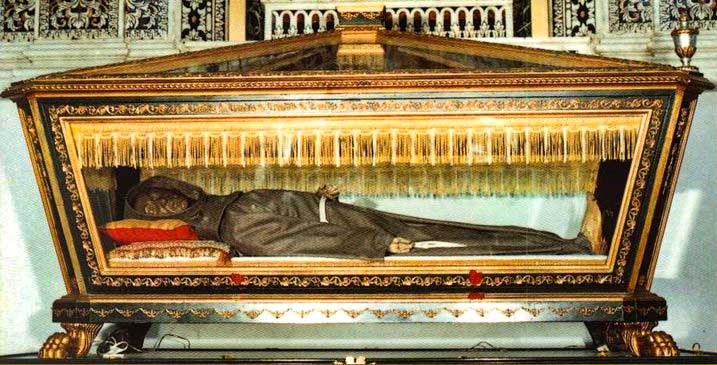
Benedict died on April 4, 1589, at the age of 62 or 63. After his death, King Philip III of Spain, the ruler of Sicily, commissioned the construction of an ornate tomb in honour of the beloved friar.
Benedict Manesseri was beatified in 1734 by Pope Benedict XIV and canonised on May 24, 1807, by Pope Pius VII. When his body was exhumed some years later, it was found to be incorrupt.
His major shrine was located at the convent of Santa Maria di Gesù al Capo in Palermo. The church and his relics fell victim to wildfires in July 2023. Only the saint’s skull was saved from the fires.
In South Africa, Sebokeng parish in the archdiocese of Johannesburg is dedicated to St Benedict the Black.
St Benedict is the patron saint of African missions and black people. His feast is on April 4.

- Sydney Duval: We Call him Friend - October 8, 2026
- St Francis and Mission - October 6, 2026
- St Francis of Assisi: Creation and Brotherhood - September 28, 2026