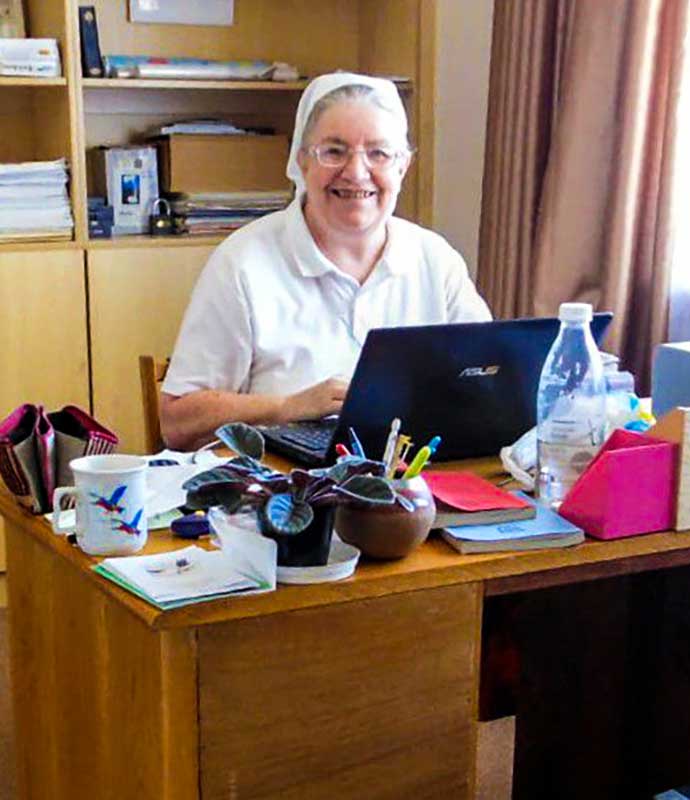
Born in troubled Northern Ireland, Holy Cross Sister Maureen Rooney faced apartheid when she was sent to South Africa more than 50 years ago. She told Daluxolo Moloantoa about her life as a religious Sister in education.
One of the great names in Catholic education in South Africa is that of Holy Cross Sister Maureen Rooney. The name on her baptismal certificate is Anne-Marie, but the name by which she grew up and has lived her life is Maureen.
Sr Maureen was born on April 12, 1944, in Loughinisland, in Northern Ireland’s County Down, to Denis and Rosaleen Rooney. “My parents christened me Anne-Marie but they never called me that. They always called me Maureen. Nobody knows the Anne Marie part except government birth registry officials,” she joked. She was the seventh child of 12 children — eight boys and four girls. Three of her siblings have passed away.
She recalls the ration books that followed World War II, but more present were the deep religious and political divisions in Northern Ireland. Her education and social life were entirely Catholic. “I hardly ever met a Protestant,” Sr Maureen noted. “I went to Catholic primary and secondary schools and then at university my friends were Catholic, and the Catholic chaplaincy was where I belonged.”

She studied Latin and mathematics. Her subjects and social environment reinforced existing separations. “Most of the people doing Latin were Catholics. Mathematics didn’t require much interaction, so I didn’t break out of the Catholic ghetto.” Social life reflected the broader segregation of Northern Ireland. “We went to Catholic dance halls. Socially we stuck to our own. It was very much a segregated society between Catholics and Protestants.”
Growing up oppressed
Growing up in Northern Ireland, Maureen became increasingly aware of discrimination. She described her Catholic community as second-class citizens under a Protestant Unionist government loyal to London. “We regarded ourselves as being oppressed,” she said. “Catholics were ‘not to be trusted’, and were kept out of all government jobs and promotion.”
Despite these limitations, she progressed academically. Maureen was the first in her family to attend a grammar school — to which pupils were admitted on the basis of ability — and the first woman in her family to go to university.
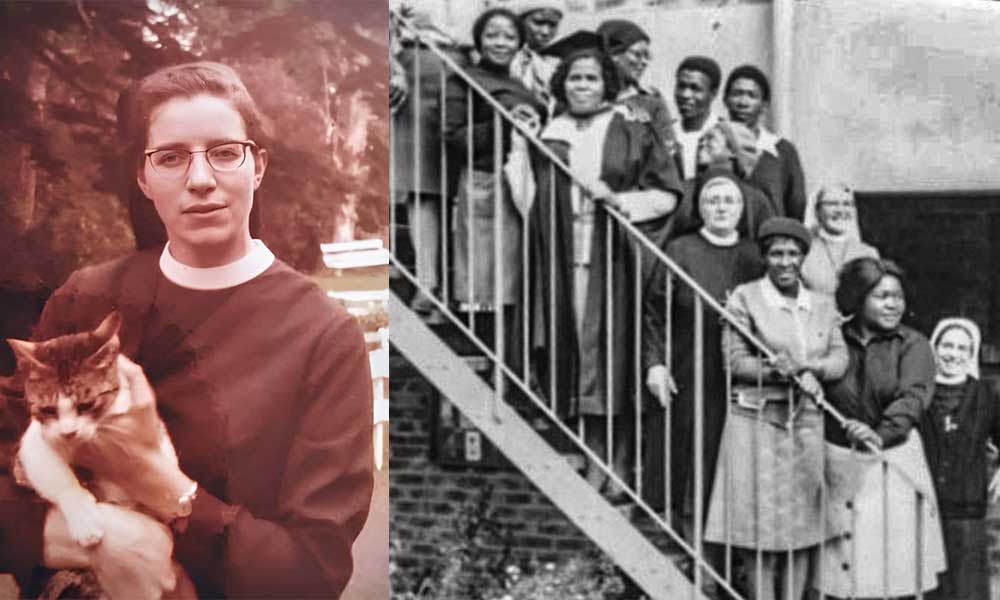
Before entering religious life, Maureen taught for two years in Nigeria’s Yoruba region at a girls’ school which was part of a mission compound. “I had never been out of Ireland before,” she recalled. “I even had to get used to people from Southern Ireland because most of the Sisters and priests were from there.”
After completing her teaching stint in Nigeria, she returned to Northern Ireland to finally answer a call she had heard since childhood: to become a religious Sister. She entered the convent at the Holy Cross Sisters in Belfast.
Coming to South Africa
After postgraduate studies in theology in Rome, Sr Maureen arrived in South Africa in 1974 and was assigned to teach at Soweto’s Immaculata High School. Apartheid regulations forbid the Sisters from living in Soweto. This meant that ten Holy Cross Sisters travelled every day by combi from their convent in nearby Mondeor to the school on the eastern edge of Soweto.
She taught at the high school, where responsibilities were shared among the Sisters. “It was a combined effort,” she said. “One Sister did cooking and ran the tuck shop, another did cleaning and handwork, and the rest of us taught.”
Sr Maureen arrived shortly before the political unrest that culminated in the June 16, 1976 uprisings, which were sparked by the government’s imposition of Afrikaans as a medium of instruction. “It was horrible,” Sr Maureen recalled. “The children were already learning through English, which wasn’t their home language, and now they were expected to learn half their subjects through Afrikaans.”
Catholic schools did not implement the Afrikaans medium directive, but followed the prescribed syllabus to ensure pupils could complete matriculation. At that time, Immaculata High School was the only Catholic secondary school in Soweto. While aware of growing unrest, the school community remained largely unaffected until June 16, 1976.
Sr Maureen later spent nine years in Zimbabwe. While she shared in the optimism of the country’s independence, she was also aware of emerging difficulties. “I had enough knowledge of history to know that liberation movements don’t solve all problems,” she reflected.
Sent to Transkei
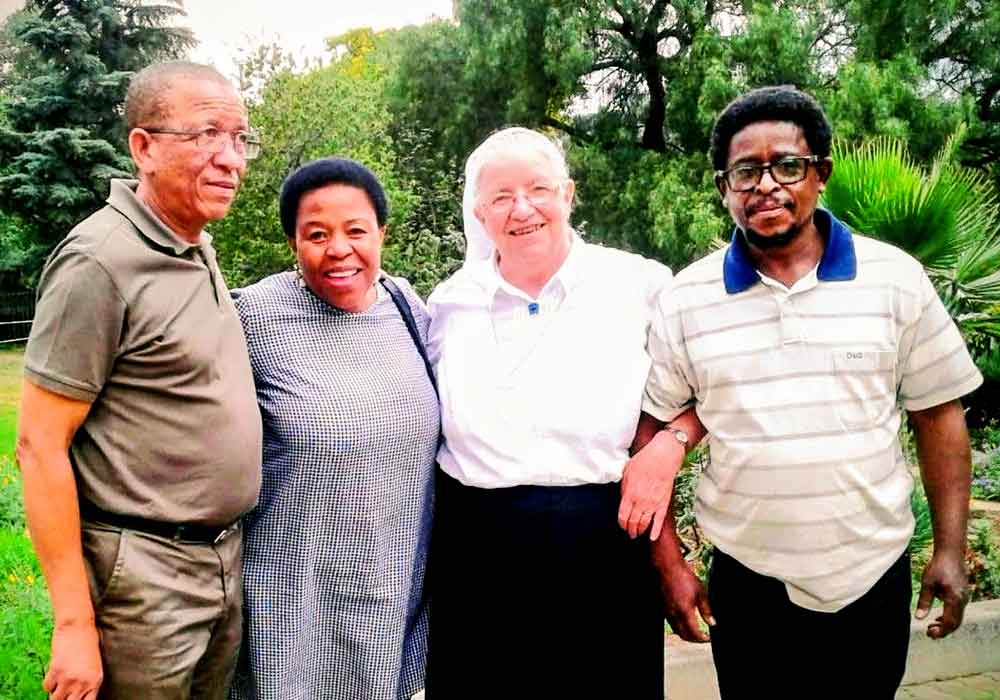
After returning to South Africa, Sr Maureen was assigned to Transkei, the former homeland in the Eastern Cape. She taught at Zingisa Secondary School, moving from a Shona-speaking environment to a Xhosa-speaking one. “It was another big shift and another learning experience,” she said. She taught mainly English and religious education and remained there for six years.
During the 1994 elections, she participated in South Africa’s first democratic election as a permanent resident. “It was a great experience lining up to vote,” she said. That same year she applied for South African citizenship. “I never applied before 1994 because I did not want to endorse apartheid,” Sr Maureen said. “Part of that process was swearing allegiance to South Africa.”
She later served in the Holy Cross Sisters’ diocesan administration in the Northern Cape, assisting the bishop with marriage tribunal cases and general administration. She studied canon law to support this work.
In 2016 Sr Maureen was elected to the provincial leadership of the Holy Cross Sisters and returned to Johannesburg, where she served for nine years. Her responsibilities included administration, visitations of communities, and oversight of seven Holy Cross schools in South Africa.
She also served as secretary general of the Leadership Conference of Consecrated Life South Africa (LCCL).
Following this, she took on the task of recording her congregation’s history from 1980 onwards, drawing on archival research. “The older generation of missionaries is disappearing and their stories will disappear with them,” she explained. “Writing the book was to honour those who went before us and to leave an account for those coming after.”
Today Sr Maureen lives at the Holy Cross Sisters’ convent in Victory Park, Johannesburg, where she continues to teach history to young Sisters, assists with marriage cases, and supports educational work within the congregation. She remains connected to her extended family and Irish culture, having spent time in the land of her birth recently.
Published in the March 2026 issue of The Southern Cross Magazine

- Walking in the footsteps of Blessed Joseph Gérard: Missionary Associates renew their missionary call - October 15, 2026
- Congratulations to Navi Pillay on Peace Prize - October 14, 2026
- 170 Years of Serving the Poor in South Africa! - October 14, 2026