
Our Call to be in Solidarity with Holy Land Christians
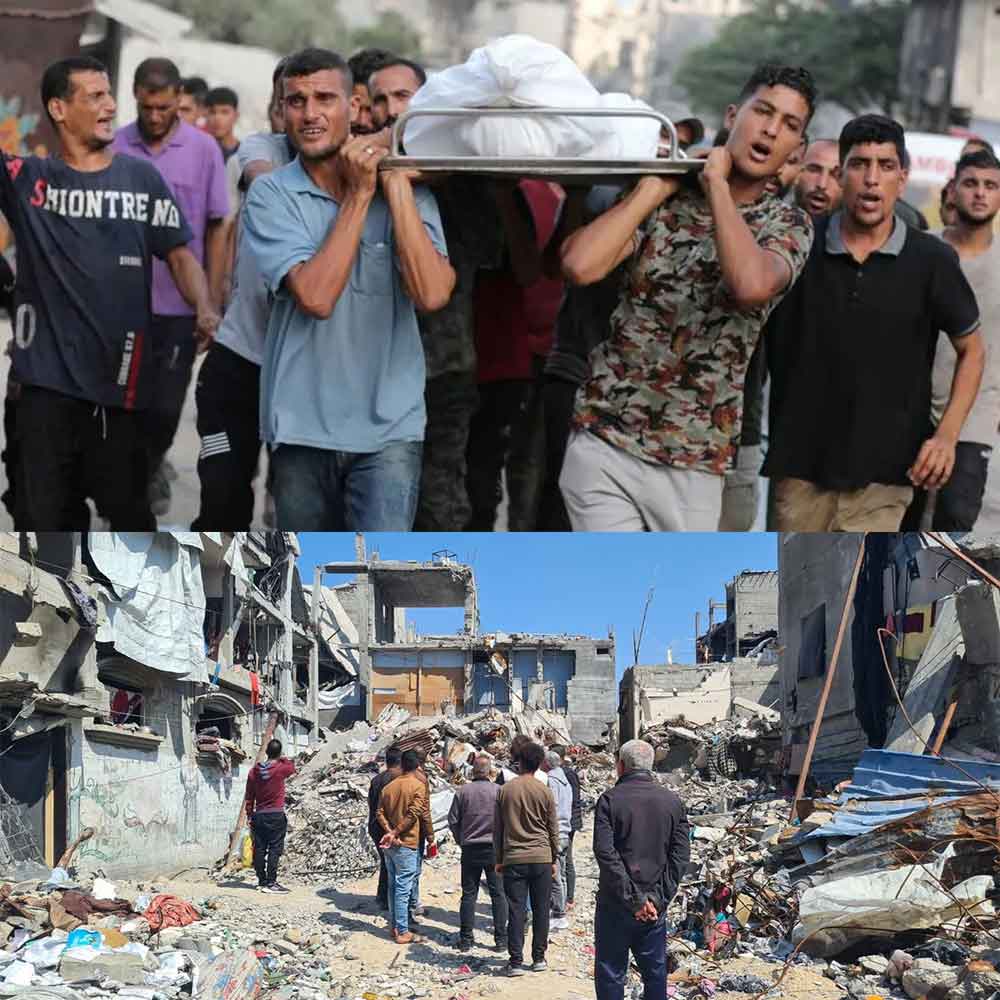
Photos: BBC/Reuters/NRC/Cyril Lambolez
By Vernon Seymour & Fr Peter Chitabanta CSsR – How should Christians respond, in solidarity with our brothers and sisters in the Holy Land, to the war in Gaza and the occupation of the West Bank?
The recent attack on the Holy Family Catholic church in Gaza and the pogroms perpetrated by Israeli settlers in the Christian village of Taybeh have brought home the harsh reality of the situation in Palestine for us as Christians.
Israel has continued its assault on the besieged Palestinian territory of Gaza, which has all but decimated hospitals and destroyed the health care system, in violation of international law. The blockade on deliveries of food, fuel, medicines and basic supplies destined for war victims has also been maintained. (The reports of Hamas intercepting and stealing aid supplies have been thoroughly proven to be false).

Caritas Internationalis, the umbrella body of Catholic charities, in a statement described Israel’s actions in Gaza as a “machinery of annihilation”. The famine in Gaza, Caritas said, is a direct consequence of a deliberate strategy “blocking aid, bombing food convoys, destroying infrastructure, and denying basic needs”.
The Caritas statement notes that civilians — particularly women and children — have borne the brunt of this starvation, bombing and eradication.
Pope Leo XIV has described these actions as “barbarism”. Responding to the attack on Holy Family church, which Israel claimed to have been “accidental”, the pope said: “Sadly, this act adds to the continuous military attacks against the civilian population and places of worship in Gaza. I again call for an immediate halt to the barbarism of the war and for a peaceful resolution of the conflict.”
In his statement responding to the attack on Holy Family church, Cardinal Stephen Brislin of Johannesburg — who has been to Gaza and the Catholic church there — reminded us of the Parable of the Good Samaritan (Luke 10:25-37) and stated that if “we remain silent in the face of ongoing violence, amidst the reality of the theft of land and houses and olive groves, then we will be no better than those who crossed over to the other side”.
The International Association of Genocide Scholars has stated that Israel’s actions meet the legal definition of genocide as set out in the UN Convention.
Notwithstanding overwhelming evidence of Israel’s genocidal actions, also stated by the Catholic aid organisation, some of our Christian brethren seem to have difficulty acknowledging the obvious.
In a hearing of the International Court of Justice, the organisation Doctors Without Borders showed a whiteboard used by doctors at a Gaza hospital, bearing the words: “Whoever stays behind will tell the story — we did what we could — remember us.” How can we, as Christians, justify supporting those who killed doctors when hospitals were bombed by the Israeli army?
Some people who profess to be Christian believe that they have a biblical duty to support the actions of the Israeli government in Palestine, and that God will bless them if they do so. When they realise that these genocidal actions are indiscriminate and also affect the Christian community in places like Bethlehem, Taybeh (the biblical Ephraim) and Gaza, some seem to be troubled by what is happening.
We have seen social media posts by self-professed Christians proclaiming solidarity with the Israeli government in its current war against the people of Palestine. They state that because the Israelis are “God’s chosen people”, Christians do not want to be on the wrong side of God, and so must support Israel.
They point to the Bible, which explains that in God’s covenant with Israel, God promised to make the Jewish nation His chosen people (who would fulfil His plan of bringing the Messiah to earth), and the people promised to obey His laws and ordinances, which led to great blessings.
This begs the question: What is the covenantal status of modern-day Israel?
A close reading of the Bible indicates that “Israel” is not a genetic term passed down through bloodlines, in the way “Egyptian” would be. To be a member of Israel was a spiritual state — of knowing God and wrestling with Him in intimate fellowship — not merely a matter of inherited DNA.
We know this is true, because God calls all kinds of ethnic peoples “Israel”. When the Israelites left the land of Egypt, escaping slavery to become a free people serving their covenant God, the Bible tells us that a “mixed multitude” went out with them (Exodus 12:38). At that time, the Israelites were travelling from Egypt to take possession of Canaan, their promised land.
Today, the modern state of Israel is not journeying to a promised land, but pursuing a very different mission in Palestine.
The Israeli government claims it is acting in self-defence after the October 7, 2023, attack by Hamas. Prime Minister Binyamin Netanyahu even quoted Deuteronomy 25:19, which commands to “blot out the memory of Amalek under heaven”, seeking to justify Israel’s actions in biblical terms.
In the Hebrew Bible, Amalek is both a nation and a nomadic tribe seen as the arch-rival of ancient Israel. Historians describe how ancient Israel waged an eternal war with Amalek.
As Christians, we respond with the Law of Christ, which is rooted in the Law of God. The Law of God is enshrined in love of God and love of neighbour (Exodus 20:2-17; Deuteronomy 5:6-21). This Law forbids killing. In other words, Yahweh is urging His people to preserve life in every way possible.
When Jesus Christ came, he preached that the Kingdom of God is at hand. As Moses received the Law on Mount Sinai, Jesus went up the mountain and gave the Law found in the Beatitudes (Matthew 5:1-12).
In his Sermon on the Mount, Jesus presents a vision of a world redeemed by love, compassion, righteousness and justice, with particular reference to the poor, the victimised and the marginalised.
We know from history that those who listened to his Sermon were living under the oppressive rule of the Roman Empire. They were experiencing oppression, discrimination, persecution and denial of basic freedoms. Isn’t that exactly what is happening in Palestine — especially Gaza — in our own time? How, then, do we as Christians justify support for the actions of the Israeli government and the Israeli Defence Force in Palestine?
What about the Christian value of peace?
Christianity is a religion of peace because we follow the King of Peace. Only those who are peacemakers shall be called the children of God, because God is peace and the Son he sent is a peacemaker (Matthew 5:9).
St Francis of Assisi prayed: “Lord, make me a channel of your peace so that I may plant your love where there is hatred.” Apostles of peace like Mahatma Gandhi and Rev. Martin Luther King Jr taught us that evil is not overcome by evil. They did not support acts of revenge or retaliation.
Jesus Christ takes it further: “Pray for those who persecute you” (Matthew 9:44). He also teaches that as Christians we must promote peace and forgiveness, rather than perpetuate hatred.
As Christians, do we hear the cries of anguish of innocent people — both Christian and Muslim — in Palestine?
Vernon Seymour is a human rights lawyer based in Cape Town. Fr Peter Chitabanta CSsR is a Catholic priest based in Nairobi.

- The Angelus Prayer - March 25, 2026
- Palm Sunday Prayer - March 24, 2026
- Pope: We Cannot Remain Silent - March 24, 2026



