Pope Leo’s First Teaching
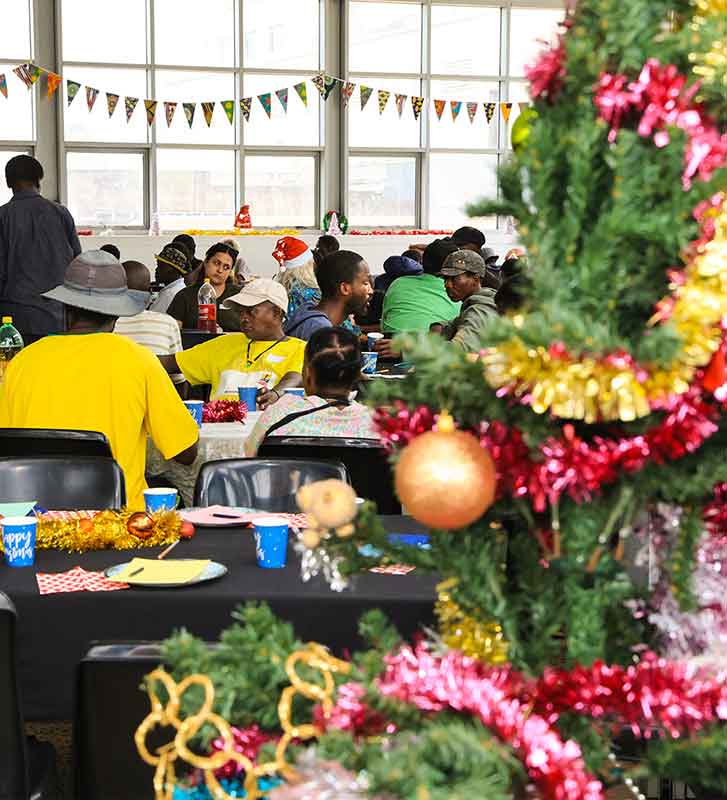
Christmas lunch for the homeless at Durban’s Denis Hurley Centre.
Last month, I talked about our care for the poor, since it was one of the November focuses of the Jubilee Year. But I wondered out loud how something that should be part of the life of the Church all year round could be limited to just one focus area in one month of the year. So I make no apologies about returning to that theme this month.
Moreover, I am justified in doing so by the recent publication of Dilexi Te, Pope Leo XIV’s first apostolic document, which is subtitled, “On the Love for the Poor”.
Pope Leo does not disguise the fact that this apostolic exhortation was written mostly by Pope Francis, so he presents Dilexi Te as his own reflection on his predecessor’s work. In fact, Francis had done the same with his first encyclical, which built on the work of Pope Benedict.

One of the beauties of the papacy is that there should be both change and continuity. Leo reminds us in great detail about Francis’ care for the poor and the example that he set. But he stresses that the focus of this document is not because Love for the Poor was a personal preoccupation of Francis, or even of himself. Rather, Leo teaches that Love for the Poor is, or should be, the overriding concern of the Church, because that is the model set by Jesus.
The Holy Father thus draws extensively on Scripture to show how frequently Jesus — and the Prophets that came before him and the Apostles that followed him — talk about care for the poor.
The pope doesn’t make the point, but I will, that many more words in Scripture are expended on sins against the poor than there are on “sins of the flesh”; by contrast, so many Christian leaders today seem more preoccupied with debating sexual matters than social ones, such as poverty.
A defining feature
Just to bring his point home, Pope Leo goes on to quote from the Church Fathers and then from the lives of more than 30 saints by name to remind us of their work for and writings about the poor. Through almost 20000 words, the pope is making clear that Love for the Poor is a defining feature of the life of the Church. In fact, the point he is making is that it should be the defining feature of the life of each of us as a Christian.
Much has been made of the twin titles of Francis’ final document Dilexit Nos (He Loved Us) and Leo’s first one Dilexi Te (I Have Loved You). This link makes it even clearer that the one follows the other — Jesus’ love for us (as epitomised by the image of the Sacred Heart) flows through into our love for the poor.
I would suggest that one way of distinguishing between the two is to see Francis’ document as helping us understand better our role collectively as a Church, and Leo’s as expanding on our role as an individual Christian.
While Dilexit Nos was an encyclical — a document that defines something to do with doctrine or morals — this new document is an exhortation. That is a lovely word meaning “a letter of encouragement” — the Holy Father is exhorting us to act, to behave in a certain way.
Scroll slowly
The best way for those words of encouragement to work is to read them not in one go and then write about them as if for an exam (though I fear that is what I am doing). Instead, let’s take each of the 121 paragraphs one by one, read them, pause to reflect on them, and let them seep into our hearts.
If you are inclined to doom-scroll on your phone, let me suggest that instead you spend the time in dream-scrolling slowly and perhaps even prayerfully through the paragraphs of Dilexi Te — you are much less likely to end up feeling despondent after a few minutes of that than by viewing unedifying material on social media.
December is a particularly good month to start this process. Pope Leo reminds us that Jesus’ solidarity with the poor is shown from the very act of his birth. So as we ponder the Nativity scene and sing carols over the next few weeks, we can recall that Jesus chose to be born into poverty, to be first welcomed by the pariahs of his time (the dirty, outcast shepherds), and then had to flee as a refugee.
Moreover, Dilexi Te is an antidote to all the worst excesses of the season. It openly challenges the consumerism and inequality which we see glorified in our malls and in our media at this time of the year, ostensibly in the name of celebrating the newborn Jesus. Pope Leo asks us to turn our focus towards the poor, since that is how we will focus on God.
Giving at Christmas
At Christmas-time, we might find ourselves sparing a thought for the less fortunate. Some people have decided, for example, that instead of giving their friends and family yet more things that they don’t need, the same money can be used to make a donation to a charity on their behalf. For example, at the Denis Hurley Centre in Durban, every year people ask us to dedicate a meal in the name of someone as a Christmas present, and we then send them a card that they can pass on to symbolise their gift.
But we must be careful not to fall into the trap of giving a nod to the poor as a way of justifying our own excesses: a case of “one for them, ten for me”. In fact, our Christmas care for the poor could be an example of what we are not called to do: it is usually too little, too infrequent, and too much of an afterthought.
So may I “exhort” each of us to think of the poor not just in December, but also to think about how our love of the poor can be a feature of our lives as Christians throughout 2026.
-I can make a commitment to volunteer for an organisation on a regular basis;
– I can get involved in the Society of St Vincent de Paul or in sodalities in my parish that care for the poor;
– I can choose not scroll past the stories in the media about inequality in our country;
– I can speak out when I hear the poor are being abused or neglected or being blamed for the ills in our society;
– I can make sure that I am paying people a just amount for the work they do for me;
– I can remember specific poor people in my prayers;
-I can set up a monthly donation to a charity that I believe is doing good work (not just the Denis Hurley Centre, though I hope you might consider us).
In this way, little by little, I will move towards the goal of Pope Leo’s exhortation. I will learn to love the poor, not because they are strangers “out there” for my pity or my charity, but because they are people “in here”, members of our family, the Church.
And that means they are deserving of the same love that I give my own family, not just at Christmas but throughout the year.

- Lumen Christi! Deo Gratias! - April 7, 2026
- The Gift of the Irish - March 10, 2026
- Catholic Schools in the Market - February 10, 2026