A Just Future for The Holy Land
Reviewed by Günther Simmermacher
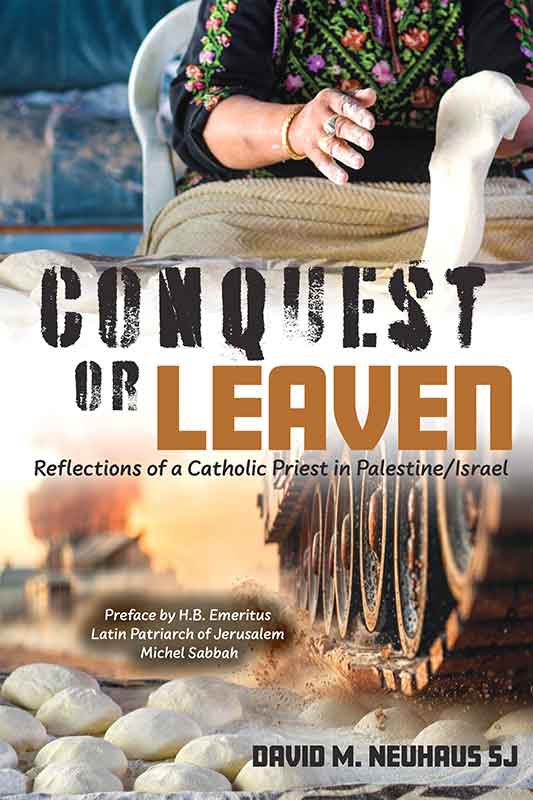
Conquest or Leaven: Reflections of a Catholic priest in Palestine/Israel, by David Neuhaus SJ. Jesuit Institute, Johannesburg (2025). 179pp
A divided, traumatised and even dehumanised people such as those we find in the Holy Land — Palestine and Israel — is in lifegiving need of transformation. In his new book, Fr David Neuhaus SJ argues that the Christians of the Holy Land may play a key part in fostering such transformation — not as a neutral bridge, for Palestinian Christians are just as oppressed as their Muslim neighbours, but as a leaven in society.

The “leaven in society” metaphor (Matthew 13:33; cf Luke 13:20–21) means that, like a small amount of yeast that makes a whole loaf of bread rise, Christians are called to quietly but effectively influence society from within, bringing about renewal and transformation disproportionate to their size.
Few are as well placed to analyse the past, present and future of Israel/Palestine as Fr Neuhaus: the son of refugees from Nazism, raised in Judaism and later becoming a Jesuit priest and Catholic theologian, who grew up under apartheid and now lives as an Israeli citizen in Jerusalem.
His reflections offer the reader an informed and empathetic overview of the issues and realities at stake, free from the propaganda and disinformation so common in much of the secular and social media. Written with admirable clarity, this book is a superb resource for those who wish to understand the realities, and a way of deepening knowledge for those who are already informed.
The Holy Land’s people
Fr Neuhaus introduces us to the various constituencies — Muslim and Christian Palestinians, and the broad variety of Jews located in Israel — and locates them within the political, social and religious landscape.
He explains the rise of Zionism and the influx of European Jews in Palestine, starting in the late 19th century, and the developments that led to the founding of the state of Israel in 1948. The Nakbah — the large-scale and violent dispossession of Palestinians before and after 1948 — is treated with great empathy. The Jesuit also looks at the settlers who arrived from Eastern Europe after the fall of communism, noting that many of them are economic migrants with only tenuous links to Judaism.
Fr Neuhaus discusses the Zionists’ invocation of Scripture to claim the land, at the cost of displacing the indigenous population. His reflection on Joshua 6, which is often used to justify ethnic cleansing as divinely sanctioned, is illuminating.
He clarifies why many Orthodox Jews, even in Israel, regard Zionism as an aberration, and the biblical basis for it a corruption of sacred Scripture. Fr Neuhaus, a Scripture scholar in his own right, has sympathy for that point of view. He stridently declares: “Israeli Prime Minister Binyamin Netanyahu is an heir to [first Israeli prime minister David] Ben-Gurion when it comes to the heritage of milking the Bible in order to legitimate and further entrench occupation, discrimination and even genocide in Palestine/Israel.”
At the same time, Fr Neuhaus issues the self-evident yet sometimes ignored warning that opposition to Israel’s many abuses of human rights and international law must not find expression in anti-Semitism. Opposing Zionism is not inherently anti-Semitic, and care must be taken that it does not take on that form of bigotry.
Solidarity with Christians
The book’s discussion of the Christians in Palestine/Israel is important, especially for readers who know little about them. He calls us to stand in solidarity with our fellow Christians in the Holy Land, much as several popes have in the past. Such solidarity makes unconditional support for Zionist Israel impossible, since Israel does not differentiate between Palestinians on grounds of religion.
Who will step up to help heal the traumatised societies of the Holy Land — to be a voice for justice, an agent of peace, a guide towards the transformation that must come?
In Fr Neuhaus’ view, the Christian Palestinians have a role to play in the struggle for equality, justice and peace. Their witness, he suggests, comes from the margins of power, where they are called to speak prophetically, challenge stereotypes, and foster a dialogue grounded in recognising the other’s humanity. The Church, and this book’s title, urges Christians to be a leaven in society — not withdrawing from Muslims or Jews, but taking their rightful place as fellow citizens and helping to articulate a vision “that can break down stereotypes and promote a culture of dialogue based upon the humanity of the other”.
The only option for peace
On which path, then, does a future of peace reside in Palestine/Israel? With even the Catholic bishops of the Holy Land having declared the option of a two-state solution dead — owing to Israel’s illegal settlements in the West Bank — there is only one option for peace and justice.
Fr Neuhaus’ view aligns with those who are calling for a unitary state under a democratic and secular constitution. Such a resolution will have to allow for certain group rights and restitution.
Much as it was in South Africa’s transition from apartheid, there will have to be sacrifices made on both sides, and reconciliation will be difficult to attain. But there simply is no moral alternative.
Portions of this review were used for the book’s back-cover blurb. Conquest or Leaven is available from the Jesuit Institute at R220 (plus delivery). Order from

- Shrines around the World: Our Lady of Beauraing - March 21, 2026
- St Patrick: From Slave to Apostle - March 17, 2026
- New Cape Town Archbishop Calls For Unity and Prophetic Courage - March 14, 2026